
Managing food safety across more than 1,000 suppliers is no small undertaking. Different products, different risk levels, different regulatory requirements, and a seemingly endless stream of documentation can make even the most organized food safety professional wonder if there is a better way.
For Santoshi Muriki, Food Safety Manager at Affiliated Foods, Inc. in Amarillo, Texas, the answer was to build one.
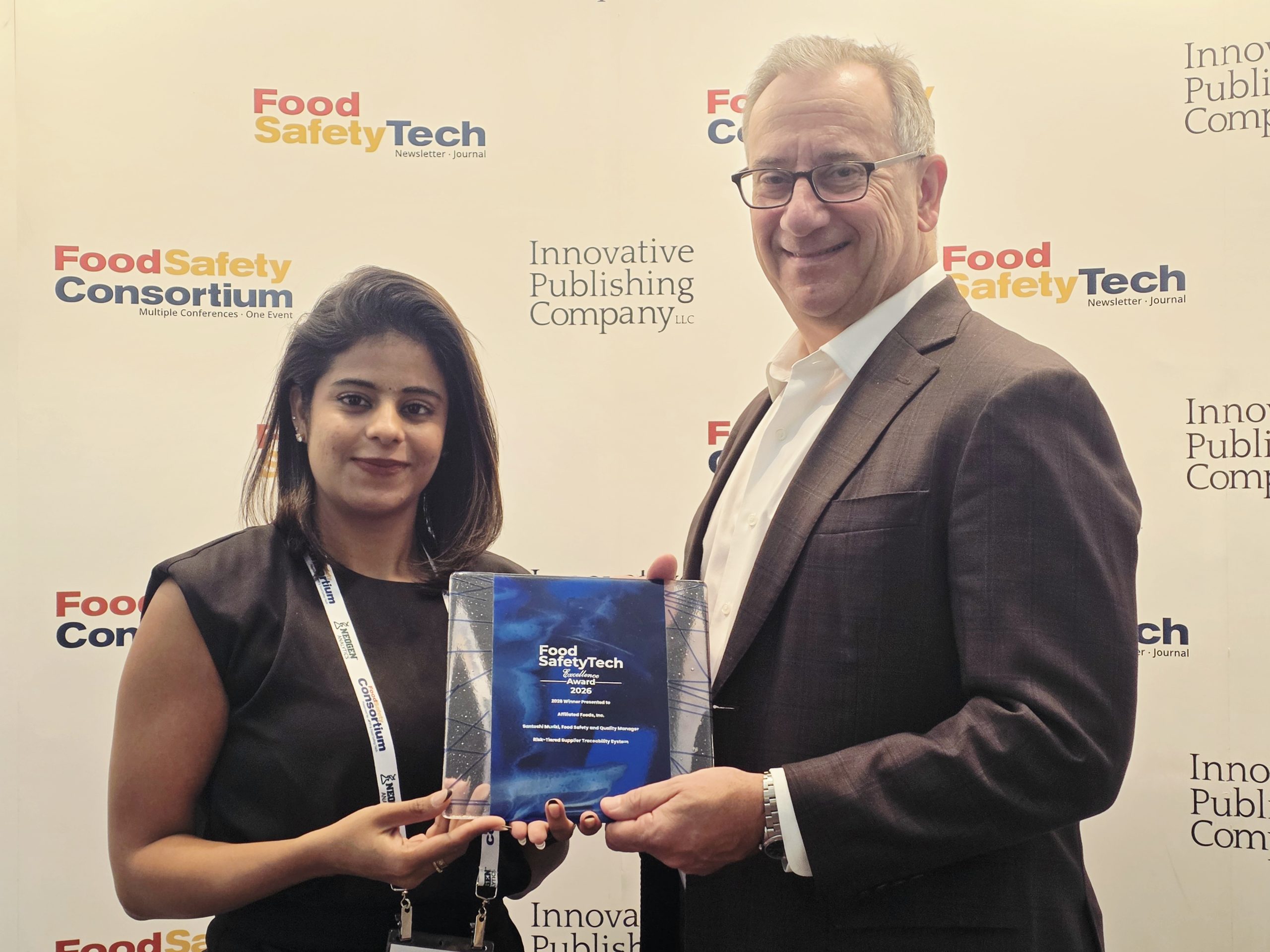
The automated risk-based supplier compliance system developed by Santoshi Muriki earned Affiliated Foods the inaugural 2026 Food Safety Tech Excellence Award. The award was presented October 22 at the 15th Annual Food Safety Consortium Conference in Washington, DC.
The award recognizes innovative technical solutions that measurably improve food safety practices. Muriki’s accomplishment stood out for its practical application of technology, measurable operational improvements, and potential relevance to other organizations managing complex supplier networks.
A Different Approach to a Familiar Problem
At Affiliated Foods, a wholesale grocery cooperative with more than 1,000 suppliers, preparing for the Food Safety Modernization Act’s Food Traceability Rule, commonly known as FSMA 204, presented a substantial challenge.
Supplier documentation was largely managed through spreadsheets, emails, and manual follow-ups. With suppliers representing a broad range of product categories and regulatory obligations, maintaining accurate compliance records required considerable time and attention.
Muriki recognized that treating every supplier and product the same way wasn’t necessarily making the process safer or more efficient.
Using the ReposiTrak platform, she designed, developed, and implemented a system that combines Affiliated Foods’ existing three-tier supplier risk structure with a new product-level classification framework.
Her Kill-Step Category A/B approach considers whether products have undergone validated processing steps, such as pasteurization or retort processing, that affect applicable food safety and traceability requirements.
This distinction allows the company to evaluate supplier reliability separately from product-level risk, helping ensure that compliance resources are directed where they are most needed.
Rather than simply digitizing an existing process, Muriki redesigned how supplier compliance was evaluated and managed.
Less Chasing Paperwork. More Managing Risk.
The results reported in Muriki’s award submission speak to the value of that approach.
- 60% reduction in manual follow-up required to track and verify supplier documentation.
- 50% faster supplier onboarding into the compliance system.
- 100% critical-document compliance achieved across the tracked supplier base.
The system automatically identifies missing or expiring documents, supports supplier onboarding, and provides food safety, procurement, and vendor management teams with greater visibility into compliance status.
It also includes re-verification triggers associated with recalls, nonconformances, and audit findings, helping ensure that documentation receives renewed attention when circumstances change.
For food safety professionals, these improvements mean less time pursuing paperwork and more time evaluating supplier performance, addressing potential gaps, and maintaining oversight.
The result is a shift from reactive documentation management toward a more proactive approach to supplier compliance.
David Hatch, Co-Founder and Chief Research Officer of Food Safety Tech Research (FSTR), highlighted the connection between food safety outcomes and measurable business value during the award presentation.
“We’ve talked a lot about the combination of achieving food safety outcomes, public health outcomes, and combining that with the business benefit, the return on investment of investments that you make in technology and in data, and this submission really stood out for those reasons. Things like that really get the attention of senior leadership, especially achieving 100% compliance with the FSMA 204 standard well ahead of schedule. It really got our attention, and so congratulations.”
The Initiative Behind the Innovation
What makes Muriki’s achievement particularly noteworthy is the level of personal responsibility she assumed.
According to her award submission, she independently identified the need for a more sustainable compliance system, designed the framework, and led its implementation across the supplier network.
She served as the project’s sole architect, taking it from concept through rollout.
Tracy Fink, Founder and Principal Advisor of ThinkFink Solutions, LLC, also recognized the effort required to implement a system of this scale.
“I wanted to recognize not only the discipline, the persistence, and the collaboration that this took. The complexity of 1,000 plus supplier networks into a practical, proactive, practical, proactive system is a phenomenal achievement, and so such a well-deserved recognition.” Fink told Muriki.
That initiative reflects a professional philosophy evident throughout Muriki’s career. Food safety programs should do more than satisfy an audit requirement. They should help organizations make informed decisions, identify potential risks, and improve everyday operations.
Muriki brings more than seven years of food safety and quality assurance experience spanning manufacturing and wholesale grocery distribution.
Her background includes HACCP program management, environmental monitoring, supplier verification, internal auditing, food safety certification systems, and recall and reclamation processes.
She holds a master’s degree in Food Science and Nutrition from the University of Central Oklahoma and a bachelor’s degree in Food Science. Her professional training and credentials cover recognized food safety standards and disciplines, including SQF, FSSC 22000, ISO 22000, preventive controls, and HACCP.
Beyond her operational responsibilities, Muriki contributes to industry discussions through technical reviewing and writing on traceability, supplier compliance, recall readiness, and food safety governance.
Her interest in advancing food safety also extends to research. The methodology underlying her award-winning project was developed into a manuscript titled Risk-Tiered Supplier Compliance Model, which, according to her submission, was accepted for publication in Food Protection Trends following scientific peer review.
Why Her Work Matters Beyond Affiliated Foods
The challenges Muriki addressed are familiar throughout the food industry.
Manufacturers, distributors, retailers, and foodservice organizations must balance regulatory requirements, supplier accountability, operational efficiency, and the need to respond quickly when something goes wrong.
Her work offers an example of how thoughtful system design and existing technology can improve that balance.
It also raises an important question for food safety leaders. How much time are their teams spending collecting information versus using that information to make better decisions?
Muriki’s project demonstrates that improvements in compliance efficiency do not have to come at the expense of oversight. When designed appropriately, automation can support both.
The approach also has potential applications beyond one company. Although each organization has its own supplier network and regulatory obligations, the underlying principles of risk-based classification, consistent documentation, and continuous monitoring are broadly relevant.
Recognizing a Commitment to Food Safety
The Food Safety Tech Excellence Award was established to recognize innovative technical solutions that produce measurable improvements in food safety operations.
Submissions were evaluated by the Food Safety Tech Advisory Board based on innovation, scalability, measurable improvement, and sustainability.
Affiliated Foods’ achievement reflects those priorities, but it also represents something less easily measured.
It demonstrates the value of professional initiative.
Muriki recognized an operational challenge, developed a practical solution, and followed through with implementation. The improvements reported in her submission show what can happen when technical knowledge is paired with the determination to make existing processes work better.
Food safety innovation doesn’t always require inventing a new technology. Sometimes it means questioning a familiar process, recognizing its limitations, and finding a more effective way forward.
As the inaugural recipient of the Food Safety Tech Excellence Award, Affiliated Foods represents the kind of dedication, resourcefulness, and practical problem-solving that continues to move the food safety profession forward.
And for professionals still spending too much of their day chasing supplier documentation, her accomplishment offers an encouraging thought.
There may be a better way to get the job done.