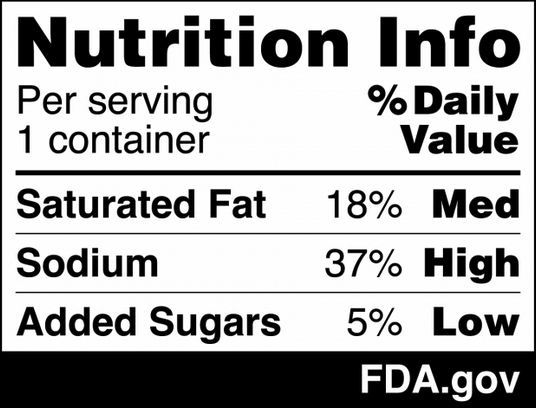
The U.S. Food and Drug Administration is announcing an important step to provide nutrition information to consumers by proposing to require a front-of-package (FOP) nutrition label for most packaged foods. This proposal plays a key role in the agency’s nutrition priorities, which are part of a government-wide effort in combatting the nation’s chronic disease crisis. If finalized, the proposal would give consumers readily visible information about a food’s saturated fat, sodium and added sugars content—three nutrients directly linked with chronic diseases when consumed in excess.
The proposed FOP nutrition label, also referred to as the “Nutrition Info box,” provides information on saturated fat, sodium and added sugars content in a simple format showing whether the food has “Low,” “Med” or “High” levels of these nutrients. It complements the FDA’s iconic Nutrition Facts label, which gives consumers more detailed information about the nutrients in their food.
The proposed rule, if finalized, would require food manufacturers to add a Nutrition Info box to most packaged food products three years after the final rule’s effective date for businesses with $10 million or more in annual food sales and four years after the final rule’s effective date for businesses with less than $10 million in annual food sales.
The Food and Drug Administration (FDA) announced on its website the availability of a final guidance for industry entitled “Action Levels for Lead in Processed Food Intended for Babies and Young Children.” The guidance establishes action levels for lead in certain processed foods intended for babies and young children less than 2 years old. The guidance is intended to set achievable action levels that will help further reduce lead in the food supply.
In accordance with § 109.6 (21 CFR 109.6), this guidance establishes the following action levels for lead in processed food intended for babies and young children less than 2 years old:
10 parts per billion (ppb) for fruits, vegetables (excluding single-ingredient root vegetables), mixtures (including grain- and meat-based mixtures), yogurts, custards/puddings, and single-ingredient meats
20 ppb for single-ingredient root vegetables; and 20 ppb for dry infant cereals
Consistent with § 109.6(d), these action levels reflect levels of lead at which FDA may regard the food as adulterated within the meaning of section 402(a)(1) of the Federal Food, Drug, and Cosmetic Act (21 U.S.C. 342(a)(1)). FDA said it intends to consider these action levels, in addition to other factors, when considering whether to bring enforcement action in a particular case.
The U.S. Food and Drug Administration (FDA) announced today it has updated the nutritional requirements a food must meet to use the claim “healthy” on the package, which includes criteria a food must meet to use the “healthy” claim on the package. The FDA also is exploring the development of a symbol to represent the claim “healthy” to make it easier to spot foods that can be the foundation of healthy eating patterns.
Updating the “Healthy” Definition on Food Packaging
The last time “healthy” was defined on packaging was in the 1990s. Based on the nutrition science and federal dietary guidelines at that time, the definition was solely focused on individual nutrients; for example, it included limits for saturated fat, total fat, cholesterol, and sodium and required a certain amount of beneficial nutrients like certain vitamins, minerals, fiber, and protein.
With a greater understanding of dietary patterns and their effects on health, and FDA recognizes that foods are made up of a variety of nutrients that work together as part of a healthy dietary pattern.
To be consistent with the latest nutrition science and federal dietary guidelines the updated definition of “healthy” requires that:
A food must contain a certain amount of a food group like fruits, vegetables, grains, protein foods, or dairy.
A food can’t contain too much saturated fat, sodium, or added sugars.
How the “Healthy” Claim Works
Placing a “healthy” claim on a food package is voluntary. If manufacturers choose to do it, their products must have the nutrient content required by the “healthy” definition. Manufacturers who choose to use the “healthy” claim can use the new criteria starting on February 25, 2025.
Here are some examples of what qualifies to use the “healthy” claim under the updated definition:
Nuts and seeds, olive oils, higher-fat fish, like salmon, and eggs would qualify as healthy because of their nutrient profile. They didn’t qualify under the previous definition.
Water. While water isn’t part of a food group, it is considered an optimal beverage by the Dietary Guidelines.
Here are some examples of what no longer qualifies to use the “healthy” claim under the updated definition:
Fortified white bread, highly sweetened yogurt, highly sweetened cereal.
FSMA requires FDA to establish a voluntary, fee-based program for the expedited review and importation of foods from importers who achieve and maintain a high level of control over the safety and security of their supply chains. This control includes importation of food from facilities[1] that have been certified in accordance with FDA’s Accredited Third-Party Certification Program (also referred to as the Third-Party Program or TPP) (section 808 of the Federal Food, Drug, and Cosmetic Act (FD&C Act) (21 U.S.C. 384d)) and the Accreditation of Third-Party Certification Bodies to Conduct Food Safety Audits and to Issue Certifications regulation (also referred to as the TPP regulation) (see 21 CFR part 1, subpart M), as well as other measures that support a high level of confidence in the safety and security of the food they import. Expedited entry incentivizes importers to adopt a robust system of supply chain management and further benefits public health by allowing FDA to focus its resources on food entries that pose a higher risk to public health.
The guidance document describes FDA’s policy regarding participation in FDA’s Voluntary Qualified Importer Program (VQIP) by importers of food for humans or animals. This document provides guidance on:
The benefits VQIP importers can expect to receive;
The eligibility criteria for VQIP participation;
Instructions for completing a VQIP application;
Conditions that may result in revocation of participation in VQIP; and
Criteria for VQIP reinstatement following revocation.
This guidance document is presented in question and answer format. This guidance document may be modified (in accordance with FDA’s good guidance practice regulation (21 CFR 10.115)) as VQIP is implemented and evaluated. FDA’s guidance documents, including this guidance, do not establish legally enforceable responsibilities. Instead, guidance describes the Agency’s current thinking on a topic and should be viewed only as recommendations, unless specific regulatory or statutory requirements are cited. The use of the word should in Agency guidance means that something is suggested or recommended, but not required. This guidance represents FDA’s current thinking regarding what will be considered for participation in VQIP and how VQIP will expedite entry of imports.
The pronouns “I,” “me,” “you,” and “your” are used in this guidance to refer to the importer who may want to participate in VQIP. “Agency” and the pronouns “we” and “our” are used to refer to FDA. The term “food” has the meaning given in section 201(f) of the Federal Food, Drug, and Cosmetic Act (FD&C Act) (21 U.S.C. 321(f)), except that, for the purposes of VQIP, food does not include pesticides as defined in 7 U.S.C. 136(u).
Owners, operators, or agents in charge of a domestic or foreign facility engaged in manufacturing/processing, packing, or holding food for consumption by humans or animals in the U.S., are required to register the facility with the FDA. The registration and renewal period is open between October 1 and December 31, 2024.
The FDA will consider the registration of a food facility to be expired if a facility’s registration is not renewed by December 31, 2024. There is no fee associated with registration or renewal. Owners, operators, or agents in charge of food facilities must submit their renewal information electronically through their FDA Industry Systems (FIS) account, unless they have received a waiver that allows for paper submission.
Food facility registration is critical to helping the FDA identify the location and possible source of a foodborne illness outbreak or potential bioterrorism incident. Food facility registration requirements were initiated with the Public Health Security and Bioterrorism Preparedness and Response Act of 2002 and amended by the FDA Food Safety Modernization Act (FSMA) in 2011. FSMA requires facilities to submit additional information to the FDA and to renew their registrations every other year.
The following resources are available to assist in the registration and renewal process:
Food facilities with questions can contact the Data Management Support Services: by phone 1- 240-247-8804; or by email at FURLS@fda.gov on U.S. Government business days (Monday to Friday, excluding U.S. government holidays) from 9:00 a.m. to 6:00 p.m. Eastern Time (see Federal Holidays (opm.gov) and Current Status (opm.gov).
The U.S. Food and Drug Administration’s reorganization implementation involving the creation of a unified Human Foods Program (HFP), adoption of a new model for its field operations and other significant modernization efforts are scheduled for Oct. 1, 2024, notably enhancing the agency’s ability to oversee and protect the human food supply and other products the FDA regulates.
Lead by Jim Jones, Deputy Commissioner for Human Foods at FDA, the reorganization establishes the HFP by realigning the functions of the Center for Food Safety and Applied Nutrition, the Office of Food Policy and Response, as well as key functions from the Office of Regulatory Affairs (ORA) under one program.
Additionally, the restructuring of ORA will enable the field operations unit to focus on inspections, investigations and imports as its core mission. The FDA is changing the name of ORA to the Office of Inspections and Investigations (OII) to better convey the organization’s role as the frontline of the FDA, which provides real time insights and science-based evidence necessary to ensure the safety and quality of products Americans depend on.
Jim Jones will Keynote the Food Safety Consortium Conference, October 20-22 in Washington DC. During this session Mr. Jones will delve into the agency’s recent reorganizational changes, key regulatory policy priorities, and commitment to stakeholder transparency. Doug Stearns, Deputy Associate Commissioner of Regulatory Affairs, will discuss how these changes will shape investigations and inspections for both domestic and foreign facilities. Attendees will gain valuable perspectives on regulatory shifts, emerging challenges, and collaborative opportunities shaping the landscape of food safety and compliance. Discover how the new Deputy Commissioner’s strategic vision will drive innovation, enhance public health outcomes, and foster trust within the food industry. Attendees will have the opportunity to gain deep insights into emerging challenges, innovative strategies, and collaborative approaches to advancing food safety.
Through product testing, the FDA has determined that the ground cinnamon products listed on their website contain elevated levels of lead and that prolonged exposure to these products may be unsafe. The FDA is advising consumers to throw away and not to buy these ground cinnamon products. The FDA has recommended that the firms voluntarily recall these products, with the exception of the MTCI cinnamon. According to the FDA’s website, the FDA has been unable to reach MTCI to share their findings and request that the company initiate a recall. No illnesses or adverse events have been reported to date in association with these products.
Following the October 2023 recall of cinnamon apple puree and applesauce products due to elevated lead levels linked to the cinnamon in those products and the concern for lead toxicity in children, the FDA initiated a targeted survey of ground cinnamon products from discount retail stores and analyzed the samples for lead and chromium.
Based on results from the survey, the FDA is recommending recalls of ground cinnamon from six distributors whose products had elevated lead levels ranging from 2.03 to 3.4 parts per million (ppm). These levels are significantly lower than the levels of lead associated with the ongoing investigation into ground cinnamon from Ecuador supplied by Negasmart to Austrofoods, the manufacturer of the apple puree and applesauce products, which were between 2,270 ppm to 5,110 ppm in the cinnamon.
FDA Actions
The FDA announced it is continuing its Toxic Elements monitoring program, which includes testing of a variety of foods including colored spices offered for sale in the U.S. According to their website, sampling at import has prevented some cinnamon with elevated lead levels from entering U.S. commerce; however, like all of FDA surveillance activities, these monitoring programs only evaluate a subset of the commodity being imported. FDA will follow-up on these findings as well as continue our activities at import to prevent unsafe cinnamon from reaching consumers in the U.S., including by adding firms and products to import alert where appropriate. Ultimately, FDA says, it is the responsibility of the manufacturers and the importers to ensure the safety of the products that enter into the U.S. market.
The FDA also sent a letter to all cinnamon manufacturers, processors, distributors, and facility operators in the U.S. reminding them of the requirement to implement controls to prevent contamination from potential chemical hazards in food, including in ground cinnamon products. The FDA will continue to work with firms to ensure they are meeting their responsibilities under provisions of the Current Good Manufacturing Practice, Hazard Analysis, and Risk-Based Preventive Controls for Human Food rule.
According the the FDA’s website, Totally Cool, Inc. of Owings Mills, Maryland is recalling multiple brands of ice cream products, because they have the potential to be contaminated with Listeria monocytogenes. Products were distributed nationwide, and available in retail locations and direct delivery. No illnesses have been reported to date.
The brands involved were Abilyn’s Frozen Bakery, Amafruits, Chipwich, Cumberland Farms, Dolcezza Gelato, Friendly’s, Hershey’s Ice Cream, Jeni’s, LaSalle, Marco, Taharka Brothers, the Frozen Farmer and Yelloh. More than 65 products were recalled, including ice cream cakes and sandwiches, as well as sorbets, according to a list published by the FDA that includes expiration dates.
Totally Cool, Inc. has ceased the production and distribution of the affected products due to FDA sampling which discovered the presence of Listeria monocytogenes. The company continues its investigation and is taking preventive actions. No other products produced by Totally Cool, Inc. are impacted by this recall.
There is only one week left to submit your comments to the docket on the New Era of Smarter Food Safety. FDA is seeking feedback on topics discussed during the public meeting as well as specific questions they have identified in the topics for consideration document on FDA’s meeting page. FDA encourages anyone interested in submitting comments to
the docket, to please do so by the June 24, 2024 deadline. Comments can be submitted at www.regulations.gov [2] to docket number FDA-2024-N-1744.
The U.S. Department of Agriculture (USDA), the U.S. Environmental Protection Agency (EPA), the U.S. Food and Drug Administration (FDA), and the White House announced the National Strategy for Reducing Food Loss and Waste and Recycling Organics as part of President Biden’s whole-of-government approach to tackle climate change, feed people, address environmental justice, and promote a circular economy.
According to the USDA’s press release, the strategy released on June 12 provides tangible goals that the U.S. government partners along with retailers and consumers can work toward to help further prevent the loss and waste of food, increase recycling of food and other organic materials to support a more circular economy for all, reduce greenhouse gas (GHG) emissions, save households and businesses money, and build cleaner, healthier communities.
“USDA is committed to reducing food loss and waste, facilitating many programs and activities to engage farmers, producers, communities and businesses in this collective effort,” said Agriculture Secretary Tom Vilsack. “This National Strategy charts a course to reduce our nation’s food loss and waste by 50% by 2030, and I am encouraged by the actions outlined for USDA and our federal partners. Everyone has a role to play in reducing food loss and waste, and I hope that these federal commitments will inspire and catalyze action in the private sector and communities around the U.S.”
“The FDA is committed to completing the actions outlined in the National Strategy that incentivize and encourage food loss and waste prevention and organics recycling,” said FDA Commissioner Robert M. Califf, M.D. “Along with the FDA, USDA and EPA efforts, U.S. consumers and retailers play an important role in meeting the National Strategy’s goal of reducing food loss and waste by 2030. As part of the release of this strategy, the FDA has made important resources available to guide, support, and accelerate their food loss and waste activities including the 2022 Food Code, Tips to Reduce Food Waste and the Food Loss and Waste Social Media Toolkit. We encourage all stakeholders to take advantage of these resources as we work together to reduce food loss and waste.”
The strategy drives progress toward the National Food Loss and Waste Reduction Goal to reduce the loss and waste of food by 50% by 2030.
The strategy highlights four objectives:
Objective 1: Prevent food loss.
Objective 2: Prevent food waste.
Objective 3: Increase the recycling rate for all organic waste.
Objective 4: Support policies that incentivize and encourage the prevention of food loss and waste and organics recycling.
For each objective, the strategy highlights actions that USDA, EPA, and FDA could take. Some of the priority USDA actions include:
* Investing $2.5 million from USDA’s National Institute of Food and Agriculture (NIFA) to rigorously test and measure the effectiveness of different consumer messages to encourage households to reduce food waste, in preparation for a National Wasted Food Prevention Campaign.
* Funding a new NIFA $1.5 million Center for Research, Behavioral Economics, and Extension on Food Loss and Waste to create meaningful momentum on food loss and waste prevention among land-grant universities, their partners and external stakeholders.
* Funding research and development on new food loss and waste innovations, such as innovative new packaging technology and cultivars to extend the shelf life of food and prevent loss.
* The Risk Management Agency (RMA) is working with farmers, crop insurance agents, and gleaning organizations to encourage the reduction of on-farm food loss.
The strategy also highlights the importance of public-private partnerships in reducing food loss and waste. On June 1, the three agencies renewed a Memorandum of Understanding (MOU) with the Food Waste Reduction Alliance (FWRA), which is comprised of the Consumer Brands Association, FMI – The Food Industry Association, and the National Restaurant Association. This public-private partnership will explore actions to reach industry sectors, through efforts such as targeted industry resources, tools, and guidance.
Additionally, USDA and EPA have been actively growing the U.S. Food Loss and Waste 2030 Champions pledge, through which food business have publicly committed to reducing food loss and waste by 50% by 2030 in their U.S. operations. 2030 Champions include industry giants such as Starbucks, Hilton, and Kroger.
The National Strategy builds on USDA’s prior work to reduce food loss and waste, including over $60 million in investments and activities that USDA has undertaken to reduce food loss and waste, including those announced in May.
For more information about Food Loss and Waste Reduction activities visit:
* USDA: Food Loss and Waste
* FDA: Food Loss and Waste
Learn more about The Impacts of Food Loss and Waste (FLW) and Food Donation at the Food Safety Consortium Conference, October 20-22 in Washington DC. This session will discuss how unique solutions such as thorough data tracking and predictive analytics in addition to a focus on food safety ultimately provides bottom-line benefits and positive community health outcomes. Presenters:
Al Baroudi, MS, Ph.D. Vice President, QA & Food Safety, The Cheesecake Factory Incorporated
Glenda Lewis, MSPH, Supervisory Consumer Safety Officer Director, Retail Food Protection Staff, U.S. Food and Drug Administration (FDA)
This website uses cookies so that we can provide you with the best user experience possible. Cookie information is stored in your browser and performs functions such as recognising you when you return to our website and helping our team to understand which sections of the website you find most interesting and useful.
Strictly Necessary Cookies
Strictly Necessary Cookies should be enabled at all times so that we can save your preferences for these cookie settings.
We use tracking pixels that set your arrival time at our website, this is used as part of our anti-spam and security measures. Disabling this tracking pixel would disable some of our security measures, and is therefore considered necessary for the safe operation of the website. This tracking pixel is cleared from your system when you delete files in your history.
We also use cookies to store your preferences regarding the setting of 3rd Party Cookies.
If you visit and/or use the FST Training Calendar, cookies are used to store your search terms, and keep track of which records you have seen already. Without these cookies, the Training Calendar would not work.
If you disable this cookie, we will not be able to save your preferences. This means that every time you visit this website you will need to enable or disable cookies again.
Cookie Policy
A browser cookie is a small piece of data that is stored on your device to help websites and mobile apps remember things about you. Other technologies, including Web storage and identifiers associated with your device, may be used for similar purposes. In this policy, we say “cookies” to discuss all of these technologies.
Our Privacy Policy explains how we collect and use information from and about you when you use This website and certain other Innovative Publishing Co LLC services. This policy explains more about how we use cookies and your related choices.
How We Use Cookies
Data generated from cookies and other behavioral tracking technology is not made available to any outside parties, and is only used in the aggregate to make editorial decisions for the websites. Most browsers are initially set up to accept cookies, but you can reset your browser to refuse all cookies or to indicate when a cookie is being sent by visiting this Cookies Policy page. If your cookies are disabled in the browser, neither the tracking cookie nor the preference cookie is set, and you are in effect opted-out.
In other cases, our advertisers request to use third-party tracking to verify our ad delivery, or to remarket their products and/or services to you on other websites. You may opt-out of these tracking pixels by adjusting the Do Not Track settings in your browser, or by visiting the Network Advertising Initiative Opt Out page.
You have control over whether, how, and when cookies and other tracking technologies are installed on your devices. Although each browser is different, most browsers enable their users to access and edit their cookie preferences in their browser settings. The rejection or disabling of some cookies may impact certain features of the site or to cause some of the website’s services not to function properly.
Individuals may opt-out of 3rd Party Cookies used on IPC websites by adjusting your cookie preferences through this Cookie Preferences tool, or by setting web browser settings to refuse cookies and similar tracking mechanisms. Please note that web browsers operate using different identifiers. As such, you must adjust your settings in each web browser and for each computer or device on which you would like to opt-out on. Further, if you simply delete your cookies, you will need to remove cookies from your device after every visit to the websites. You may download a browser plugin that will help you maintain your opt-out choices by visiting www.aboutads.info/pmc. You may block cookies entirely by disabling cookie use in your browser or by setting your browser to ask for your permission before setting a cookie. Blocking cookies entirely may cause some websites to work incorrectly or less effectively.
The use of online tracking mechanisms by third parties is subject to those third parties’ own privacy policies, and not this Policy. If you prefer to prevent third parties from setting and accessing cookies on your computer, you may set your browser to block all cookies. Additionally, you may remove yourself from the targeted advertising of companies within the Network Advertising Initiative by opting out here, or of companies participating in the Digital Advertising Alliance program by opting out here.