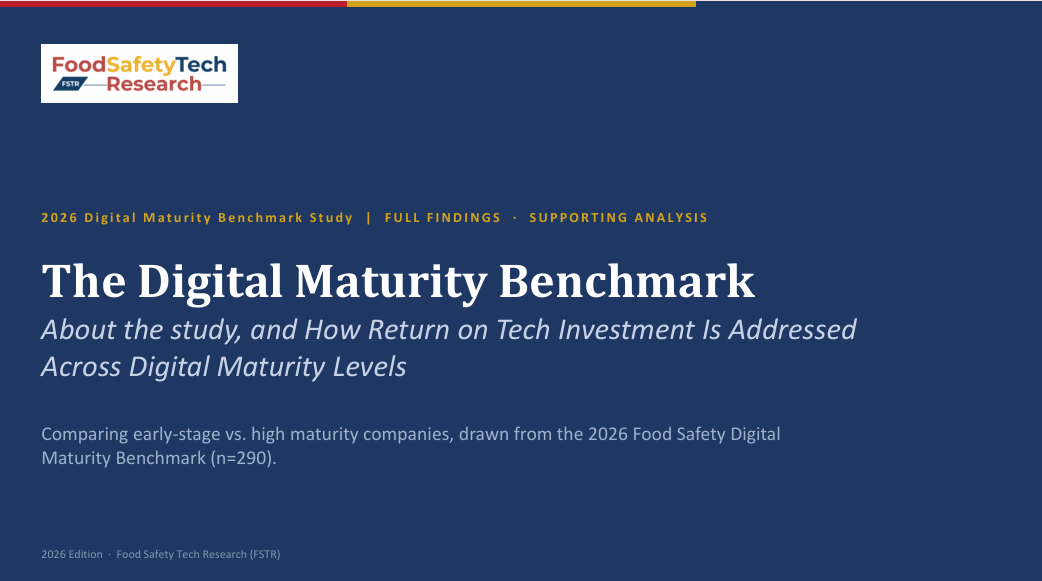
Missed a session? Want another look at the strategies, challenges, and insights discussed at FSC 2026? Access expert presentations covering the issues shaping food safety today. Featured this week is the FSTR ROI by Maturity Group FSC 2026 Presentation.
What decision is your team weighing right now? Bring it to Dave Hatch, Co-Founder and Chief Research Officer of Food Safety Tech Research (FSTR). His consulting approach starts with the question you need to answer. Through FSTR membership, Dave helps you connect relevant research to decisions such as which digital tools to prioritize or which customer needs to address in your product plans.
Compare your priorities with industry research.
Apply findings to a decision with Dave’s guidance.
Ask a food safety director whether the new system paid off, and you will hear about audit readiness, faster CAPA closure and the recall that never happened. Ask the CFO the same question, and you will get a different question back: how much? Both answers are sincere. They just aren’t the same answer. And the gap between them may be why so many food safety technology business cases die in the budget meeting.
The 2026 Food Safety Digital Maturity Benchmark surveyed 290 qualified food manufacturers on what they have deployed, what they set out to achieve and what they got back. For this article, Food Safety Tech Research (FSTR) went back into the raw responses and cross-tabulated the ROI question against everything else respondents told us. None of the cross-tabulations described in this article have been published before.
The ROI that isn’t
Let’s start with the good news: 72% of respondents say their digital food safety investment has produced a positive return: 30% call it strong and 42% call it moderate. The ‘moderate’ answer choice reads “benefits have somewhat exceeded costs,” and it is the single most popular answer in the survey. But that isn’t necessarily an ROI. It’s a mood.
Then there is everyone else. 80 of the 290 companies, or 28%, cannot say their technology has paid for itself. 12% call it break-even, 8% say it is too early to tell, 4% have not tried to quantify it, and 3% admit it lost money.
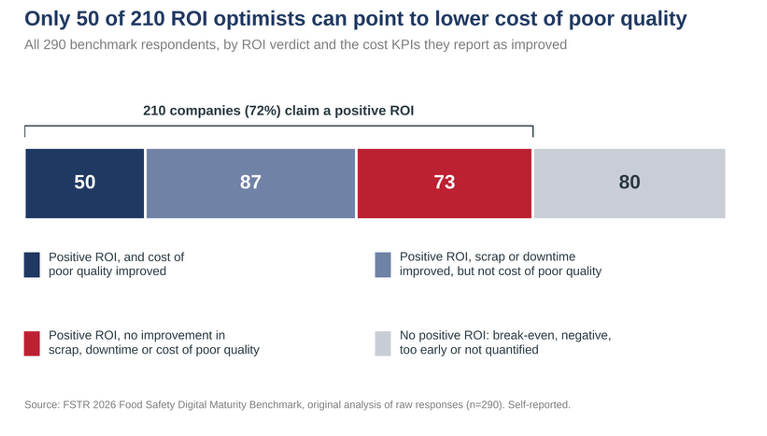
The more revealing number is hiding inside the optimists. Of the 210 companies that report a positive ROI, 160, or 76%, did not report an improvement in cost of poor quality. That is the one KPI on the list that is literally measured in dollars. More than a third of the optimists (35%) report no improvement in scrap, downtime or cost of poor quality at all. While the return may feel “real” from a food safety team KPI standpoint, it just doesn’t show up anywhere a controller would look for it.
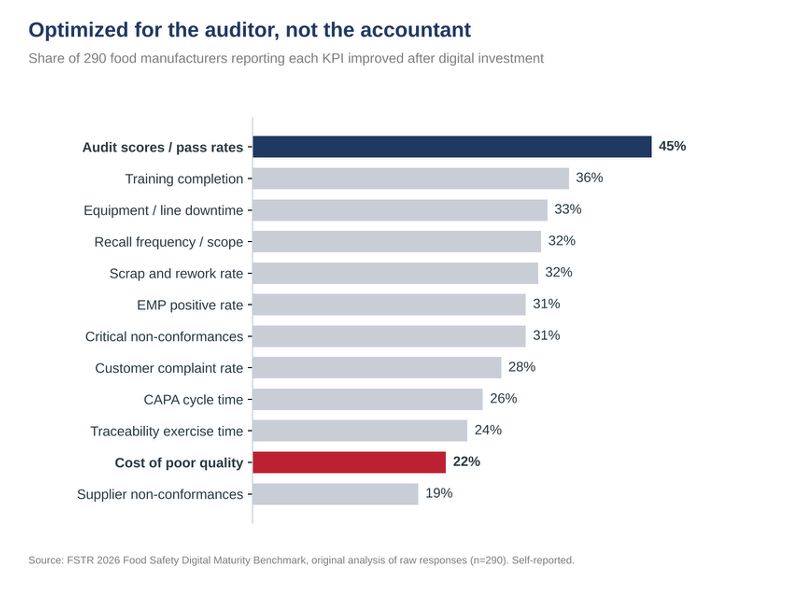
Across all 290 companies, the KPI most often reported as improved is audit scores (45%). Cost of poor quality ranks 11th of 12 (22%). The industry has optimized its technology for the auditor, not the CFO, and this is a real problem when it comes to justifying spend on new innovative tech.
And don’t think that the CFO doesn’t notice. Among companies reporting strong ROI, 82% say senior management fully supports digital investment. Among companies that call it too early to tell or haven’t quantified it, that figure falls to 17%.
Same mission, different scorecard
Food safety leaders and business leaders agree on the mission. About half of each group lists preventing contamination events as an investment objective. Where they part ways is the scorecard.
Compare the 94 respondents in food safety and quality leadership with the 42 executives and general managers who responded to the survey:
Budget: 52% of executives call budget a barrier to digital investment, versus 31% of food safety leaders.
Cost: 57% of executives set reducing scrap, waste and cost of poor quality as an objective, versus 38% of food safety leaders.
Compliance: 44% of food safety leaders cite regulatory compliance as a driver, versus 29% of executives. (42% set GFSI certification as an objective, versus 26%).
The executive sample is small, so treat everything except the budget gap as “directionally significant”. But the direction is hard to miss. One side is buying insurance against a bad day. The other side is reading the invoice.
Here is where it gets uncomfortable. Business framing gets business results. Companies that cite at least one business driver (reducing waste, improving uptime, cutting labor costs or competitive differentiation) were roughly twice as likely to report improvement in a hard-dollar KPI: 67% versus 34%. Companies that set a scrap or cost objective: 71% versus 51%.
One more twist, before anyone blames the food safety department. When a VP or director of food safety or quality owns the investment decision, 83% of companies report a positive ROI, versus 68% when someone else owns it. That holds even when the person answering the survey isn’t in food safety (85% versus 69%). Those companies also report full senior management support more often (72% versus 58%).
Decisions made by cross-functional steering committees fare worst: only 55% report a positive return. Food safety leadership isn’t the problem. Translating its value into the CFO’s language is.
Misery has company
If it helps, food safety, or the food and beverage industry in general is not the only function struggling to put a number on the value of its technology investments.
Deloitte: close to home, Deloitte’s 2025 Smart Manufacturing Survey of 600 manufacturing executives reported output gains of 10% to 20%. Yet only 42% said they were developing value targets and a measurement plan to assess progress.
IBM:IBM’s 2025 CEO Study surveyed 2,000 CEOs across 24 industries. They reported that only 25% of AI initiatives had delivered their expected ROI, and 64% admitted that fear of falling behind drives investment before they clearly understand the value.
Next to these cohorts, food safety looks like a star: 72% positive ROI. But notice the difference in the question. IBM asked whether initiatives met expected ROI. Deloitte asked about gains and KPIs. Our survey asked whether benefits exceeded costs and let respondents decide what counted as a benefit. Either food safety is the most ROI-efficient function in global industry, or it is grading on a curve. The cost-of-poor-quality numbers suggest the curve.
How to stop grading on a curve
None of this means food safety technology doesn’t pay. It means the industry is bad at proving that it does. The fix is less about technology than about bookkeeping.
Baseline before you buy. Record the cost of poor quality, scrap, downtime and hold-and-release times before the system goes live. You can’t show an improvement against a number nobody wrote down.
Translate prevention into dollars. “We avoided a recall” is a story. Your own cost of a hold, a write-off or a customer chargeback is a number. Finance will accept a conservative estimate with a source over an inspiring story without one.
Retire qualified metrics from your vocabulary. Report a figure, even a range, with its assumptions in plain sight. A business case with a range invites a conversation. A business case with an adjective invites a no.
Give the investment one owner who keeps two scorecards. The data favors food safety ownership over committees. But that owner needs to report the CFO’s metrics alongside the auditor’s.
The food safety function has spent decades learning to prove a negative: the outbreak that didn’t happen. That is hard, valuable work. The next step is learning to prove a positive, in dollars, to the people who sign the checks. Until then, “somewhat exceeded costs” will keep getting what it deserves: somewhat of a budget.
About the data
The 2026 Food Safety Digital Maturity Benchmark surveyed 290 qualified food and beverage manufacturers between July 22 and September 16, 2026. All benchmark figures are self-reported. The cross-tabulations in this article are original FSTR analysis of the qualified survey responses and have not been published before. Differences described as significant were tested with Fisher’s exact test at p<0.05; others are directional.
After more than a decade of informing and connecting the global food safety community through independent journalism, conferences, webinars, and expert insights, Food Safety Tech is expanding its mission with the launch of Food Safety Tech Research (FSTR), a dedicated research and advisory practice focused exclusively on the intersection of food safety, technology, and data driven operational performance.
FSTR is launching with its flagship Food Safety Digital Maturity Benchmark, an independent industry study designed to establish the first comprehensive benchmark of how food and beverage manufacturers are adopting digital technologies, where they are succeeding, where they face barriers, and how digital maturity influences food safety, operational resilience, and business performance.
For years, food companies have invested in software, automation, artificial intelligence, analytics, laboratory systems, traceability, and connected technologies without an independent benchmark to understand what meaningful progress or outcomes looks like. Vendors publish case studies. Analysts publish opinions. Individual organizations measure themselves. Until now, the industry has lacked an independent, research driven benchmark that objectively measures digital maturity and tech use cases across food manufacturing.
Food Safety Tech Research was created to close that gap. Through primary research, advisory services, and longitudinal benchmark studies, FSTR will generate practical intelligence that helps manufacturers make more informed investment decisions while providing solution providers, insurers, investors, and other stakeholders with credible market insights.
“The food industry has reached a point where digital transformation is no longer optional, but organizations still lack independent evidence that helps them separate technology promises from measurable business outcomes,” said David Hatch, Co-Founder and Chief Research Officer of Food Safety Tech Research. “Our goal is to create trusted research-driven insights that helps organizations understand where they are today, where they can improve tomorrow, and how the industry is evolving over time.”
Rick Biros, Founder and President of Innovative Publishing, Publisher of Food Safety Tech, and Co-Founder of Food Safety Tech Research, said the launch represents a natural evolution of Food Safety Tech’s mission. “For over fifteen years, Food Safety Tech has helped the industry understand emerging technologies, regulatory developments, and best practices. FSTR extends that mission by generating original research that the industry can use to make smarter decisions and accelerate meaningful progress.”
The launch also opens participation in the inaugural Food Safety Digital Maturity Benchmark. Qualified professionals from food and beverage manufacturers are invited to contribute confidentially and anonymously. Participants will receive a findings report and a personalized maturity scorecard while helping establish an independent benchmark that will benefit the broader industry.
Take the Food Safety Digital Maturity Benchmark SurveyEarly findings from the benchmark study will be shared throughout the fall, culminating in the official public debut of Food Safety Tech Research during the 15th Anniversary Food Safety Consortium Conference & Expo, October 21 through 23, 2026, in Washington, DC. The conference, organized by Food Safety Tech, will provide the industry’s first opportunity to explore the benchmark findings, discuss emerging trends, and engage directly with FSTR leadership.
Food Safety Tech Research is a subsidiary of Innovative Publishing and operates as the research and advisory division of Food Safety Tech.
This website uses cookies so that we can provide you with the best user experience possible. Cookie information is stored in your browser and performs functions such as recognising you when you return to our website and helping our team to understand which sections of the website you find most interesting and useful.
Strictly Necessary Cookies
Strictly Necessary Cookies should be enabled at all times so that we can save your preferences for these cookie settings.
We use tracking pixels that set your arrival time at our website, this is used as part of our anti-spam and security measures. Disabling this tracking pixel would disable some of our security measures, and is therefore considered necessary for the safe operation of the website. This tracking pixel is cleared from your system when you delete files in your history.
We also use cookies to store your preferences regarding the setting of 3rd Party Cookies.
If you visit and/or use the FST Training Calendar, cookies are used to store your search terms, and keep track of which records you have seen already. Without these cookies, the Training Calendar would not work.
If you disable this cookie, we will not be able to save your preferences. This means that every time you visit this website you will need to enable or disable cookies again.
Cookie Policy
A browser cookie is a small piece of data that is stored on your device to help websites and mobile apps remember things about you. Other technologies, including Web storage and identifiers associated with your device, may be used for similar purposes. In this policy, we say “cookies” to discuss all of these technologies.
Our Privacy Policy explains how we collect and use information from and about you when you use This website and certain other Innovative Publishing Co LLC services. This policy explains more about how we use cookies and your related choices.
How We Use Cookies
Data generated from cookies and other behavioral tracking technology is not made available to any outside parties, and is only used in the aggregate to make editorial decisions for the websites. Most browsers are initially set up to accept cookies, but you can reset your browser to refuse all cookies or to indicate when a cookie is being sent by visiting this Cookies Policy page. If your cookies are disabled in the browser, neither the tracking cookie nor the preference cookie is set, and you are in effect opted-out.
In other cases, our advertisers request to use third-party tracking to verify our ad delivery, or to remarket their products and/or services to you on other websites. You may opt-out of these tracking pixels by adjusting the Do Not Track settings in your browser, or by visiting the Network Advertising Initiative Opt Out page.
You have control over whether, how, and when cookies and other tracking technologies are installed on your devices. Although each browser is different, most browsers enable their users to access and edit their cookie preferences in their browser settings. The rejection or disabling of some cookies may impact certain features of the site or to cause some of the website’s services not to function properly.
Individuals may opt-out of 3rd Party Cookies used on IPC websites by adjusting your cookie preferences through this Cookie Preferences tool, or by setting web browser settings to refuse cookies and similar tracking mechanisms. Please note that web browsers operate using different identifiers. As such, you must adjust your settings in each web browser and for each computer or device on which you would like to opt-out on. Further, if you simply delete your cookies, you will need to remove cookies from your device after every visit to the websites. You may download a browser plugin that will help you maintain your opt-out choices by visiting www.aboutads.info/pmc. You may block cookies entirely by disabling cookie use in your browser or by setting your browser to ask for your permission before setting a cookie. Blocking cookies entirely may cause some websites to work incorrectly or less effectively.
The use of online tracking mechanisms by third parties is subject to those third parties’ own privacy policies, and not this Policy. If you prefer to prevent third parties from setting and accessing cookies on your computer, you may set your browser to block all cookies. Additionally, you may remove yourself from the targeted advertising of companies within the Network Advertising Initiative by opting out here, or of companies participating in the Digital Advertising Alliance program by opting out here.