

Tag Archives: FSMA 204

Affiliated Foods Named Inaugural Recipient of the Food Safety Tech Excellence Award

By Candace Taylor
No Comments

Managing food safety across more than 1,000 suppliers is no small undertaking. Different products, different risk levels, different regulatory requirements, and a seemingly endless stream of documentation can make even the most organized food safety professional wonder if there is a better way.

For Santoshi Muriki, Food Safety Manager at Affiliated Foods, Inc. in Amarillo, Texas, the answer was to build one.

The automated risk-based supplier compliance system developed by Santoshi Muriki earned Affiliated Foods the inaugural 2026 Food Safety Tech Excellence Award. The award was presented October 22 at the 15th Annual Food Safety Consortium Conference in Washington, DC.

The award recognizes innovative technical solutions that measurably improve food safety practices. Muriki’s accomplishment stood out for its practical application of technology, measurable operational improvements, and potential relevance to other organizations managing complex supplier networks.
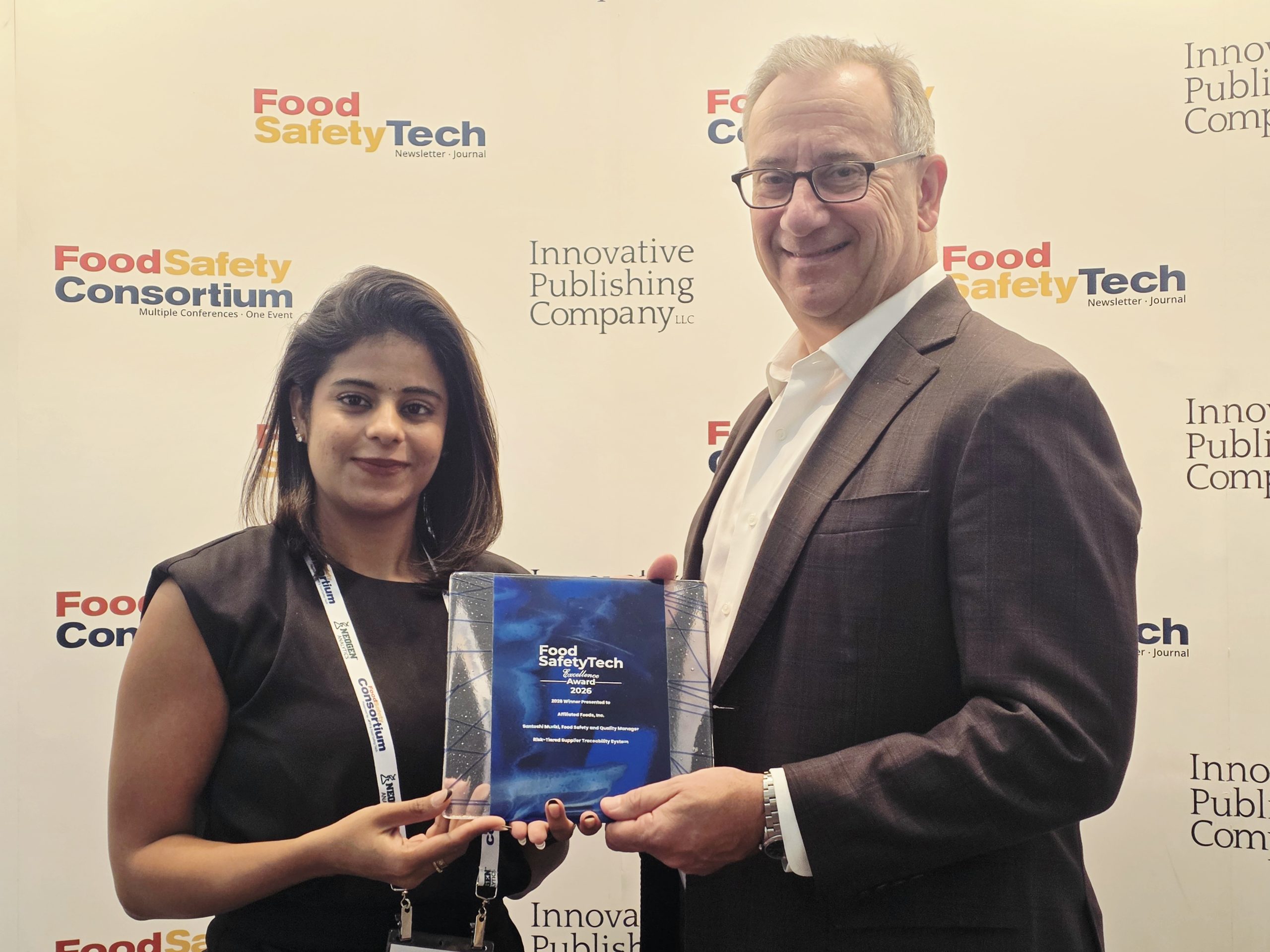
Rick Biros, Content Director and Founder of Food Safety Tech presenting the Food Safety Tech Excellence Award to Santoshi Muriki, Food Safety Manager at Affiliated Foods

A Different Approach to a Familiar Problem

At Affiliated Foods, a wholesale grocery cooperative with more than 1,000 suppliers, preparing for the Food Safety Modernization Act’s Food Traceability Rule, commonly known as FSMA 204, presented a substantial challenge.

Supplier documentation was largely managed through spreadsheets, emails, and manual follow-ups. With suppliers representing a broad range of product categories and regulatory obligations, maintaining accurate compliance records required considerable time and attention.

Muriki recognized that treating every supplier and product the same way wasn’t necessarily making the process safer or more efficient.

Using the ReposiTrak platform, she designed, developed, and implemented a system that combines Affiliated Foods’ existing three-tier supplier risk structure with a new product-level classification framework.

Her Kill-Step Category A/B approach considers whether products have undergone validated processing steps, such as pasteurization or retort processing, that affect applicable food safety and traceability requirements.

This distinction allows the company to evaluate supplier reliability separately from product-level risk, helping ensure that compliance resources are directed where they are most needed.

Rather than simply digitizing an existing process, Muriki redesigned how supplier compliance was evaluated and managed.

Less Chasing Paperwork. More Managing Risk.

The results reported in Muriki’s award submission speak to the value of that approach.

  • 60% reduction in manual follow-up required to track and verify supplier documentation.
  • 50% faster supplier onboarding into the compliance system.
  • 100% critical-document compliance achieved across the tracked supplier base.

The system automatically identifies missing or expiring documents, supports supplier onboarding, and provides food safety, procurement, and vendor management teams with greater visibility into compliance status.

It also includes re-verification triggers associated with recalls, nonconformances, and audit findings, helping ensure that documentation receives renewed attention when circumstances change.

For food safety professionals, these improvements mean less time pursuing paperwork and more time evaluating supplier performance, addressing potential gaps, and maintaining oversight.

The result is a shift from reactive documentation management toward a more proactive approach to supplier compliance.

David Hatch, Co-Founder and Chief Research Officer of Food Safety Tech Research (FSTR), highlighted the connection between food safety outcomes and measurable business value during the award presentation.

“We’ve talked a lot about the combination of achieving food safety outcomes, public health outcomes, and combining that with the business benefit, the return on investment of investments that you make in technology and in data, and this submission really stood out for those reasons. Things like that really get the attention of senior leadership, especially achieving 100% compliance with the FSMA 204 standard well ahead of schedule. It really got our attention, and so congratulations.”

The Initiative Behind the Innovation

What makes Muriki’s achievement particularly noteworthy is the level of personal responsibility she assumed.

According to her award submission, she independently identified the need for a more sustainable compliance system, designed the framework, and led its implementation across the supplier network.

She served as the project’s sole architect, taking it from concept through rollout.

Tracy Fink, Founder and Principal Advisor of ThinkFink Solutions, LLC, also recognized the effort required to implement a system of this scale.

“I wanted to recognize not only the discipline, the persistence, and the collaboration that this took. The complexity of 1,000 plus supplier networks into a practical, proactive, practical, proactive system is a phenomenal achievement, and so such a well-deserved recognition.” Fink told Muriki. 

That initiative reflects a professional philosophy evident throughout Muriki’s career. Food safety programs should do more than satisfy an audit requirement. They should help organizations make informed decisions, identify potential risks, and improve everyday operations.

Muriki brings more than seven years of food safety and quality assurance experience spanning manufacturing and wholesale grocery distribution.

Her background includes HACCP program management, environmental monitoring, supplier verification, internal auditing, food safety certification systems, and recall and reclamation processes.

She holds a master’s degree in Food Science and Nutrition from the University of Central Oklahoma and a bachelor’s degree in Food Science. Her professional training and credentials cover recognized food safety standards and disciplines, including SQF, FSSC 22000, ISO 22000, preventive controls, and HACCP.

Beyond her operational responsibilities, Muriki contributes to industry discussions through technical reviewing and writing on traceability, supplier compliance, recall readiness, and food safety governance.

Her interest in advancing food safety also extends to research. The methodology underlying her award-winning project was developed into a manuscript titled Risk-Tiered Supplier Compliance Model, which, according to her submission, was accepted for publication in Food Protection Trends following scientific peer review.

Why Her Work Matters Beyond Affiliated Foods

The challenges Muriki addressed are familiar throughout the food industry.

Manufacturers, distributors, retailers, and foodservice organizations must balance regulatory requirements, supplier accountability, operational efficiency, and the need to respond quickly when something goes wrong.

Her work offers an example of how thoughtful system design and existing technology can improve that balance.

It also raises an important question for food safety leaders. How much time are their teams spending collecting information versus using that information to make better decisions?

Muriki’s project demonstrates that improvements in compliance efficiency do not have to come at the expense of oversight. When designed appropriately, automation can support both.

The approach also has potential applications beyond one company. Although each organization has its own supplier network and regulatory obligations, the underlying principles of risk-based classification, consistent documentation, and continuous monitoring are broadly relevant.

Recognizing a Commitment to Food Safety

The Food Safety Tech Excellence Award was established to recognize innovative technical solutions that produce measurable improvements in food safety operations.

Submissions were evaluated by the Food Safety Tech Advisory Board based on innovation, scalability, measurable improvement, and sustainability.

Affiliated Foods’ achievement reflects those priorities, but it also represents something less easily measured.

It demonstrates the value of professional initiative.

Muriki recognized an operational challenge, developed a practical solution, and followed through with implementation. The improvements reported in her submission show what can happen when technical knowledge is paired with the determination to make existing processes work better.

Food safety innovation doesn’t always require inventing a new technology. Sometimes it means questioning a familiar process, recognizing its limitations, and finding a more effective way forward.

As the inaugural recipient of the Food Safety Tech Excellence Award, Affiliated Foods represents the kind of dedication, resourcefulness, and practical problem-solving that continues to move the food safety profession forward.

And for professionals still spending too much of their day chasing supplier documentation, her accomplishment offers an encouraging thought.

There may be a better way to get the job done.

Ask The Expert

AI Agents in Food Safety Operations: Three Questions Nobody is Asking

By Johannes Gudmundsson
No Comments

Everyone in the food industry, from the boardroom to the operations staff, is getting excited about the advent of AI and how it can impact their business. There is so much possibility in what an AI agent can handle to speed up delivery, streamline efficiencies, and flag issues before they become real problems. However, after being mesmerized by the razzle-dazzle of the demo, food companies are forgetting to slow down and ask the most critical questions of the vendors looking to serve them.

AI agents move more swiftly than a person ever could, which means their mistakes can be much more costly than we imagined. Especially for food safety teams, where an agent operating without guardrails in lot traceability or QC hold management can contribute to massive compliance failure.

I have spent most of my career in operations and finance, CFO and COO roles in manufacturing, and before that leading information security, and I have seen what happens when controls are not in place, well before AI exploded into the stratosphere.  It is very similar to the advent of ERP implementation in the industry.  Food manufacturers found that the generic systems they were putting into place could not understand the nuances of the operational needs they were trying to serve.  These systems had to be rebuilt with a specific purpose in food.  Now, it is a similar issue, but with AI, and the implications are much greater.

AI is being sold to the food industry the same way ERP systems were years ago. It is the latest shiny tech in the room and, like ERP sales meetings of the past, it is a pitch of capabilities assessments and a review of interactive demonstrations.  However, there is something missing…the question of real-world compatibility and, frankly, the elephant in the room: what happens if the system goes sideways?

That said, before engaging with an AI provider who says they can offer your company a bevy of undeniable operational benefits, you must ask the right questions.  These are three of the most important to note and inquire about…please, do not leave the room without asking them!

1) This is a question that should stop a demo in its tracks if a vendor fumbles the answer. “Will the agent guess or stop when it cannot come to a conclusion on its own?”  Agents should not be left to their own judgment. They must have guardrails around a defined set of operations specific to the task they are seeking to accomplish. If the agent finds it needs assistance, it should be programmed to flag a human for interaction, rather than the other way around.  Ask the vendor what the agent will do if it is not sure of its conclusion. If they cannot answer the question, it is indeed a cause for alarm and an indication that their service may not be an asset, but a liability.

For food safety professionals, this is imperative to FSMA 204.  The rule demands companies produce their Key Data Elements at Critical Tracking events within 24 hours[1]. If the agent is guessing at the decisions it makes in the data layer, that means your ability to meet the FSMA requirement depends on if the agent guessed correctly.

2) Many companies regret not asking this one. “Who is in control of the agent?”  This is a very important question because you need to understand the difference between an agent programmed to operate at the system level and one with autonomy to make decisions for itself while executing actions within the guidelines it has been given. Yes, they essentially become extended members of your team and can take on tasks they know they can handle, such as monitoring inbox communications and processing new invoices, but they should never bypass a human’s permission in what they are not allowed to handle. While agents make things quicker, faster, and easier, a human touch remains important for monitoring their interactions.

In the context of food safety, this matters most for QC hold management. Agents should have the capability to flag holds, provide the test data, and notify the right people. They should not be allowed to release any hold without human permission.

3) Finally, if a vendor cannot answer this question, walk. “If something goes wrong, will the team be able to find out what happened and why?” If there is an error, the agent must be able to produce a report to show what happened, where it happened, how it happened, and the potential implications of its mistake on operations.  It should also be able to provide you with troubleshooting recommendations so that changes can be made directly into the system and the program relaunched. If the agent cannot operate on a fail-diagnose-inform-and-fix cycle, then it is not a technology you can trust.

[1] U.S. Food & Drug Administration. Requirements for Additional Traceability Records for Certain Foods (Food Traceability Rule), 21 CFR Part 1, Subpart S. Effective January 20, 2023; compliance date July 20, 2028. https://www.fda.gov/food/food-safety-modernization-act-fsma/fsma-final-rule-requirements-additional-traceability-records-certain-foods.

This is not optional per FSMA 204. An auditor is going to ask for a complete record of every action taken by an agent in your traceability data.  Make it a priority practice to ensure you can provide one.

Most food professionals in operations have been managing this kind of oversight throughout their careers.  The only change is that they are using a different tool to enhance efficiency. Just like a generic ERP in the food industry will never function as efficiently as a purpose-built ERP, the same holds true here for AI.  Agents must be purpose-built to understand the industry they are working in and the components that make up the engine, including lot records, catch weight, FEFO inventory, and quality control.

We encourage professionals in the food industry to ask hard questions of any vendor:

  1. Will the agent guess or stop?
  2. Who is really in control of the agent?
  3. Will my team be able to understand an agent’s failure and fix it?

Vendors with real expertise in the food industry can confidently answer these questions. Those who can’t will struggle to explain whether the technology they are offering you was really built for the job.

Photo by Mohamed Nohassi on Unsplash

Food Fraud Quick Bites

Food Fraud and the Case for Traceability

By Johnna Hepner, Jon Woody
No Comments

Food fraud isn’t new, and I don’t know that it’s actually gotten worse over the years. What’s changed is our awareness of it. At its core, food fraud is the intentional substitution, addition, tampering, or misrepresentation of a food or ingredient for economic gain. The drivers haven’t changed much: high-value ingredients, complex global supply chains with more intermediaries than most people realize, price volatility from tariffs or natural disasters, and food safety standards that vary from country to country. Put those together and food fraud is going to keep happening. The question is how well The question is how well companies understand where they’re vulnerable and what they’re doing to reduce that risk.companies understand where they’re vulnerable and what they’re doing to reduce that risk.

I spent 24 years at FDA before retiring in 2025, and this issue followed me through most of that career. I got pulled into response and traceback work on some of the most significant food fraud events involving FDA-regulated products, including the melamine-in-infant-formula crisis, the Peanut Corporation of America case, and, near the end of my time there, the lead contamination of cinnamon that made its way into applesauce pouches sold across the U.S. That last one is worth walking through in detail because it’s a case study in exactly where our current traceability infrastructure falls short, and why that matters.

From Cinnamon Sticks to Lead Chromate

The cinnamon sticks at the center of this case originated in Sri Lanka. From there they were exported to Ecuador, passing through several intermediaries along the way, likely bought and sold more than once, before one of those intermediaries ground the sticks into powder. It was during that grinding step that lead chromate was introduced into the cinnamon.

Why lead chromate specifically? Because the product was being valued primarily based on two things, color and weight, and lead chromate enhances both. It’s the same motive behind decades of similar cases: lead chromate showing up in Hungarian paprika in the 1990s, in turmeric in Bangladesh and India. The objective wasn’t to cause harm. It was to make a cheaper product look and weigh like a more valuable one and get paid accordingly.

That contaminated cinnamon was sold to a processor in Ecuador, Austrofood, that used it to produce applesauce. The finished product was imported into the U.S. by a company called WanaBana and distributed nationally. CDC identified 566 cases of elevated blood lead levels associated with consumption of the pouches, approximately 96% of them in children under six. Nearly 3 million pouches were recalled, and WanaBana filed for Chapter 7 bankruptcy protection within months.

Why This Case Sticks With Me

Of the cases I worked, the Peanut Corporation of America investigation remains the most complex traceback I was ever part of. A single contaminated peanut paste ingredient had worked its way into literally hundreds of products, and untangling that took an enormous amount of manual effort. The cinnamon case was complex in a different way. It wasn’t about how many finished products contained the ingredient. It was about how many countries, companies, and hand-offs the ingredient itself passed through before anyone in the U.S. ever saw it: a grower in Sri Lanka, an exporter, several intermediaries in Ecuador, the grinding operation that FDA had no direct relationship with and no visibility into, a finished-goods processor, an importer, and multiple national distributors. Every additional hand-off adds another place where visibility can be lost and another party a company may know very little about.

FDA didn’t stop at identifying where the contamination happened. The warning letter to Austrofood, the Ecuador-based manufacturer, lays out the part I think is the real lesson here. Austrofood had actually flagged lead as a potential hazard twice before the recall, once in a 2022 hazard analysis covering raw materials generally and again in 2023 when it specifically named the cinnamon ingredient, and both times concluded a preventive control wasn’t necessary. The justification the second time was that the supplier had no history of problems. FDA’s response was direct: given how often lead turns up in spices, and given that this product was intended for infants as young as six months, a knowledgeable person should have reached the opposite conclusion.

There’s another interesting detail buried in the warning letter. Austrofood’s own supply chain program required an annual onsite audit of its Ecuador-based suppliers, including Negasmart, the distributor that supplied the contaminated ground cinnamon. That onsite audit never happened. Austrofood substituted what the letter calls a “desk audit,” a paper review, which FDA noted wasn’t consistent with the company’s own supply-chain program. When FDA tested the cinnamon from that supplier directly, it found lead as high as 5,110 parts per million, along with extremely high chromium levels. Further analysis identified lead chromate in the cinnamon rather than incidental lead contamination. Lead chromate doesn’t turn up in cinnamon by accident.

None of that is really a traceability problem. It’s a prevention problem. Austrofood had information that should have led to stronger supplier controls before the contaminated cinnamon ever reached the applesauce. But once prevention fails, traceability determines how quickly you can figure out where a product came from, where it went, and what else may be affected.

Where FSMA 204 Doesn’t Reach

Here’s the part I think gets missed in a lot of the traceability conversation right now. There’s a lot of attention on FSMA 204, FDA’s food traceability rule, and rightly so, particularly in light of a string of high profile foodborne illness outbreaks this year. But that rule applies specifically to foods on FDA’s Food Traceability List, and a lot of the products that show up again and again in food fraud cases simply aren’t on it. Spices are a good example. Cinnamon isn’t on the list, and neither are a lot of the other high-value, high-fraud-risk commodities that keep showing up in incident after incident. If your compliance program stops at the FTL, you have no visibility into exactly the categories most likely to be defrauded.

So companies that are only building traceability programs to satisfy the letter of FSMA 204 are going to have blind spots in some of the very categories that repeatedly show up in food fraud cases. That’s not a shortcoming of FSMA 204; it wasn’t designed as a food fraud prevention rule or as a universal traceability requirement. But it does mean companies shouldn’t treat FSMA 204 compliance as the endpoint of their traceability programs. This is particularly true for ingredients like spices and honey that show up year after year in global fraud reporting but aren’t covered by the FTL.

Buying Down the Risk

There isn’t one control that’s going to prevent food fraud. What companies are really trying to do is buy down risk. The starting point is recognizing that food fraud is a business risk in the first place, separate from the microbiological and chemical safety risks most food safety programs are already built around.

That risk also changes over time. A commodity that looks relatively low-risk today may look very different after a crop failure, a sudden price increase, new tariffs, or instability in a major sourcing region. Horizon scanning can help companies see those pressures developing and ask where they may be creating new incentives for fraud.

A food fraud vulnerability assessment brings that down to the ingredients and products a company actually buys. Where does an ingredient come from? How many hands does it pass through? Does it have a history of adulteration? Is there an inexpensive way to make it look better, weigh more, or otherwise appear more valuable than it really is? From there, supplier audits and targeted testing can help address the vulnerabilities you’ve identified, although neither eliminates the risk.

Traceability plays a different role. A traceability system wouldn’t have stopped someone in Ecuador from grinding lead chromate into cinnamon to make it heavier and brighter. That’s what the preventive side of the equation is for. But when prevention fails, traceability determines how quickly you can figure out where an ingredient came from, where it went, and what else may be affected. For cinnamon and other high-value ingredients moving through complex global supply chains, that’s worth knowing even when a regulation doesn’t require you to.

The Data Has to Move

The cinnamon case raises a broader question for the food industry: How well do we really understand the journey of an ingredient before it reaches the consumer?

As ingredients move through multiple suppliers, countries, and systems, information can become fragmented. Companies may have the records they need within their own operations, but connecting that information across the supply chain is often a different challenge.

Across the food supply chain, companies already generate enormous amounts of data. The challenge isn’t necessarily a lack of information. It’s that the systems holding that information often weren’t designed to communicate with one another.

A grower may have visibility within its operation. A processor may have the records it needs within its facility. Distributors and retailers may each maintain their own information. Yet gaps can still exist between those systems and trading partners, making it difficult to piece together the complete journey of an ingredient or finished product.

At Starfish, we see this challenge across the food supply chain. Companies often have the information they need within their own operations, but connecting that information across trading partners remains difficult. The next phase of traceability isn’t simply about collecting more data or introducing another technology platform. It’s about making the information companies already generate more accessible and useful across the supply chain.

This is where interoperability becomes important. The ability for different systems to exchange and use information, without requiring everyone to operate on the same platform, can help close gaps in supply chain visibility.

Better connected data won’t prevent someone from intentionally adulterating an ingredient. But it can strengthen supply chain visibility, support investigations, and help companies identify where affected products have moved.

FSMA 204 is helping advance the industry toward more structured, accessible traceability information. But the opportunity extends beyond the foods covered by the rule.

The bigger question isn’t simply whether companies have traceability data. It’s whether they can access and share that information across their supply chains when it matters most.

Learning From the Past

The food industry has decades of experience to learn from. Investigations like the cinnamon case have exposed vulnerabilities in supplier oversight, preventive controls, and visibility across complex supply chains.

Yet many of these same challenges continue to surface. Information remains fragmented, companies struggle to see beyond their immediate suppliers, and investigators often spend valuable time piecing together records from multiple sources.

Technology alone won’t prevent food fraud. But stronger supplier verification, better-connected information, and the ability to share data across trading partners can help companies recognize vulnerabilities and respond more effectively when prevention fails.

The real opportunity is to take what we’ve learned from past incidents and put those lessons into practice. That means looking beyond regulatory requirements and asking whether our systems, processes, and supplier relationships are giving us the visibility needed to identify risks before they become another food safety crisis.


Investigation background draws on the authors’ direct experience with the FDA response, supplemented by Weed et al., “International Investigation of Lead and Chromium Contamination in Imported Apple Puree,” Journal of Environmental Health, Vol. 89, No. 1 (July/August 2026) (DOI link); FDA’s warning letter to Austrofood S.A.S., MARCS-CMS 679052, August 9, 2024; reporting by Will Fitzgibbon for The Examination, in partnership with The New York Times and El Universo; the Food Authenticity Network’s “2024 Global Food Fraud Report”;

Restaurant Food
Beltway Beat

Food Traceability: FDA Issues Draft Enforcement Discretion Policy for Certain Small Retailers and Restaurants

By Food Safety Tech Staff
No Comments
Restaurant Food

In response to feedback from stakeholders, and after determining there would be minimal public health impact, the FDA is issuing draft guidance that will, if finalized, provide enforcement discretion from the requirements of the Food Traceability Rule for certain smaller retail food establishments (RFEs) and restaurants that were not previously captured as part of the full exemption for small RFEs and restaurants offered as part of the rule. The FDA states that they believe this additional flexibility will maintain the intended public health benefits of the rule as it would only impact a small percentage of total food sales while also providing relief to numerous smaller RFEs and restaurants.

Under the draft policy, the FDA does not intend to enforce any of the requirements of the Food Traceability Rule for RFEs and restaurants whose average monetary value of food sold or provided during the previous three-year period is greater than $250,000 but not more than $1million, adjusted for inflation using 2020 as the baseline year for calculating the adjustment.

FDA plans to offer additional flexibilities for complying with the Food Traceability Rule, beyond this draft enforcement policy for small RFEs and restaurants. Towards that end, the FDA will hold a public meeting on November 6, 2026. The public meeting is free and open to the public, but registration is necessary to attend.

FSMA 204 Isn’t Just Your Challenge. It’s Your Supplier’s Challenge, Too.

By Kevin Donaghy
No Comments

Imagine it’s July 21, 2028. The FDA contacts your site with a traceability request related to a contamination issue. You have 24 hours to provide data on the entire journey of a product through your supply chain, including your suppliers’ entire network.

This means you will need to answer a few questions. Do you know how your suppliers store their records? Do they use the same lot-code formats as you? Can they deliver their critical tracking events (CTEs) and key data elements (KDEs) in a way that is useful to your system?

If you can’t answer this with confidence, you’re not alone. But you are not prepared.

The Mistake Everyone Is Making with FSMA 204

The Food Safety Modernization Act (FSMA) was signed into law by President Obama in 2011 and celebrates its 15th anniversary this year. Section 204, the FDA’s Food Traceability Rule, takes effect on July 20, 2028. It calls for enhanced electronic recordkeeping for specific foods as they travel through the supply chain, including leafy greens, soft cheeses, shell eggs, fresh-cut produce and seafood. If any of these move through your network, you’ll be impacted. So will all of your suppliers.

The rule was originally set to take effect on January 20, 2026, but was extended to “ensure coordination between supply chain partners in order to fully implement the final rule’s requirements,” per the FDA. It cited industry feedback and a concern that trading partners lacked readiness, which points to a very real supplier network problem.

There are two big mistakes manufacturers are making with FSMA 204. The first is assuming that because you’re FSMA-compliant, you’ll be compliant with Section 204. The second is thinking about the rule as an internal issue that can be solved with better recordkeeping.

When the FDA shows up with that traceability request, you’ll be expected to provide an electronic sortable spreadsheet with key details within 24 hours. In order for you to obtain that information quickly – and in the correct format – your suppliers and vendors will also need to be in compliance with the rules.

The 24-Hour Rule: The Creeper Threat

What you, as a quality leader, should be most concerned about isn’t whether you’re capturing the right data (that’s a no-brainer), but whether you can access data from wherever it is in the supply chain, within 24 hours.

So let’s break down what this looks like in the real world: A manufacturer has to contact a co-packer who contacts a raw material supplier who needs to find a lot code in a spreadsheet or legacy ERP system, that may not even be compatible with our system, and you have to do it in 24 hours. That’s an extremely short window.

The financial impact, meanwhile, is massive. The FDA lacks the authority to impose fines directly, but can pursue federal civil or criminal actions if noncompliance is persistent. The greater risk, however, is losing your supplier status with major retail partners – many of which are mandating compliance before enforcement.

The Dirty Little Secret: Data Fragmentation Across Your Network

The uncomfortable truth about supplier networks in food manufacturing is that they weren’t built for this level of complexity. They have evolved, supplier by supplier, system by system. Most operate as a patchwork of disconnected ERPs, spreadsheets, and paper logs. Each node in that network may be capturing traceability data, but almost none of it is shared in a way that easily connects to the next node.

This is really what FSMA 204 is getting at: not whether you’re prepared internally, but how consistently your supply chain as a data-sharing network is performing. Those who will be most challenged won’t be companies that haven’t invested in compliance (many have). It will be those who have invested in their internal operations, but have not extended that effort to their supply networks. The moment the FDA begins tracking, the weakest link in your data chain becomes your biggest liability.

Warehouse worker in protective clothing operating a pallet jack, moving stock within a large, low-temperature cold storage facility

What “Ready” Actually Looks Like

True FSMA 204 readiness requires three interconnected elements, all of which must happen simultaneously, not in sequence.

  • Full chain traceability. All CTEs in your network must be identified and associated with the corresponding KDEs, from farm to fork. Your traceability system must extend beyond your four walls to create a seamless record that connects your supplier data with your own.
  • For manufacturers, a critical factor will be to establish a community of suppliers all speaking the same data language, capable of automatically transmitting data to one another error-free.
  • A rapid recall response is a must. The 24-hour clock isn’t about meeting a deadline for paperwork, it’s a litmus test for operational efficacy. Your quality teams must be able to achieve instant traceback and traceforward without manually combing through supplier emails.

To achieve this, you’ll need a single source of truth where all documentation is readily accessible, lot codes are automatically associated, and automatic notifications are triggered the moment a potential issue arises, all before the FDA ever knocks on the door. That way you can manage proactively and maintain continuity.

The Window Is Narrowing

July 2028 may seem like a long way off, but it’s closer than you think. Interoperability across an entire supply chain takes time, and getting your organization completely aligned on new data standards and traceability is a monumental undertaking that will require significant time and effort.

Companies that don’t take action now, and instead push the problem off until next year, will find themselves in a world of hurt when 2028 rolls around and they still aren’t prepared. Plus, many major retailers are requiring early and expanded compliance, so you’ll want to make sure you’re aligned with the expectations of your customers.

The question now isn’t if you should start preparing. It’s whether you’re preparing for the right things.

Ghost Kitchens and Food Traceability: Understanding Food Safety Responsibilities in a Reinvented Operating Model

By Jeremy Schneider, Johnna Hepner
No Comments

The food service industry has undergone significant transformation since the COVID era, and few innovations have evolved as rapidly as the rise of ghost kitchens. Whether operating as delivery-only restaurants, virtual brands, commissary kitchens, multi-branded sites, or shared commercial kitchen spaces, ghost kitchens have allowed for new opportunities for food entrepreneurs while simultaneously introducing unique food safety and traceability challenges.

As regulators, customers, and supply chain partners continue to increase their focus on transparency and traceability, ghost kitchen operators must understand how food safety responsibilities apply to their business and where risks may exist within their operation. While the operating model may be different, the food safety expectations remain the same.

What is a Ghost Kitchen?

A “ghost kitchen” is generally defined as a food preparation facility that produces meals for off-premises consumption, often through third-party delivery platforms, without a traditional dine-in experience.

These operations can take several forms, including:

  • Single-brand delivery-only restaurants.
  • Virtual restaurant brands operating out of existing restaurants.
  • Shared commissary kitchens housing multiple operators.
  • Centralized production kitchens supplying multiple delivery concepts.
  • Hybrid models supporting both retail and delivery operations, which may or may not include virtual or branded concepts.

While these models offer operational flexibility, reduced overhead costs, and open the opportunity to significant new revenue streams, they also create additional complexity when it comes to supplier management, ingredient traceability, allergen control, and recall readiness.

Why Traceability Matters in Ghost Kitchens

Traditional restaurants often have relatively straightforward ingredient flows. Ingredients arrive, are prepared, served, and consumed at a single location.

Ghost kitchens, however, frequently involve multiple brands operating from one facility with shared storage areas and preparation equipment, common ingredients used across several menu concepts, a variety of delivery providers, and central commissaries supplying multiple locations.

This complexity increases the importance of maintaining accurate records that identify:

  • What ingredients were received
  • Which suppliers provided them
  • When products were received
  • How products were used
  • Which menu items contained those ingredients
  • Where finished products were distributed
  • Enhanced requirements outlined within FDA’s FSMA 204 regulations.

Without adequate traceability records, identifying affected products during a food safety incident can become extremely difficult.

Supplier Approval is More Important Than Ever

Many ghost kitchen operators focus heavily on speed and convenience when sourcing ingredients. However, rapid growth can sometimes outpace supplier verification processes.

An effective supplier approval program should include:

  • Approved supplier lists
  • Supplier food safety documentation
  • Third-party audit verification
  • Certificates of Analysis (COA) when appropriate
  • Ingredient specifications
  • Recall and crisis management procedures.

This becomes particularly important when multiple virtual brands rely on common ingredients. A single supplier issue may impact numerous menu offerings simultaneously.

The Recall Challenge for Ghost Kitchens

One of the most significant food safety concerns for ghost kitchens is recall execution.

Imagine a scenario where a contaminated ingredient is used across six virtual restaurant brands operating within the same facility. The affected ingredient may have been incorporated into dozens of menu items sold through multiple delivery platforms over several weeks.

Questions operators must be able to answer include:

  • Which supplier provided the ingredient?
  • What lot codes were received?
  • Which menu items contained the affected ingredient?
  • Which brand(s) utilized the ingredient?
  • During what dates the ingredient was used?
  • How much inventory remains on-site?

The ability to answer these critical questions rapidly can significantly reduce the scope of a recall and help protect consumers.

The Missing Ingredient: Connected Information

One of the biggest misconceptions about traceability is that organizations simply need better software. In reality, most ghost kitchens already have technology. They use procurement systems, inventory platforms, POS systems, kitchen management software, supplier portals, delivery applications, and food safety systems.

The challenge isn’t that the information doesn’t exist. The challenge is that it often lives in disconnected systems owned by different organizations.

A single meal may involve ingredients from multiple suppliers, inventory managed in one application, orders placed through another, delivery fulfilled by a third-party platform, and customer information maintained somewhere else entirely. During a food safety event, operators must quickly connect those pieces together.

The future of traceability in foodservice won’t be defined by replacing existing systems. It will be defined by connecting them, allowing information to move securely between suppliers, operators, delivery partners, and customers while each continues using the technology that best supports its business.

FSMA 204 and Ghost Kitchens

The FDA’s Food Traceability Rule (FSMA Rule 204) has largely focused industry attention on additional traceability requirements for foods appearing on the Food Traceability List (FTL). While many ghost kitchens may not fall directly under all aspects of FSMA 204, operators should pay close attention to how their suppliers and supply chain partners are implementing enhanced traceability systems.

As traceability requirements expand throughout the food industry, businesses that maintain strong receiving records, inventory controls, and ingredient tracking systems will be better positioned to meet customer, regulatory, and supply chain expectations. Many ghost kitchens already utilize digital ordering and inventory management platforms, making them well-positioned to leverage technology for improved traceability. The opportunity isn’t simply to digitize more processes. It’s to ensure the information already being captured can be shared quickly with trading partners, customers, and regulators when needed. Traceability becomes significantly more valuable when it moves beyond compliance and supports day-to-day operations, supplier collaboration, and faster decision-making.

Food Security in Mind

Ghost kitchens frequently receive orders and pickups from multiple delivery services and this can significantly increase food security risks.

Challenges often include:

  • unknown drivers and companies
  • different requirements for handling
  • multiple menu concepts using different handling expectations, or,
  • food packaged in a way that does not protect it from adulteration

Companies should implement processes that protect food during transit from the ghost kitchen to the customer. This often includes tamper evident packaging, external packaging, and other deterrents that limit driver access.

Looking Ahead

Ghost kitchens represent an exciting evolution within the foodservice industry, but they are not exempt from the food safety responsibilities required of their traditional counterparts. In many ways, the complexity of shared facilities, virtual brands, and centralized production models makes robust food safety and traceability programs even more important.

As consumer expectations for transparency continue to increase and regulatory requirements evolve, ghost kitchen operators that invest in supplier management, traceability systems, allergen controls, and recall readiness will be better positioned to protect their customers and their brands.

The question is no longer whether traceability matters in foodservice. The question is whether your operation can quickly identify where ingredients came from, where they were used, and what actions need to be taken when something goes wrong.


FDA Logo

FDA Shares Recording of Traceability Public Meeting

FDA Logo

On June 15, 2026 The FDA held a public meeting to give the public an opportunity to share information on continued implementation of the Food Traceability Rule and areas of remaining concern, specifically as they relate to lot-level tracking and flexibilities for compliance. The Agency is now making the video recording of the meeting available for stakeholders. 

The FDA final rule on Requirements for Additional Traceability Records for Certain Foods (Food Traceability Rule) requires persons who manufacture, process, pack, or hold food on FDA’s Food Traceability List to maintain and (in some cases) provide to their supply chain partners key data elements (KDEs) for certain critical tracking events (CTEs) in the food’s supply chain. The requirements in the rule will allow for faster identification and rapid removal of potentially contaminated food from the market, resulting in fewer foodborne illnesses and deaths.

The original compliance date for all persons subject to the recordkeeping requirements of the Food Traceability Rule was January 20, 2026. The FDA proposed to extend the compliance date for the rule by 30 months to July 20, 2028. Subsequently, the Continuing Appropriations, Agriculture, Legislative Branch, Military Construction and Veterans Affairs, and Extensions Act of 2026 (the Continuing Appropriations Act) directed FDA not to enforce the Food Traceability Rule prior to that same date of July 20, 2028. The FDA  intends to comply with this Congressional directive.

The Continuing Appropriations Act also required FDA to engage quarterly with regulated entities, including farms, restaurants, retail food establishments, and warehouses distributing to retail food establishments and restaurants, to identify and implement, as appropriate, additional flexibilities for satisfying the Food Traceability Rule’s lot-level tracking requirement. This public meeting is the second of these quarterly engagements.

The recording, and related transcripts, can be found on the public meeting webpage. 

FDA Logo
Beltway Beat

FDA Releases Discussion Paper Ahead of Traceability Public Meeting in June

By Food Safety Tech Staff
No Comments
FDA Logo

The FDA has released a discussion paper to promote deeper and more productive engagements with stakeholders on potential flexibilities regarding the lot-level tracking requirements in the final rule, “Requirements for Additional Traceability Records for Certain Foods” (Food Traceability Rule). The discussion paper includes information and questions to help inform FDA’s engagements with stakeholders, including the upcoming virtual FDA-led public meeting on June 15th.

The FDA encourages those attending and speaking at the public meeting to consider the topics in the discussion paper. The public meeting is free and open to the public, but registration is necessary to attend. If you would like to speak during the public comment period, please register by June 5. All others can register until June 14th. More information about registration and how to request to speak during the public comment period are available on our meeting page.

In addition to the public meeting, the FDA wants to provide all stakeholders with an opportunity to actively engage with the Agency on this topic. Therefore, all interested parties are encouraged to submit feedback on the discussion paper to https://www.regulations.gov, Docket No. FDA-2014-N-0053. Feedback does not need to cover every question that is asked in the document; you are encouraged to focus on whichever aspects of the discussion paper are of the most interest to you. To ensure that we can fully consider your feedback as we continue our stakeholder engagements and work to expeditiously identify flexibilities to help implement the lot-level tracking requirements of the Food Traceability Rule, provide feedback by July 15, 2026.

FDA Logo
Beltway Beat

FDA Takes Several Actions Related to the Food Traceability Rule

By Food Safety Tech Staff
No Comments
FDA Logo

On February 19, the FDA issued guidance addressing stakeholder questions regarding implementation of the Food Traceability Rule and a notice exempting certain cottage cheese products from the requirements of the Food Traceability Rule. FDA is also announcing a series of engagements with stakeholders to fulfill a directive from Congress in the Continuing Appropriations, Agriculture, Legislative Branch, Military Construction and Veterans Affairs, and Extensions Act of 2026.

The Food Traceability Rule establishes additional recordkeeping requirements, beyond those in existing regulations, for those who manufacture, process, pack, or hold foods FDA has designated for inclusion on the Food Traceability List. The final rule requires such entities to maintain records containing information on critical tracking events in the supply chain for these designated foods, such as initial packing, shipping, receiving, and transforming these foods. The requirements established in the final rule will help FDA rapidly and effectively identify recipients of these foods to prevent or mitigate foodborne illness outbreaks and address credible threats of serious adverse health consequences or death.

Questions and Answers Guidance on the Food Traceability Rule

The guidance issued includes questions and answers to assist industry with understanding the scope of the Food Traceability Rule and meeting the requirements of the rule. The guidance addresses several topics, including:

  • Applicability of the rule to entities such as farms, farmers’ market stalls, fishing vessels, first land-based receivers, retail food establishments, and restaurants;
  • Applicability of the rule to activities such as intracompany shipments, commingling, initial packing, and transformation, including answers to questions about breaking pallets and culling produce;
  • Details about the exemption for raw molluscan shellfish;
  • Determining if a product is “fresh-cut” for the purpose of identifying whether it is on the Food Traceability List; and
  • Additional information on the food traceability plan and recordkeeping requirements.

Finalizing Exemption for Certain Cottage Cheese Products from the Requirements of the Food Traceability Rule

In the preamble to the final Food Traceability Rule, FDA announced its intention to consider initiating a process to exempt certain cottage cheese products from the rule. In 2024, FDA published a notice proposing to exempt Grade “A” cottage cheese that appears on the Interstate Milk Shippers (IMS) List (“IMS listed Grade “A” cottage cheese”) from the rule. FDA published a notice announcing that they are finalizing that exemption.

Much of the cottage cheese produced in the U.S. is regulated through the National Conference on Interstate Milk Shipments (NCIMS). FDA and NCIMS have together developed a cooperative, Federal-State program (the IMS Program) to ensure the sanitary quality of milk and milk products shipped interstate. The IMS program relies on the Pasteurized Milk Ordinance (PMO), which represents the most current science-based knowledge and experience concerning the safe production and processing of Grade “A” milk products, including cottage cheese.

After considering the comments on the proposal, FDA has concluded that the exemption is warranted because the processing requirements specified in the PMO for IMS listed Grade “A” cottage cheese address the risk factors that resulted in cottage cheese being included on the Food Traceability List, and because of the enhanced oversight of the manufacturing of IMS listed Grade “A” cottage cheese through the IMS program. In keeping with the statutory and regulatory provisions that allow for this type of exemption, facilities required to register with FDA that manufacture, process, pack, or hold IMS listed Grade “A” cottage cheese will still be required to maintain records identifying the immediate previous source of such food and the immediate subsequent recipient of such food.

Stakeholder Engagement Sessions

The FDA is also announcing a series of engagements with stakeholders, organized by the Partnership for Food Traceability (PFT), to fulfill a directive from Congress in the Continuing Appropriations, Agriculture, Legislative Branch, Military Construction and Veterans Affairs, and Extensions Act of 2026. FDA will engage quarterly with regulated entities, including farms, restaurants, retail food establishments, and warehouses distributing to retail food establishments and restaurants, to better understand concerns and explore options for assisting regulated entities with complying with the Food Traceability Rule. The PFT and FDA will hold a series of listening sessions on these topics. The sessions will include opportunities for public input as well as smaller group discussions. The listening sessions will provide an opportunity to engage with FDA on Food Traceability Rule implementation of lot-level tracking, challenges facing regulated entities, and potential solutions. The first session will take place March 6, 2026, for PFT members, with a public session the following quarter. Additional sessions will be announced as they are scheduled.

Additional Information

Connected Factory, manufacturing

Predictive, Preventive, Powerful: The Future of Data-Driven Food Safety

By Wiggs Civitillo
No Comments
Connected Factory, manufacturing

Food safety is at an inflection point. Regulations are shifting, deadlines are moving, and technology is advancing faster than most organizations can keep up. The FDA’s FSMA 204 Traceability Rule is a clear signal: data is now central to compliance, consumer trust, and competitive resilience. But here’s the hard truth — extending compliance dates doesn’t extend the shelf life of risk. Outbreaks won’t wait until 2028. Consumer expectations won’t wait either.

The challenge before us is simple but daunting: can the food industry shift from a reactive mindset — responding after the fact — to a predictive and preventive one, powered by data?

From Reactive to Predictive

For decades, food safety has been a compliance exercise. Check the box, pass the audit, and move on. That model doesn’t work anymore. The industry has too much complexity, too many blind spots, and too much at stake.

The next era of food safety will be defined by predictive tools — artificial intelligence, machine learning, anomaly detection, and real-time visibility platforms that allow us to see risk before it becomes crisis. Imagine spotting a deviation in cold chain patterns before it leads to spoilage, or detecting unusual movement in supply chains that hints at fraud. These tools exist today, but they can only succeed if the data feeding them is complete, consistent, and trusted.

What’s Holding Us Back

So why aren’t we there yet? The barrier isn’t the lack of technology. The tools exist. The real problem is data fragmentation and trust.

  • Fragmentation: Every player in the food chain speaks a slightly different “data language.” A grower might record harvest time in one format, while a processor logs it differently, and a retailer doesn’t capture it at all. Even when companies are technically compliant, the data sets don’t align. What should be a continuous record ends up a patchwork that’s hard to stitch together in real time.
  • Manual Workarounds: In too many cases, people are still rekeying data from one system into another, or relying on email, PDFs, or even phone calls to close gaps. These workarounds introduce errors and slow response times. In a recall, hours matter — and a manual process can be the difference between containment and escalation.
  • Trust & Control: Many companies hesitate to share data because they fear it will be used against them — to negotiate harder, cut margins, or reveal competitive strategies. This lack of trust creates bottlenecks. Without a neutral space, every data exchange feels like a negotiation rather than a collaboration.
  • Short-Term Compliance Thinking: Too often, data-sharing investments are framed only in terms of passing an audit or meeting FSMA 204 requirements. That keeps the focus narrow: “What’s the minimum we need to do?” rather than, “How do we build a system that gives us real-time visibility, predictive insight, and long-term resilience?”

The result is that AI and machine learning don’t have clean, connected data to work with. Instead of unlocking predictive power, they reinforce the fragmentation — analyzing partial views that miss the bigger picture. In other words, bad or siloed data doesn’t just limit progress; it actively undermines the promise of next-gen tools.

What Needs to Change

If we want predictive, preventive, and truly powerful food safety systems, we need to rethink how we share data. That means moving from a “winner take all” mentality to an ecosystem mindset — where data isn’t a competitive advantage but a shared asset.

The key isn’t ripping and replacing existing systems. The food industry has invested heavily in ERP, WMS, quality, and compliance platforms — and those systems aren’t going anywhere. What we need is a neutral connectivity layer: a translator that lets each system keep doing what it does best, while still moving data securely and consistently across trading partners.

Neutrality matters. If one player owns the data exchange, others will always hesitate. But when no one company controls the pipes, collaboration becomes possible. That’s when we can unleash the full potential of AI, machine learning, and real-time analytics — because the data finally flows freely.

With connected, high-quality data, predictive models can detect anomalies earlier. Preventive actions become possible before outbreaks spread. And companies can move beyond compliance to true resilience — strengthening trust with consumers and trading partners alike.

The Call to Leadership

This isn’t about compliance dates or government mandates. It’s about leadership. The companies that lean into collaboration, prioritize interoperability, and invest in data quality will define the future of food safety. They will turn regulation into trust, compliance into resilience, and risk into competitive advantage.

The future of food safety is predictive. It’s preventive. It’s powerful. But only if we decide, as an industry, to break down silos and build systems that can truly talk to each other.

We don’t have 30 months to wait. The opportunity — and the responsibility — is right in front of us.