The U.S. Food and Drug Administration issued a Request for Information (RFI) regarding labeling and preventing cross-contact of gluten in packaged food. The FDA is taking this action as a first step to improve transparency in disclosures of ingredients that impact certain health conditions, such as gluten for those with celiac disease, and other established food allergens.
The agency is seeking information on adverse reactions due to “ingredients of interest” (i.e., non-wheat gluten containing grains (GCGs) which are rye and barley, and oats due to cross-contact with GCGs) and on labeling issues or concerns with identifying these “ingredients of interest” on packaged food products in the U.S.
The agency has received a citizen petition on this matter and has reviewed available data and reports including the most recent reports by the Food and Agriculture Organization of the United Nations expert consultation. The FDA’s review of this information indicates that there are several serious data gaps limiting the agency’s ability to fully evaluate the public health importance of these ingredients which includes limited U.S. data on adverse reactions to the “ingredients of interest.”
The FDA seeks detailed information such as the prevalence of products where rye or barley are not currently disclosed; information on the severity of and potency of immunoglobulin E-mediated food allergy to rye and barley; concerns around the gluten content of oats due to cross-contact and other questions related to these issues.
The FDA is taking this action to help enhance transparency for consumers and inform the agency’s gluten-related labeling priorities and next steps. The FDA intends to use the information to support a determination on what type(s) of future regulatory actions we should take to better protect consumers with celiac disease.
How to Submit Comments
Electronic Submissions Comments can be submitted via the Federal eRulemaking Portal to Docket No FDA-2023-P-3942 (open for 60 days). Follow the instructions for submitting comments.
Written Submissions Written comments may be mailed to:
Dockets Management Staff (HFA-305)
Food and Drug Administration
5630 Fishers Lane, Rm. 1061
Rockville, MD 20852
Ensure that all comments include Docket No. FDA-2023-P-3942. Confidential submissions should be appropriately marked.
The NY Post reported that Nassau County Executive Bruce Blakeman joined Long Island families Monday, Nov. 24 in leading a push to add gluten warnings to add packaged foods and restaurant menus across the country.
Blakeman, who is eyeing a potential run for the Republican gubernatorial nomination next year, called on the US Department of Health and Human Services to mandate that companies add labels clearly stating whether products or dishes contain gluten of any kind.
“This issue is important because there are so many people who have celiac disease,” said Blakeman at a press conference. “We need to make sure people who have food issues, whether it’s a food allergy or an autoimmune condition, have access to proper labeling so they know what they can safely consume,” he said.
Roughly 14,000 people suffer from the disease in Nassau County alone. “If we get gluten labeled, life would become so much easier,” 11-year-old, Jax Bari, told The Post after the press conference.
The kids explained how difficult it is to navigate life while avoiding gluten, which includes wheat, barley, rye, and a slew of other everyday ingredients found in nearly all breads, pastas, cereals and processed foods.
Judging the nature and suitability of items we put in our mouths is a task we perform daily, whether it’s due to different taste preferences, being on a diet, or from particular foods not agreeing with our metabolisms. Some foods can trigger mild reactions such as an upset stomach, or more serious skin rashes and outbreaks, from shortness of breath to even death.
Many of us have been somewhere where someone with a peanut allergy has been brought to everyone’s attention. The situation may have been publicized before boarding a plane, at a school where parents are asked to refrain from giving their children any food containing peanut products, or restaurants that clearly indicate which dishes are peanut-free on their menu, or that the kitchen is absent of the legume.
The number of people with food allergies continues to rise, and although many theories have been provided for the increase, the exact cause is unknown. Many foods are documented as being able to produce an allergic reaction—milk, eggs, soy and shellfish, to name a few—but peanuts and gluten are highlighted as major offenders. Canadian government regulations require that manufacturers label products that contain certain allergens, even if they are made in a facility where allergens are in another product.
The Threat of Gluten and Peanuts
Gluten contained in wheat has become a widely avoided food substance, although the reason for this might has more to do with health concerns than allergies. The American College of Allergy, Asthma and Immunology (ACAAI) estimates that 400,000 U.S. school children have a peanut allergy, with many of those also having other food allergies. According to the ACAAI, many children will eventually outgrow most food allergies, but only 20% of those who have a peanut tolerance will outgrow it.
The charity organization Food Allergy Canada states that 2.5 million people suffer from a food allergy in Canada, while 2 in 100 children are susceptible to peanuts causing a reaction. There isn’t a cure for food allergies, so governments and food inspectors have the weighty task of ensuring that commercially produced products are packaged or served with proper labeling and information to protect consumers. This requires constant checking and testing of products that may have come in contact with peanuts or gluten.
New Tool for Food Inspectors
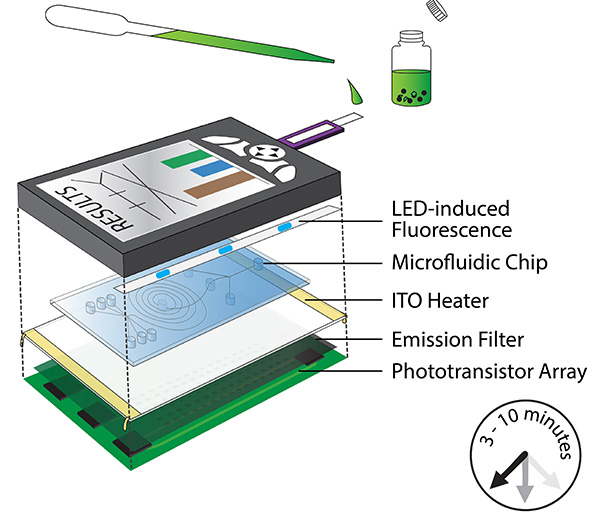
To provide regular analysis, the procedure has been lengthy and expensive, but scientific researchers at Canada’s University of Guelph have developed an apparatus that can identify allergens in a much shorter time span while being considerably more cost effective. The new allergen detector could expedite allergen reporting and possibly reduce the number of allergic reactions through more timely results.
Schematic of the biosensor for the rapid detection of food allergens. Image courtesy of BioNanoLab, University of Guelph.
Based on the ELISA (enzyme-linked immunosorbent assay) platform that is widely used in diagnostic labs to identify allergens, the new apparatus provides comparable accuracy. The technology has been miniaturized so that equipment is portable, about the size of an audiocassette case, and tests can be conducted on location instead of relying on a lab that may be far away.
An Allergen that Glows
In the case of peanuts, the scientists focused on a prominent allergen named Ara h 1, because it can be identified through non-radioactive fluorescence. Although there are other allergens in peanuts, they don’t share the same property by which they can be identified, as does Ara h 1.
The process requires a small amount of the suspected food to be liquefied in a suspension so that it can be injected using a filter syringe into a silicon-based plate, or chip, of microcapillaries. As the sample passes through tiny tubes of the microfluidic chip using capillary action, it travels through a beam of light from a LED source that is monitored by a specialized camera, which is also a product of the scientists’ work.
The image captures Ara h 1 protein particles that fluoresce when they come in contact with the chemical properties of the suspension. Currently, the camera records the data and sends it to a computer to be analyzed and deciphered with a result being provided within 20 minutes, compared to a conventional lab test that takes up to four hours after a sample has been received.
In a modification to provide an extremely portable system, research is underway to develop an app to enable results via a smartphone. Testing foods in the near future will be as convenient and prompt as holding the detector in one hand and a smartphone in the other so that a restaurant owner, for example, will be assured that dishes are allergen-free before being served to customers.
Imitating the Human System for Detection
To enable the allergen to fluoresce, the compound graphene oxide (GO) was utilized in combination with a bio-sensing component, known as an aptamer. The aptamer acts similarly to antibodies that identify and attach themselves to foreign and hostile elements that enter our blood system. Once a GO-aptamer mixture is attached to the allergen, the light source allows the protein particle to be detected and its image captured electronically.
By altering an aptamer’s composition to identify other allergens, such as gluten, the detector is a versatile piece of scientific equipment for identifying potentially hazardous food ingredients. The developers of the technology are confident that their discovery will change the future of identifying potentially hazardous food components. The final step in the allergen detector’s development seems to be fine tuning the detection process for certain processed foods, such as roasted peanuts, that can alter the composition of Ara H 1 making it less obvious to be identified.
This website uses cookies so that we can provide you with the best user experience possible. Cookie information is stored in your browser and performs functions such as recognising you when you return to our website and helping our team to understand which sections of the website you find most interesting and useful.
Strictly Necessary Cookies
Strictly Necessary Cookies should be enabled at all times so that we can save your preferences for these cookie settings.
We use tracking pixels that set your arrival time at our website, this is used as part of our anti-spam and security measures. Disabling this tracking pixel would disable some of our security measures, and is therefore considered necessary for the safe operation of the website. This tracking pixel is cleared from your system when you delete files in your history.
We also use cookies to store your preferences regarding the setting of 3rd Party Cookies.
If you visit and/or use the FST Training Calendar, cookies are used to store your search terms, and keep track of which records you have seen already. Without these cookies, the Training Calendar would not work.
If you disable this cookie, we will not be able to save your preferences. This means that every time you visit this website you will need to enable or disable cookies again.
Cookie Policy
A browser cookie is a small piece of data that is stored on your device to help websites and mobile apps remember things about you. Other technologies, including Web storage and identifiers associated with your device, may be used for similar purposes. In this policy, we say “cookies” to discuss all of these technologies.
Our Privacy Policy explains how we collect and use information from and about you when you use This website and certain other Innovative Publishing Co LLC services. This policy explains more about how we use cookies and your related choices.
How We Use Cookies
Data generated from cookies and other behavioral tracking technology is not made available to any outside parties, and is only used in the aggregate to make editorial decisions for the websites. Most browsers are initially set up to accept cookies, but you can reset your browser to refuse all cookies or to indicate when a cookie is being sent by visiting this Cookies Policy page. If your cookies are disabled in the browser, neither the tracking cookie nor the preference cookie is set, and you are in effect opted-out.
In other cases, our advertisers request to use third-party tracking to verify our ad delivery, or to remarket their products and/or services to you on other websites. You may opt-out of these tracking pixels by adjusting the Do Not Track settings in your browser, or by visiting the Network Advertising Initiative Opt Out page.
You have control over whether, how, and when cookies and other tracking technologies are installed on your devices. Although each browser is different, most browsers enable their users to access and edit their cookie preferences in their browser settings. The rejection or disabling of some cookies may impact certain features of the site or to cause some of the website’s services not to function properly.
Individuals may opt-out of 3rd Party Cookies used on IPC websites by adjusting your cookie preferences through this Cookie Preferences tool, or by setting web browser settings to refuse cookies and similar tracking mechanisms. Please note that web browsers operate using different identifiers. As such, you must adjust your settings in each web browser and for each computer or device on which you would like to opt-out on. Further, if you simply delete your cookies, you will need to remove cookies from your device after every visit to the websites. You may download a browser plugin that will help you maintain your opt-out choices by visiting www.aboutads.info/pmc. You may block cookies entirely by disabling cookie use in your browser or by setting your browser to ask for your permission before setting a cookie. Blocking cookies entirely may cause some websites to work incorrectly or less effectively.
The use of online tracking mechanisms by third parties is subject to those third parties’ own privacy policies, and not this Policy. If you prefer to prevent third parties from setting and accessing cookies on your computer, you may set your browser to block all cookies. Additionally, you may remove yourself from the targeted advertising of companies within the Network Advertising Initiative by opting out here, or of companies participating in the Digital Advertising Alliance program by opting out here.