Sangita Viswanathan, Former Editor-in-Chief, FoodSafetyTech

Pet Food Safety: Regulations and Challenges

By Sangita Viswanathan
No Comments
Sangita Viswanathan, Former Editor-in-Chief, FoodSafetyTech

Alan Baumfalk is Pet Food Safety Specialist and food safety Auditor at Eurofins US Foods Division. After more than three decades of experience in human food production facilities, Baumfalk began inspecting and auditing pet food companies with a fresh pair of eyes and in his opinion, “pet food plants typically are very well maintained, embrace technology, are highly automated, have great productivity and are very efficient with their sanitation and production.”

In an interview with Food Safety Tech, Baumfalk talks about differences in production of human food and pet food; lessons learned from historical incidents such as melamine in pet food and contaminated chicken jerky; what are some gaps in pet food safety he’s noticing and impact of the Food Safety Modernization Act or FSMA on this sector.

Food Safety Tech (FST): What are the differences between the production of human food and pet food?
Baumfalk: In most cases, pet food facilities are dry facilities, making kibbles and similar products, and their cleaning sanitation processes are mostly sweeping and dusting, with very little water involved. When it comes to regulations covering pet food facilities, most of these fall under FDA jurisdiction, and pet food facilities need to have in place risk-based HACCP plans to ensure food safety. Some of the challenges involved in pet foods are how do you do sensory testing on dry pet food or test for taste or consistency? Pet food testers look at certain quality attributes such as color, look, smell and taste of the product. They look for data such as amount of protein in the food etc. They also need to consider if humans – especially the elderly, or children – would consume the pet food product, because this can have many food safety implications.

FST: Humans have allergic reactions to certain food ingredients. Do pets have similar concerns of allergens?
Baumfalk: We don’t know if pets suffer allergic reactions to any specific food ingredients similar to humans. Pet food manufacturers are not subject to allergens and are exempt under FDA’s allergen management regulations. However, there are strict GMPs maintained in pet food production facilities, so that known allergens are identified. Pet food manufacturers give attention to allergens though they are exempt because it’s possible that the allergens could get transferred to a human in the house who could be allergic to nuts or soy, and this could be a huge problem. In our experience, we have seen that pet food can be occasionally consumed by a child or an elderly pet owner, out of curiosity.

FST: How about pathogens such as Salmonella and E.coli, are pets susceptible to these?
Baumfalk: Pets are not typically affected by pathogens such as Salmonella or E.coli, and this goes back to their genetic background, which is, dogs coming from wolves, and cats from tigers and lions. These animals are used to eating things with pathogens, fecal matter etc. However, humans are at risk of infection by Salmonella and E.coli, so while the end consumer of pet foods are not affected by these pathogens, their handlers are. Hence, pet foods are tested for Salmonella and E.coli to make sure they are pathogen free. They have Critical Control Points (CCPs) and kill-steps just like human foods, and pet foods are diligently sampled before they are released in the market. Environmental monitoring is also strictly carried out – such as extensive swabbing of processing floor, walls etc. to test for Salmonella/ E.coli/ mycotoxins etc. If a raw material exceeds FDA guidance for mycotoxins, then they are rejected. Many manufacturers test for mycotoxin levels in finished product as well.

FST: Are there differences in auditing pet food companies versus human food manufacturers?
Baumfalk: All pet food companies are looking to get certified and audited under a GFSI-recognized scheme. SQF is probably the biggest standard though some choose BRC. Eurofins has close ties with the American Feed industry Association (AFIA) which recommends SQF, and so we follow the same standard when auditing pet food facilities. SQF has modules specific to pet food category and dry pet food products. There are a lot of similarities with requirements for human food – for instance, pest control within a pet food plant is the same as within a human plant. The commitment and requirement for compliance is the same.

FST: What are some gaps or challenges in pet food safety?
Baumfalk: Most of the folks working in the pet food industry have a background in human food and are very much aware of the technical and regulatory requirements for making human food, so they end up carrying it over to pet food production. They typically follow GMPs and HACCP, and safety plans to ensure there are no food safety gaps. While most pet food companies meet, or even exceed, compliance requirements, there are always some people in the industry that don’t get the message.

FST: When we think about pet food safety, the history of melamine contamination of pet food, and tainted chicken jerky from China come to mind. What are lessons learned and how can the pet food industry be prepared for the unknown?
Baumfalk: The melamine adulteration and chicken jerky contamination incidents have taught the industry to be on guard. The industry has to make sure that they are in close alignment with their industry association which speaks for them, read technical documents, hire and train knowledgeable staff – all of which helps constantly look for the next thing that we weren’t aware of. Apart from diligently monitoring the global supply chain, it would help to have strict audit specifications for global suppliers. If something is coming from the other part of the world, where there’s a history of food safety standards not always being up to par, the pet food industry needs to make sure to buy only from a known and approved entity. Also look for lessons that can be learned from the human foods industry. Read about recalls and withdrawals and find out why that happened, if the pet food industry has similar exposure, and how this can be addressed.

FST: What will be the impact of the proposed pet food safety rule under FSMA be on this industry?
Baumfalk: FSMA is going to tighten things up, paying a lot of attention to the global supply chain and any vulnerabilities. While regulations are still being finalized, the pet food industry is already aligning itself with these proposed regulations. The technical and regulatory folks in the industry are following it; they are reading food safety journals and interacting with their associations for guidance and for making comments on the regulations. We are also updating our auditing checklists to see how we can align better with new FSMA requirements.

For more information on Eurofins, it’s pet food and auditing capabilities, click here.

5 Tips for Conducting a Successful Internal Audit

By Michael Biros
No Comments

A strong internal audit program will help drive continuous improvement, promote a food safety culture within the organization, and help improve the external audit score.

Beyond achieving compliance with the SQF program requirements, internal audits help drive continuous improvement and can facilitate a food safety culture throughout all levels of an organization. Gary Smith, Senior Technical Director at SAI Global, discusses 5 key factors to successfully conducting an internal audit.

What is the SQF Standard: Item 2.5.7 Internal Audit?

This requirement includes methods and responsibilities for scheduling and conducting internal audits to verify the effectiveness of the SQF system including facility and equipment inspections, PRPs, food safety plans, food quality plans, and regulation controls. Companies must have an internal audit schedule with scope and frequency and records of internal audits, corrections, and corrective actions. The internal audit must be conducted by staff trained in internal audit procedures and the audit results must be communicated to relevant management.

In the SQF program, a major nonconformance indicates a systematic failure where an element is failing or not existing. Some common major nonconformances include not having a schedule of internal audits, having verification and validation activities defined but not having an internal audit program, not having a facilitator for an internal audit program assigned, and having the internal audit only cover GMPs, but not the SQF system. Some of the minor nonconformances include not having an internal auditor training for the lead auditor, not defining how results are to be communicated to leadership, not taking corrective actions for internal audits, or not having records of corrective actions.

5 Keys to Success

  1. Reach out to leadership. Work with your leadership to define objectives of the internal audit program with management to facilitate management commitment. Build the internal audit program with management objectives. Remember, it’s not the QA’s program certification, it’s the entire company’s.
  2. Formalize the audit process. Set an audit schedule and keep to it. Assign an audit team with responsibilities. Use an audit checklist. Develop an audit plan. Conduct interviews during the audit. Conduct opening and closing meetings with staff.
  3. Communicate well. Regularly provide updates to leadership at routine meetings. Provide the audit plan and checklist to auditees one week prior to the audit. Take photos of good practices and nonconformances. Provide the audit results in a timely manner.
  4. Manage internal audits as its own program. Have standard operating procedures describing the responsibilities and procedures. Have the facilitator be trained as a lead auditor and appropriate training for all team members. Include as many people as possible in the audit team from all departments within the company.
  5. Use corrective action management program for all internal audit findings. Keep an internal log of all your internal nonconformances. Use root cause analysis to understand why nonconformances occur and include internal audit findings, regulatory audit findings, nonconforming products, and customer complaints in the corrective action management plan.

A strong internal audit program will help drive continuous improvement. It will help promote ownership of the entire SQF system and promote a food safety culture within the organization. Lastly, a strong internal audit program can improve the external audit score.

For more information, see this archived webinar: SQF 5 Tips for Conducting a Successful Internal Audit 

Traceability Requirements and Best Practices

By Michael Biros
No Comments

What is a traceability system and how is it related to a recall plan? Will FDA require electronic record-keeping? What does FSMA require FDA and industry to do in terms of traceability? These questions and more are answered by The Acheson Group in the latest FSMA Fridays webinar.

What are the latest updates on FSMA?
In response to the substantive nature of the public comments, FDA plans on proposing new versions of the Preventative Controls Rules for Humans and Animals.

The proposed Preventative Control rule requires a recall plan. Is traceability covered through mock recalls?
A recall plan and a mock recall are not the same as a traceability system. A traceability system focuses on the ability to know what came in from where and where it was sent. A mock recall is a much more involved process that looks at production records and many other factors. However, in order to do a robust recall, you need a functional traceability system. The Preventative Control rule requires a recall plan and other parts of FSMA require traceability systems. The two are related, but they are fundamentally different.

How does FSMA address traceability and why is traceability a part of FSMA?
Traceability is distinct from a recall plan and FDA will have to address it separately from the Preventative Controls requirements. Traceability is covered in Section 204 of FSMA which describes the detection and response to food safety problems. While there’s an element of prevention in having a good traceability system, it really focuses on the response side. Traceability continues to be an Achilles’ heel for the regulators. Many of the statute components that are built into FSMA are based on prior experiences and situations. The biggest debacle with traceability was the tomato/pepper issue in 2008 where not only was the commodity wrongly identified, but it took close to eight weeks to figure out that it was wrong.

In this instance, FDA struggled with not having adequate records and being able to do the traceability components correctly and quickly. This and other similar issues has caused the food safety pendulum to swing.

Traceability is essential. FDA would love for the traceability requirements to be more robust, but they are limited by what is economically feasible and practical. Looking to the future, it’s entirely reasonable that traceability requirements could be strengthened.

What does FSMA require FDA to do in terms of traceability?
Pre-FSMA, there are record-keeping requirements in place related to traceability coming from the Bioterrorism Act. Basically, the current requirements are one-up, one-down: where did you get the product from, where did you send the product to? In developing the traceability requirements of FSMA, Congress required FDA to conduct pilot studies to determine what practices and technologies work and what doesn’t. FDA also needed to look at the cost/benefit related to technology and changes in traceability systems and what was current practice both domestically and internationally. FDA has the authority through FSMA to require additional records be kept for high risk foods. We expect FDA to issue a proposed regulation for traceability and record-keeping with high risk foods sometime in the future.

What did the traceability pilots recommend and are those recommendations now in effect?
Ten recommendations were made to FDA based on the results of the pilot studies and stakeholder input. The first recommendation was that all foods should be designated as traceable, not just those that are designated as high risk. Another recommendation was that FDA should accept electronic records rather than going in person and getting photocopies and that FDA should develop a system for processing traceability data. It was also recommended that FDA work collaboratively with industry. Over the past few years, there have been several industry led efforts with varying levels of adoption that are generally moving towards standardized and electronic records-keeping systems. Finally, it was recommended that FDA identify subject matter experts to help the agency understand specific industries for when there is an issue with the supply chain.

None of these recommendations are currently in effect because FDA hasn’t released a proposed rule yet and is still reviewing the report and public comments. The full report is available for the public to view, but ultimately it is up to FDA whether they accept the recommendations and if/how they put them into regulation.

Will FDA require electronic record-keeping?
The agency does not have the statutory authority to require companies to use electronic record-keeping. FDA recognizes that electronic record-keeping is the way of the future and prefers it, but they cannot require it. They will let companies keep their records how they want as long as they can be produced within 24 hours if requested.

What should companies do today to prepare and what do you think FDA will do next?
Companies should read the IFT report, read the recommendations, and consider how they would have fared if they participated in the pilot studies. They should give some critical thought to how they would perform if there was an outbreak and they were the focus of a traceability study. Traceability is a byproduct of good record-keeping. If a company has an opportunity to make improvements, consider how traceability can factor in to those changes. Companies should talk to supply partners and understand the whole supply chain. Ultimately, the company is connected to all the other links in the supply chain and any one of those links can impact you.

Why GFSI? And How Can It Help?

By Jennifer Brusco
No Comments

The Global Food Safety Initiative or GFSI, simply explained, is a business-to-business Food Safety and Modernization Act (FSMA). It operates quietly and privately within the marketplace between the customers and their suppliers. It operates on not only a global basis, but also on a regional and local basis.

“Although people look at the [GFSI] program and see a lot of multinational corporate logos, frankly the majority of our operations are small and medium size facilities at the local level. So we welcome facilities of all natures – large, medium, and small, across the food to fork continuum,” Karil Kochenderfer, North American representative, GFSI, said during a recent webinar.

GFSI has approximately 25 benchmarked guidances, with some of the latest scope expansions include:

  • Packaging and animal conversion – August 2011;
  • Animal feed – June 2012;
  • Storage and distribution – October 2013;
  • Food brokerage/agents, retail/wholesale – early 2014; and
  • Catering, equipment manufacturing, food safety services – 2015.

Where are these guidances coming from? How can you be sure that these guidelines are science-based, risk-based, and address the issues in your plant/facility?

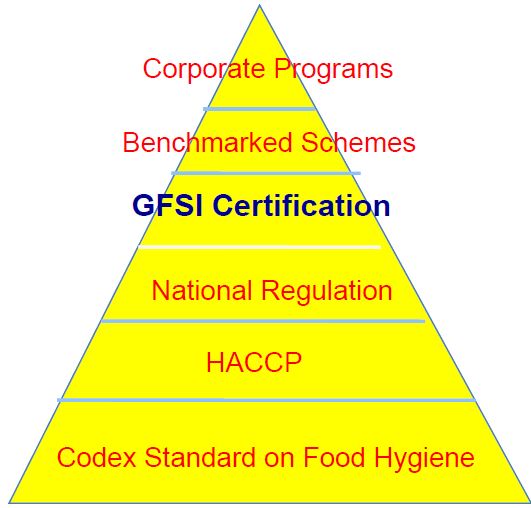
Why-GFSI-June2014At the very base of our efforts that are ensconced within these guidance on a sector by sector basis, are the international standards of science based within the Codex Standard on Food Hygiene. On top of that are Hazard Analysis and Critical Control Points or HACCP standards. Above HACCP are National Regulations, which includes FSMA in the U.S. and the Safe Food for Canadians Act in Canada. In Europe it’s something different, in Japan it’s something different, but all have iterative levels of science-based regulation in place to ensure the safest control of the food and management of the food. Above National Regulation is GFSI Certification.

“We go above and beyond the science of Codex, HACCP, and national regulation to perform at the highest level of industry. And our benchmarked schemes [eg. BRC Global Standards (BRC), Food Safety System Certification (FSSC 22000), International Featured Standards (IFS)] go beyond us and corporate programs go even further,” Kochenderfer highlighted.So what you have are several layers of protection that will help protect both consumers and companies.

What are some of the shared benefits for industry?

There are several benefits, which include:

  • Meet the requirements for one, meet the requirements for all;
  • Reduce duplication of audits;
  • Have comparable audit approach and outcomes;
  • Ensure the continuous improvement and customer opportunity for those GFSI-benchmarked companies;
  • Enhance trade opportunities;
  • Improve customer confidence in food safety; and
  • Gain cost efficiencies throughout the supply chain.

“We have now built confidence in third-party certification because we have reduced inefficiency in the food system. Now, it’s ‘Once Certified, Accepted Everywhere,'” stated Kochenderfer.

John Kukoly, Director of BRC in the Americas, added that companies should pursue GFSI certification for a number of reasons:

  • Customer mandate;
  • FSMA;
  • Nearly a 40 percent reduction in product non-conformance;
  • Competitiveness; and
  • Superiority in the market.

Right now, only a third of the industry has achieved GFSI certification, which leaves the remaining two-thirds either still at the starting line or just a few steps into their journey. How do you choose a GFSI-recognized scheme and get started?

Karil Kochenderfer shared a chart to allow users to see where they fall on the farm-to-fork continuum and further determine which scheme(s) would work for them.

Further, we have developed four GFSI checklists for the four major schemes that apply to food manufacturers, co-produced with the respective scheme owners to ensure accuracy and usability. The checklists are complimentary and may serve as a great resource on your journey toward GFSI certification.

Additional Resources:

FDA Access to Records Under FSMA

By Michael Biros
No Comments

What are the latest updates with FSMA and how has FDA’s access to records changed? Dr. David Acheson of The Acheson Group gives us the latest.

When it comes to latest updates regarding FSMA, the comment period on the proposed sanitary transportation rule has been extended to July 30, 2014.

What does FSMA change in terms of FDA access to records?

Before FSMA, FDA needed reasonable proof that a food would be adulterated and a threat of serious adverse health consequences or death to humans or animals (SAHCODHA) in order to access records.

Now, FDA needs reasonable probability that the use or exposure to a food, or any other articles of food that FDA believes is likely to be affected in a similar manner, would cause serious adverse health consequences. What FDA considers to be a reasonable probability will be determined on a case-by-case basis. These changes significantly expand the scope of what FDA can look at and lowers the threshold for records access.

Does FDA need to issue a formal request?

Formerly, FDA needed to invoke the Bioterrorism Act in order to gain access to records. This was a cumbersome process that required strict criteria to be met.

Currently under FSMA, FDA must provide written notice of what they are asking for. This documentation will be delivered by a credentialed FDA official.

Generally, access to records must be given as quickly as possible within 24 hours of the request. The records do not need to be in any particular format. Electronic records are still considered on-site records so long as they can be accessed from within the facility.

What can FDA ask for?

FDA has produced guidance documents that lists what they can ask for. FDA can request access to manufacturing records, ingredients receipt records, product distribution records, product inventory records, test records, recall records, reportable food records, customer distribution lists, and complaint/adverse event records.

There are some exceptions. FDA cannot request personnel records, financial records, recipes, some records from farms, and some records from restaurants.

How will FDA maintain the confidentiality of any protected information in records it obtains?

While some of these records may be accessible through the Freedom of Information Act (FOIA), FDA is responsible to protect and redact commercial confidential information in accordance with their own requirements. However, some of this sensitive information can be shared with other federal, state, local, and foreign authorities.

For more information, click here to see archived FSMA Fridays webinars, organized by SafetyChain Software

Marijuana Edibles: A Regulatory Nightmare

By Aaron G. Biros
No Comments

With an estimated 8 million to 12 million servings of edible marijuana already sold in Colorado, there is cause for concern over food safety testing, and how manufacturers will tackle challenges like regulatory compliance and quality assurance.

When Colorado made history this year by legalizing recreational marijuana use, lawmakers were tasked with creating a regulatory framework for the production, sale, and use of the previously illegal substance. While Colorado has addressed issues such as taxation and cultivation of the plant, the state has struggled to provide clear guidelines for food safety, testing, and lab certification regarding marijuana edibles, causing difficulties for regulators and manufacturers alike.

Federally, USDA and FDA are reluctant to regulate the nascent industry because marijuana is still considered a Schedule I narcotic by the DEA. The Colorado Department of Public Health and Environment is unwilling to regulate marijuana edibles out of fear of jeopardizing their federal funding.

In lieu of the Department of Public Health and Environment’s oversight, the state allows the Marijuana Enforcement Division, under the Department of Revenue, to handle food safety and lab certification. It appears this regulatory agency may be in over its head as concerns grow over potency testing and labeling in the wake of two deaths allegedly involving the overconsumption of marijuana edibles. Adding insult to injury, the Denver Department of Environmental Health cited 58 violations at 24 edible marijuana establishments this past month.

Still, with an estimated 8 million to 12 million servings of edible marijuana already sold in Colorado, there is an immediate cause for concern in food safety testing. As the edible marijuana industry grows, so do worries over how manufacturers will tackle challenges like regulatory compliance and quality assurance.

Ben Pascal, Co-Founder and Chief Business Officer of Invisible Sentinel, feels that there is a lot more the government should be doing right now. “This is a growing trend that will continue in the United States; these products will continue to gain market share and there should be some sort of guidance on how and when to regulate the safety of these products,” explains Pascal.

Invisible-Sentinel-June-2014
Invisible Sentinel’s rapid molecular diagnostics product, Veriflow, can help address some the concerns around risk in conducting testing for marijuana edibles,” says Ben Pascal.

With a rapidly growing industry, more producers of pot edibles are finding it harder to meet regulatory compliance goals. “Larger accredited labs in the US find that there is risk in conducting testing for marijuana edibles,” says Pascal. He believes that Invisible Sentinel’s rapid molecular diagnostics product,Veriflow, can help solve some of these issues.

“We make molecular testing more accessible with low cost, ease of use, robust technology, and the ability to bring all of this testing in-house, helping to eliminate risk factors for clients,” describes Pascal. While Veriflow has the capability to alleviate some quality assurance worries, Pascal points to the lack of regulatory oversight as the main issue.

“If you are not going to be regulated by the federal government, holding you to a safety standard, then smaller groups will not make the proper investments to ensure the safety of their product,” Pascal explains. “It is not about cost, it is about the lack of education and knowledge surrounding the implications of food safety issues in this industry.”

After some of these smaller regulatory hurdles are cleared within the state, then we can start to look toward future food safety standards in the marijuana edibles industry on a national level. Colorado’s experiment in legalization foreshadows some of the issues we will face when marijuana is accepted at a federal level.

As this trend continues, we should act preemptively to alleviate regulatory headaches before they are exacerbated, Pascal adds. The nation’s agencies need to be ready to embrace the legalization of marijuana and related food products in order to prevent real safety issues from surfacing.

Sangita Viswanathan, Former Editor-in-Chief, FoodSafetyTech

Food Safety Training: Trends and Gaps

By Sangita Viswanathan
No Comments
Sangita Viswanathan, Former Editor-in-Chief, FoodSafetyTech

With new regulations demanding more testing, consumer preferences and cost pressures creating global supply chains and markets demanding faster distribution, what are some of the demands on the food safety testing market? In this Q&A, 3M Food Safety Division’s Technical Service Director Nancy H. Eggink talks about trends and concerns when it comes to food safety testing and training. 

Food Safety Tech (FST): What are some big shifts/ trends in food safety testing that you are noticing?

Nancy Eggink: Not necessarily big shifts, but customers still are looking for easy to use tests that provide fast accurate results, The target lists are broadening (microorganisms & allergens), and the sample matrices more and more complex. Following R&D trends, nutraceuticals, unique flavors and novel processing are changing the foods, environments, and ultimately the testing needs. Currently available, and future tests must be able to accommodate these sample matrices and the innovations as they are commercialized.

FST: Given the evolving food safety regulations, how are educational and training needs for food labs managers and testing changing?

Eggink: When considering GFSI schemes and FSMA, the requirements indicate competencies and what constitutes a ‘qualified individual’. So now, it’s not just a requirement to have a training program and adhere to what the training program includes. It is a requirement to lay out competencies that an individual must have after training. This indicates the training should be developed to ensure it’s effective in delivering the appropriate content in a way the learner will develop a competency, and also it should be verified through an assessment process to ensure the competency was developed.

FST: What are some of the gaps in food safety testing that need to be addressed?

Eggink: Food industry leaders are looking for ways to ensure that they have fast accurate information to make the best possible decision at each step in the process. Without compromising accuracy and reliability, opportunities are those that make testing easier to use, provide faster results and improve productivity.

FST: What are areas of training that clients are seeking out the most? And why?

Eggink: With all the guidance and requirements available, it’s easy to get consumed with keeping up on the changes happening constantly. Our customers are looking to 3M Food Safety for training on how to effectively use our solutions so to ensure they have fast accurate information to make the best possible decisions. Our customers are seeking effective and efficient ways of staying current in their professional life that fits into their work demands, and we have a key initiative to provide them with access to high quality educational content and scientific information. This educational content will be offered in the form of hands-on product training, live seminars, on-line self-study and webinars to help them with their current and potential future challenges.

FST: What impact will lab accreditation have on food safety testing and methodology?

Eggink: Lab accreditation is similar to the GFSI schemes and FSMA in the sense it is development and implementation of a quality system within the laboratory operation to ensure predictable outcomes. Specifically, minimize the variation between the technology, processes, samples, technicians, tools, environment and ensure safety. Standardization of training & education is a critical component within that quality system to ensure consistency within that system.

FST: Specifically about 3M Food safety – what are your focus areas in terms of new products, testing solutions?

Eggink: Global regulations are changing and Microbiology labs are faced with considerable challenges including but not limited to rapid results, increasing volume of work, cost constraints and increasing customer, media and regulatory scrutiny. Our focus is to provide solutions in the food diagnostics testing market to address these needs at all levels and penetrate local markets and geographies. Pathogens are a real threat to public health, and we have recently launched an additional assay to our Molecular Detection System (Listeria monocytogenes), while working to ensure all assays have third party certifications against reference methods such as AOAC and AFNOR.

We also continue to innovate with Petrifilm™ Plates. Petrifilm™ Salmonella Express System provides a qualitative confirmed Salmonella result in as little as 44 hours which is two times faster than agar methods. The newest solution is Petrifilm™ Rapid Yeast and Mold Plate that provides quantitative Yeast and Mold counts at 48 hours. As customers ask for easy to use, faster results that don’t compromise accuracy and reliability, we will continue to innovate to meet those needs.

Barbara Levin, SVP of Marketing & Customer Community, SafetyChain Software

What is True Food Safety Audit Readiness… and How Can Automation Help?

By Sangita Viswanathan
No Comments
Barbara Levin, SVP of Marketing & Customer Community, SafetyChain Software

Barbara Levin, Senior Vice President and Co-Founder of SafetyChain Software, shared her thoughts during a recent interview with Food Safety Tech

Food Safety Tech (FST): Why are food safety audits such a hot topic of conversation?

Barbara Levin: Audits are a critical component of any food safety plan, and I’ve never heard food safety and quality assurance (FSQA) folks disagree with that assumption. But between regulatory, 3rd party standards such as GFSI, customer and internal audits – most of which are still very manual processes – audit preparation and response have become a huge manual burden that can be highly disruptive to operations. And while all audits has some commonalities, each has its own specific requirements as well, adding to the challenge. 

In conversations with our clients at SafetyChain, we have heard of companies that have as many as 300 audits a year! So it’s a struggle to manage these audits while also having to get product out on time, within operational Key Performance Indicators, and of course meeting safety and quality requirements. This is why we’re also hearing more about technology solutions that can help companies be audit ready. But whether or not a particular solution is right for your company depends on how you define audit readiness. 

FST: Before we discuss the definition of audit readiness, you mentioned that each type of audit has its own requirements – can you highlight some of these?

Levin: Let’s begin with what all of the audit types have in common – which fall in to four areas: 

  • First, you have to say what you do – all of your SOPs, PRPs, GMPs, HACCP/HARPC components, etc. 
  • Second, you have to verify that you do what you say. 
  • Third, you have to validate that it works. 
  • And last, you have to ensure that everything is documented. 

On top of these commonalities, each audit type has some specific requirements. For example:  

With regulatory audits, USDA can ask for pre-shipment reviews, while FDA can do unannounced audits with just a two hour notice.  

  • With the GFSI schemes, you have to have an approved vendor program and be able to demonstrate management commitment and continuous improvement. And of course everyone is talking about the upcoming SQF unannounced audits, which, I personally think, is something that the industry should embrace.
  • With customer audits, it’s not just about safety, but also quality attributes such as weight, moisture or salt content to name just a few.
  • And internal audits can be the hardest of all as many of the above elements, among others, can get combined. 

FST: Given this wide range of requirements, what then, do you mean, when you say “true audit readiness?”

Levin: When you hear people talk about audit readiness, and audit automation solutions, the conversation is often focused on documentation – the ability to produce electronic records. And this is of course an important component of being audit ready. But in my view, true audit readiness goes far beyond documentation. It should also mean that you have the tools and processes in place to ensure that you actually PASS your audits with flying colors! It means that food safety systems have been consistently and diligently followed across all facilities; you have a robust supplier compliance program; non-conformances are caught at the earliest point possible, and CAPAs have been put in place; you have easy access to data for continuous improvement; and everything is documented. In other words, it’s not enough to just show that the paper has been gathered for the audit – but that you are doing the right things for food safety every single day. And if we’re talking about audit automation technology – these solutions should support all of these components.

FST: How can companies assess if they’re truly audit ready?

Levin: Here are some basic questions FSQA teams should ask themselves:  

  • Are we 100 percent sure that all SOPs, CCPs, PRPs, GMPs, etc., are current and being carried out, and that we can easily access verifying documentation?
  • Do we have a robust supplier compliance program to ensure vendors are meeting our safety and quality requirements? Can we easily access all of those records?
  • Are we getting non-conformance alerts in a timely manner to take corrective/preventive actions before product goes in to commerce? Can we easily access proof of CAPAs?
  • Do we have easy access to all of the data required for trending, hazard analysis and continuous improvement? 

There can be three answers to these questions: Yes, No and Hmmmmm. If you’ve had one or more No’s or Hmmms… chances are you may not be as audit ready as possible. 

FST: What are then the challenges to being truly audit-ready?

Levin: I would list the biggest challenges with being audit ready as falling into four key areas:

  1. The volume of forms, records and paper that needs to be current, managed, easily accessed and actionable – meaning the data from these records can be trended for continuous improvement;
  2. Ensuring that all food safety programs are being carried out correctly and consistently – including the ability to catch problems at the earliest point possible, put a corrective/preventive action in place and make sure that all of that is documented;
  3. Management of supplier compliance (are you sure your suppliers are following all of your requirements?) and approved vendor program management; and
  4. The amount of time it takes to prepare for audits – especially as unannounced audits become more prevalent. 

FST: How can automation help with these challenges?

Levin: Technology solution that helps companies be audit ready must go beyond document management. They have to integrate supplier/vendor management; food safety and quality program management – HACCP and HARPC programs, for example; process management and workflow; GFSI program compliance; and, of course, ensure that all records and documentation is available in a central repository for trending, continuous improvement and of course audit readiness.

These solutions should automate, streamline and improve FSQA. And the final result has to be that actionable data – across all products and facilities – that allows you to find ways to improve processes, put preventive controls in place and make continuous improvement an inherent part of company’s overall food safety culture. Audit readiness then becomes the benefit – not just the goal. 

If you are using a cloud based FSQA automation solution – with roles-based security – automation can provide the kind of transparency and visibility that can actually reduce the amount of audits a company has by allowing suppliers, auditors and customers to view various slices of data. For example auditors might see non-conformances and the documented CAPA; a customer could see a finished product review; and a supplier can see that their Certificate of Analysis was received and met specifications. That’s a true change in traditional culture, but we’re seeing it more and more. 

Food companies need to remember that auditors do not expect to see that everything thing was perfect all the time. But what they do want to see is that a problem was found in a timely manner and that it was fixed before the product went into commerce. Bottom line? Automation can help food and beverage companies say what they do, do what they say, make sure it works and make sure it’s documented and actionable. And when all of this information is easily organized by the type of audit – and cloud-based – companies can be audit-ready on-demand! 

Click here to read Barbara Levin’s paper on how to be audit ready, on-demand with Food Safety Chain Management Systems.

Ask the Compliance Expert: Unannounced Audits

By Sangita Viswanathan
No Comments

Do you know when your next unannounced audit will be? And can a site refuse entry to an auditor? In this Q&A, Jane Pappin of Cert-ID provides some answers.

Food companies are now handling and preparing for increased number of inspections and audits. Food safety rules under the Food Safety Modernization Act have proposed unannounced audits of food facilities as a way to include another level of security to ensure that these facilities are compliant with the various standards. Such audits, regulators hope, will give a more realistic picture of compliance, rather than facilities appearing to comply just the day of the inspection.

Food companies that have been abiding by all the requirements of the specific food safety standard don’t have to do anything differently than what they have been doing all along, says Jane Pappin, Certification Director at Cert-ID: “If they have a strong food safety and quality management program in place, have been conducting regular internal audits, and gap analysis etc., they shouldn’t have anything to worry about. The auditor is not going ask anything that they would be unprepared for,” she adds.

We present below excerpts from a Q&A with Pappin.

Q: How will my site know if our next audit is unannounced or not?

A: SQF has indicated that the Certification Body (CB) is responsible for telling the site when their unannounced audit will be. As the CB is charged with reminding the site of their upcoming renewal audit approximately three to five months in advance of the re-audit due date, the site could be informed then.

Once the site is told when their unannounced audit will be, there is opportunity to negotiate black-out dates – these are only for days when the site will not be in production. The unannounced audit will always take place within the site’s renewal audit window, which is from 30 days before the site’s re-audit due date (which is listed on your certificate) to 30 days after the re-audit due date. 

A site must have one unannounced audit per three-year cycle. For those sites already certified, their first unannounced audit will take place either in 2014 (from July 3 to Dec 31), 2015 or 2016 and they will be informed by their CB which year it will be in. Their second unannounced audit will take place in either 2017, 2018 or 2019, and so on. Once your unannounced audit year is determined, this will be recorded in SQF’s Reliance Database. Even if you change CBs, this information will go with your facility’s profile and your unannounced audit year will not change.

Q: What happens if the auditor arrives for the unannounced audit and the site refuses entry?

A: The ramifications of disallowing the auditor entry to your facility are far reaching: First, you will still be charged for the visit, including auditor expenses. Second, your facility will immediately be put into suspension. Third, an announced audit must now take place no later than 30 days from the date you denied entry to the auditor. If this doesn’t happen, your certification will be withdrawn. Fourth, because you were put into suspension, you will also be required to have a surveillance audit six months after the 30 day audit. Fifth and last, your next audit will then be your unannounced audit.

What’s Changing with Nutritional Labeling and Serving Sizes?

By Michael Biros
No Comments

Bailey Pudenz, Nutritional Coordinator at Eurofins Nutrition Analysis Center, explains what the proposed changes are, and how the labeling would need to change under the new requirements.

FDA has proposed changes to the current nutritional labeling. Currently both the proposed nutritional labeling and serving size rules are in comment period which will close June 2, 2014. Once the final rule is published, it will become law 60 days after the publication date. Industry will then have two years to achieve compliance.

Calories

Calories, calories from saturated fat, the 2000 calorie reference, and percent daily value for calories will remain the same. However, calories from fat will be removed completely. FDA wants consumers to be more aware of the amount and type of fat they eat rather than the calories the fat contributes.

Fat

Total fat, saturated fat, trans fat, poly and monounsaturated fat, and cholesterol will remain the same. FDA considered changing the cutoff value for declaration of zero trans fat, but they have chosen not to change this either. Currently this value is 0.5g per serving. Anything less than this can be declared as zero. FDA is not allowing mandatory or voluntary declaration of the omega-3 fatty acids, EPA and DHA.

Carbohydrates

There are no proposed changes to mandatory declaration or daily reference value for total carbohydrates. However, FDA has proposed changing the name to total carbs. Other carbohydrates, such as starches, are no longer allowed to be voluntarily declared on the label.

FDA is also proposing to change the calories from carbohydrates calculation. The calories from carbohydrates would then be used to calculate the total calorie content in the product. This proposal would exclude soluble and insoluble non-digestible carbohydrates from the calculation. Calories from carbohydrates would then be calculated using 4kcal/g less the amount of non-digestible carbohydrates. Soluble carbohydrates will then be added at a value of 2 kcal/g.

Sugars

There are no proposed changes to mandatory declaration or daily reference value for sugars. However, the name will be changed to total sugars and and a new category of added sugars will be mandatory to declare. FDA has developed an extensive list of what is considered an added sugar: brown sugar, corn sweetener, corn syrup, dextrose, fructose, fruit juice concentrate, glucose, high fructose corn syrup, honey, lactose, maltose, malt sugar, molasses, raw sugar, turbinado, sugar, and sucrose. FDA acknowledges that there is no analytical method available to determine added sugars and will rely on ingredient records to determine the amount and type of added sugars. There are no proposed changes to sugar alcohols.

Dietary fiber

Dietary fiber will still be mandatory to declare, however FDA is proposing to increase the daily reference value to 28g per day. They will adopt the Institute of Medicine’s definition of total fiber which focuses on fiber that is beneficial to human health. There are no proposed changes to soluble or insoluble dietary fiber. 

Protein and Sodium

There are no proposed changes to protein. Sodium is still mandatory to list and FDA is considering lowering the daily reference value from 2400mg to 2300mg.

Essential Vitamins

Vitamins A and C will no longer be mandatory to declare on the label, but can still be voluntarily listed. Vitamin D will be mandatory to declare. FDA has proposed changing the units for vitamin A from IU to µg RAE (Retinol Activity Equivalents) and for vitamin D from IU to µg.

Vitamin K, vitamin B6, vitamin B12, thiamin, riboflavin, biotin, and pantothenic acid will still be voluntary to declare. FDA is proposing the voluntary labeling of choline. The units for vitamin E will be changed from IU to mg. Folate/folic acid will still be voluntary, but they will no longer be interchangeable and the units will be changed from µg to µg DFE (Dietary Folate Equivalents). Niacin is still voluntary to declare, but the units will be changed from mg to mg NE (Niacin Equivalents).

Vitamins
Current RDIs
Proposed RDIs
Biotin
300 µg
30 µg
Choline
550 µg
550 µg
Folate 
400 µg
400 µg DFE
Niacin 
20 mg  
16 mg NE
Pantothenic Acid 
10 mg  
5 mg 
Riboflavin 
1.7 mg 
1.3 mg 
Thiamin 
1.5 mg 
1.2 mg
Vitamin A 
5000 IU 
900 µg RAE
Vitamin B6 
2.0 mg 
1.7 mg
Vitamin B12 
6 µg 
2.4 µg
Vitamin C 
60 mg 
90 mg
Vitamin D 
400 IU 
20 µg
Vitamin E 
30 IU 
15 mg
Vitamin K 
80 µg 
120 µg

Essential minerals

Calcium and iron will both remain mandatory to declare. It will be required to declare potassium. 

Phosphorus, iodine, magnesium, zinc, selenium, copper, manganese, chromium, molybdenum, and chloride will still be voluntary to declare. Fluoride will be voluntary to declare and FDA is not defining a daily reference value. 

Minerals
Current RDIs
Proposed RDIs
Calcium
1000 mg
1300 mg
Chloride
3400 mg
2300 mg
Chromium
120 µg
35 µg
Copper
2.0 mg
0.9 mg
Iodine
150 µg
150 µg
Iron
18 mg
18 mg
Magnesium
400 mg
420 mg
Manganese
2.0 mg
2.3 mg
Molybendum
75 µg
45 µg
Phosphorus
1000 mg
1250 mg
Potassium
3500 mg
4700 mg
Selenium
70 µg
55 µg
Zinc
15 mg
11 mg

Serving sizes

Changes to RACCs (Reference Amount Customarily Consumed) were proposed if consumption data increased or decreased by 25 percent or more. Based on this, about 17 percent of the RACCs will change. FDA will also be adding 25 new RACC categories. Changes in the RACC can potentially change claims such as “low fat” or “a good source of calcium.”

FDA has proposed specifications for how to determine servings per container. Products containing 200 percent or less than the RACC are considered a single serving. Products containing 200-400 percent of the RACC can be labeled with dual columns (single serving and per container). Products with more than 400 percent of the RACC are multi-serving.


Nutrition Labels – Old and New
Nutrition-Label-Old-May-2014 Nutrition-Label-New-May-2014

Formatting

Calories and servings per container will be increased in size. The location of servings per container and serving size will be switched. Serving size will be right justified. The phrasing of amount per serving will be changed to include the serving size. Calories from fat will be removed. Percent daily value will be located on the left side of the label. Added sugars will be included below sugars. Mandatory vitamins and minerals will have quantitative amounts in addition to percent daily value. FDA is requesting comments on how the footnotes should be adjusted.