


While we are in the middle of another massive food recall exercise, many people are dreading having to implement a food traceability system as designed by the FDA in response to Food Safety Modernization Act requirements. The FDA, after smoking some whacky weed, has burdened the food industry with a “well thought out” set of traceability rules. Currently being delayed due to a lack of understanding, some traceability rules must surely be devised and implemented prior to the demise of the FDA regardless of how burdensome they might be.
The Goal: Create and tie lot codes to Key Data Elements (KDEs) at Critical Tracking Events (CTEs).
Food traceability is critical to the survival of innocent companies and products when the recall monster raises its head.
With so much confusion over the FDA’s FSMA food traceability requirements, companies need to begin considering standardization. This is especially true for companies with long supplier lines.
Take for instance tomato sauce. Boiled tomatoes may have salt, basil, garlic and other ingredients added during the cooking process and prior to bottling and labeling the sauce. The FDA Food Traceability List below includes tomatoes and fresh herbs (basil, parsley and garlic) that are, in this case, input in a raw form prior to the cooking process. All require identification of the specific harvest location, time and traceability lot number and all fall within traceability requirements. From harvest, through cooling, into sorting, etc. these ingredients must be tracked. A hundred cases of tomatoes harvested from the same field on the same day may be divided and shipped to five or more locations including distribution centers, stores or a farmer’s market.
For the tomato sauce under consideration, a kill step (cooking) is involved meaning that these Food Traceability List (FTL Table 1) ingredients no longer need to be tracked under their original lot tracking number. A new lot number is generated and tied to the original tracking numbers after the cook (blend) step.
It gets confusing and difficult early in the life of the tomato sauce.
The Food Traceability List
| Food Traceability List | Description |
|---|---|
| Cheeses, other than hard cheeses, specifically: | |
|
Includes soft unripened/fresh soft cheeses. Examples include, but are not limited to, cottage [1], chevre, cream cheese, mascarpone, ricotta, queso blanco, queso fresco, queso de crema, and queso de puna. Does not include cheeses that are frozen or previously frozen, shelf stable at ambient temperature, or aseptically processed and packaged. |
|
Includes soft ripened/semi-soft cheeses. Examples include, but are not limited to, brie, camembert, feta, mozzarella, taleggio, blue, brick, fontina, monterey jack, and muenster. Does not include cheeses that are frozen or previously frozen, shelf stable at ambient temperature, or aseptically processed and packaged. |
|
Includes all cheeses made with unpasteurized milk, other than hard cheeses. Does not include cheeses that are frozen or previously frozen, shelf stable at ambient temperature, or aseptically processed and packaged. |
| Shell eggs | Shell egg means the egg of the domesticated chicken. Includes products (whether fresh or frozen) that contain raw, unpasteurized eggs as ingredients.[3] |
| Nut butters | Includes all types of tree nut and peanut butters. Includes all forms of nut butters, including shelf stable, refrigerated, frozen, and previously frozen products. Examples include, but are not limited to, almond, cashew, chestnut, coconut, hazelnut, peanut, pistachio, and walnut butters. Does not include soy or seed butters. |
| Cucumbers (fresh)[4] | Includes all varieties of fresh cucumbers. |
| Herbs (fresh) | Includes all types of fresh herbs. Examples include, but are not limited to, parsley, cilantro, and basil. Herbs listed in 21 CFR 112.2(a)(1), such as dill, are exempt from the requirements of the rule under 21 CFR 1.1305(e). |
| Leafy greens (fresh) | Includes all types of fresh leafy greens. Examples include, but are not limited to, arugula, baby leaf, butter lettuce, chard, chicory, endive, escarole, green leaf, iceberg lettuce, kale, red leaf, pak choi/bok choi, Romaine, sorrel, spinach, and watercress. Does not include whole head cabbages such as green cabbage, red cabbage, or savoy cabbage. Does not include banana leaf, grape leaf, and leaves that are grown on trees. Leafy greens listed in § 112.2(a)(1), such as collards, are exempt from the requirements of the rule under § 1.1305(e). |
| Leafy greens (fresh-cut)[5] | Includes all types of fresh-cut leafy greens, including single and mixed greens. |
| Melons (fresh) | Includes all types of fresh melons. Examples include, but are not limited to, cantaloupe, honeydew, muskmelon, and watermelon. |
| Peppers (fresh) | Includes all varieties of fresh peppers. |
| Sprouts (fresh) | Includes all varieties of fresh sprouts (irrespective of seed source), including single and mixed sprouts. Examples include, but are not limited to, alfalfa sprouts, allium sprouts, bean sprouts, broccoli sprouts, clover sprouts, radish sprouts, alfalfa & radish sprouts, and other fresh sprouted grains, nuts, and seeds. |
| Tomatoes (fresh) | Includes all varieties of fresh tomatoes. |
| Tropical tree fruits (fresh) | Includes all types of fresh tropical tree fruit. Examples include, but are not limited to, mango, papaya, mamey, guava, lychee, jackfruit, and starfruit. Does not include non-tree fruits such as bananas, pineapple, dates, soursop, jujube, passionfruit, Loquat, pomegranate, and sapodilla. Does not include tree nuts such as coconut. Does not include pit fruits such as avocado. Does not include citrus, such as orange, clementine, tangerine, mandarins, lemon, lime, citron, grapefruit, kumquat, and pomelo. Tropical tree fruits listed in § 112.2(a)(1), such as figs, are exempt from the requirements of the rule under § 1.1305(e). |
| Fruits (fresh-cut) | Includes all types of fresh-cut fruits. Fruits listed in § 112.2(a)(1) are exempt from the requirements of the rule under § 1.1305(e). |
| Vegetables other than leafy greens (fresh-cut) | Includes all types of fresh-cut vegetables other than leafy greens. Vegetables listed in § 112.2(a)(1) are exempt from the requirements of the rule under § 1.1305(e). |
| Finfish (fresh, frozen, and previously frozen), specifically: | |
|
Includes all histamine-producing species of finfish. Examples include, but are not limited to, tuna, mahi mahi, mackerel, amberjack, jack, swordfish, and yellowtail. |
|
Includes all finfish species potentially contaminated with ciguatoxin. Examples include, but are not limited to, grouper, barracuda, and snapper. |
|
Includes all species of finfish not associated with histamine or ciguatoxin. Examples include, but are not limited to, cod, haddock, Alaska pollock, salmon, tilapia, and trout.[6] Siluriformes fish, such as catfish, are not included.[7] |
| Smoked finfish (refrigerated, frozen, and previously frozen) | Includes all types of smoked finfish, including cold smoked finfish and hot smoked finfish.[8] |
| Crustaceans (fresh, frozen, and previously frozen) | Includes all crustacean species. Examples include but are not limited to shrimp, crab, lobster, and crayfish. |
| Molluscan shellfish, bivalves (fresh, frozen, and previously frozen)[9] | Includes all species of bivalve mollusks. Examples include, but are not limited to, oysters, clams, and mussels. Does not include scallop adductor muscle. Raw bivalve molluscan shellfish that are (1) covered by the requirements of the National Shellfish Sanitation Program; (2) subject to the requirements of 21 CFR part 123, subpart C, and 21 CFR 1240.60; or (3) covered by a final equivalence determination by FDA for raw bivalve molluscan shellfish are exempt from the requirements of the rule under § 1.1305(f). |
| Ready-to-eat deli salads (refrigerated) | Includes all types of refrigerated ready-to-eat deli salads, including ready-to-eat deli salads that are frozen at some point in the supply chain prior to retail. Examples include, but are not limited to, egg salad, potato salad, pasta salad, and seafood salad. Does not include meat salads. |
The tomato paste company must train and establish data input requirements for all suppliers and must assure that each supplier is in traceability compliance. Compliance requires that each supplier and the tomato sauce company are all capable of supplying the FDA lot traceability data when any recall occurs. The FDA, in turn, must store (electronic record keeping) take that data (spread sheet or whatever form) from all sources and somehow establish a traceability path.
The FDA cannot do that. Someone must wonder how all this will eventually work.
The Need for Some Standardization
If you study the FDA FSMA Food Traceability requirements for any period of time, you will notice how similar requirements are repeated. This repetition provides a basis for standardization. Given a relatively large processor company with perhaps hundreds of suppliers and dozens of final products, the need to control and guide those suppliers in a consistent manner arises if any semblance of food traceability is to result. Take for example the concept put forth by the illustration below. A “Universal Input Screen” (Figure 1) sets the scene for entering food traceability data (in compliance with FDA rules) from any place in the supply chain.
Figure 1
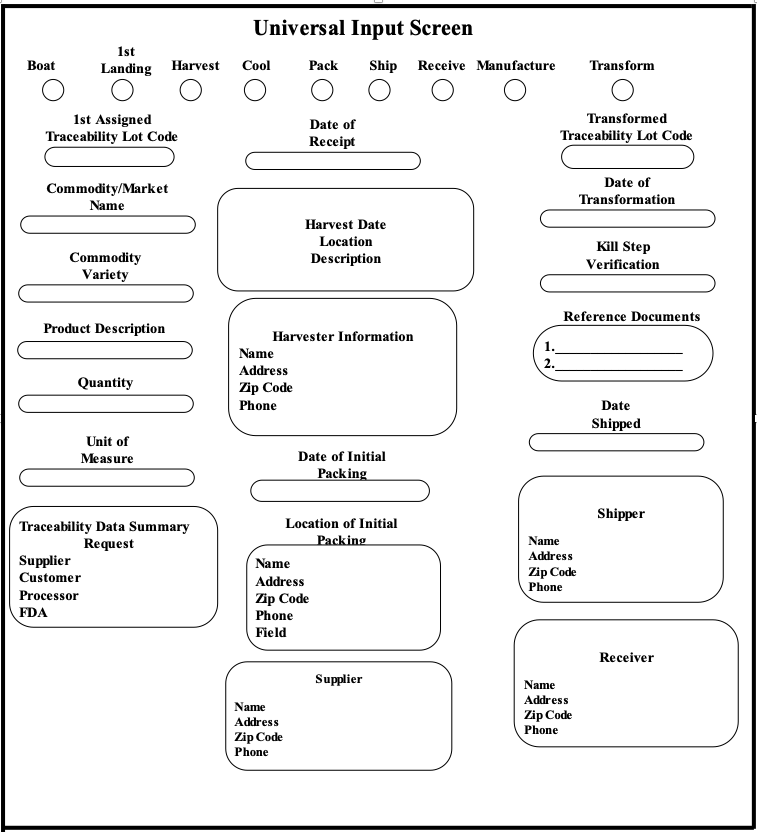
By checking on the “Harvest” link at the top of the screen, the farm can enter data to record date, time location, lot number, product name/description, quantity, unit of measure, variety, name, and packing or cooling information. The harvester can also record the shipper and date shipped, location of packing and other data.
Likewise a producer can, by clicking on the “Manufacture” button enter data relative to receipt from, transformation, new lot number, kill step (including date, verification and reference documents.)
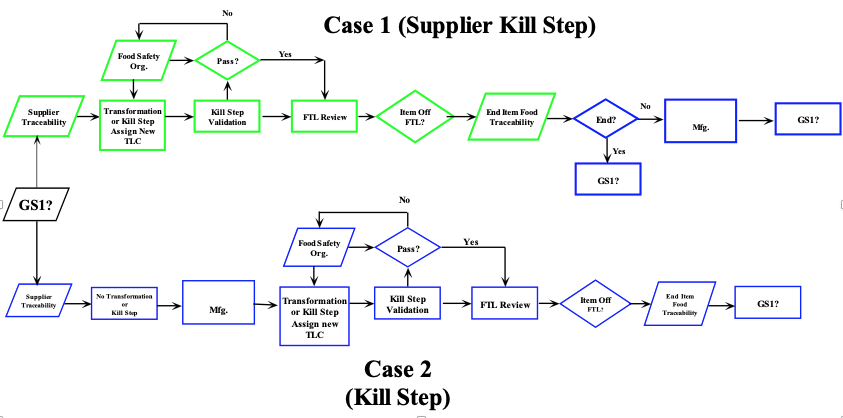
If required, other input screens can be developed to incorporate such things as GS1 requirements or data (Figure 2). GS1 identities are in use for hundreds of food products and many companies are in need of incorporating them into their own traceability systems.
In Case 1, the supplier has a kill step for a GS1 product in their process that ends traceability for the item prior to hand off to the parent production facility. In case 2 only the parent facility has a kill step. In both instances, maintenance and hand-off of GS1 identities is critical.
Figure 2 GS1 and Kill Steps
The system can be programmed so that whenever a “Critical Tracking Event” occurs, Key Data Element data may be entered and controlled by a smart programmer who sets up controls to only allow required data for any event. For example, if the “Harvest” button is enabled, any data entry for “Transformation” would be unenabled.
Other controls can be established such as date checks, traceability lot number verification or comparison to Food Traceability List requirements.
Standardizing the use of a system like this would establish a single Traceability Plan for all suppliers as well as the parent company. The ability to supply the FDA or any traceability effort would be available by entering a request using the “Traceability Data Summary Request” button. Fast, simple and allows the computer to do the work. Reduces response time to a minimum and maybe even saves lives and money. That’s what food traceability should do.
Time to standardize!
Related Articles
-


This series examines food safety as business infrastructure: the business decisions, governance structures, and operational conditions that determine whether technical food safety systems can hold under production pressure. The first three articles followed the record inward—from the corrective-action log, through…
-

Food safety audit failures repeat year after year because they're behavior problems, not protocol problems. The compliance gaps auditors document result from daily habits that erode under production pressure and unsupervised moments. Facilities that break the cycle invest in training…
-

New award will recognize food and beverage organizations applying innovative technology to strengthen food safety performance
-

The term, Normalization of Deviance has since become standard vocabulary in aviation safety, nuclear safety, and patient safety literature, precisely because the pattern keeps recurring: a known risk, documented, unresolved, tolerated because the bad outcome hasn't happened yet… until the…