

Tag Archives: aflatoxins

Nuts, tree nuts
Allergen Alley

Aflatoxin: Managing A Stubborn Threat To Global Food Safety

By Stephen Fapohunda
No Comments
Nuts, tree nuts

Aflatoxins are a group of secondary metabolites  that   can be highly toxic, mutagenic and most importantly, carcinogenic. They are produced  primarily by species of the fungal genus called Aspergillus under  favourable conditions of humidity, temperature  and matrix integrity (is the food item healthy of not, whole or broken?) The regular species are Aspergillus flavus and Aspergillus parasiticus . Aflatoxins are categorized based on fluorescence and source. The B  and G aflatoxins  give blue and green colour respectively on UV light, while M group is specifically located in the milk of livestock. Both B and G categories are dietary aflatoxins .Ordinarily they are all colourless, tasteless and odourless.

Aflatoxin contamination of crops is a global  food safety concern. The most dangerous form is Aflatoxin B1 (AFB1), classified as a Group 1 carcinogen by the International Agency for Research on Cancer, IARC, which is the technical arm of the WHO. Generally many  food items are susceptible(1.)  however, notable candidate  crops include  maize, groundnuts, tree nuts, and spices on which contamination happens  before harvest and during storage under poor conditions.   (2, 3 )

For food brands, processors, and exporters, aflatoxins represent a dual risk: severe public health consequences and strict regulatory enforcement. In 2024 alone, the EU rejected 127 shipments from Africa due to aflatoxin levels exceeding 2 ppb  for AFB1. For consultants and auditors, understanding aflatoxin risk is now a core compliance skill for food safety, sustainability, and ESG(Environmental, Social and Governance) audits.

Geography

Aflatoxin contamination is not random. It clusters in tropical and subtropical regions with high heat and humidity. High-risk zones  are:

Sub-Saharan Africa like Ghana, Nigeria, Kenya, Tanzania, Senegal where  maize and groundnuts show 60-90% contamination rates. This is why the  various national regulatory agencies like NAFDAC (Nigeria) and KEBS (Kenya) enforce strict testing.

South/Southeast Asia comprising  India, Thailand and Vietnam with  spices, dried chilies, and pistachios being  major export rejection points. Some parts of the US are also recorded to experience  aflatoxin on farm and store. Significant work has been done on the Arizona field with regard to tree nuts, and cotton

Latin America with maize and peanut exports face EU/US border controls.

Low-risk zones include temperate regions like Northern Europe and Canada having a minimal pre-harvest risk but  could invite  post-harvest risk if imports are stored improperly.

For brands sourcing globally, geography is the first risk filter. For example, a peanut butter brand sourcing from west Africa may  face substantially  higher audit risk than one sourcing from the US.

Impact of Climate Change

As in other mycotoxins, climate change is making aflatoxin risk significant  and expanding its range  (4, 5)

The 3 mechanisms associated with climate change are:

Higher temperatures: A. flavus grows fastest at 28-35°C. As West Africa warms, more crops hit this range during growing season. Some  predictions  suggest  a 20% increase in contamination risk in Nigeria by 2030.

Drought stress: Water-stressed maize and groundnuts crack, allowing fungal spores to enter.Both  drought and heat combine to potentiate aflatoxin production,

Unpredictability: In recent times, regions previously “too cold” like Southern Europe are now reporting A. flavus in maize. For auditors, “climate risk” is no longer future talk. Clients must now ask suppliers: “What’s your drought mitigation plan?” If none, then the risk score goes up.

Recent taxonomic advances have expanded the list of known aflatoxin-producing fungi beyond Aspergillus flavus and A. parasiticus. Phylogenetic studies now confirm at least 18 species within Aspergillus section Flavi as aflatoxigenic, including newly described species such as A. korhogoensis from West Africa (6) and A. pseudocaelatus from South America  These cryptic species are morphologically identical to non-toxigenic strains, creating false-negative risks for labs using only visual or TLC methods. Molecular identification targeting aflatoxin biosynthesis genes such as aflR, nor-1, and omtA is now required for regulatory compliance. Climate change is therefore  driving range expansion of section Flavi species into temperate zones, increasing detection complexity for import/export audits (7, 8)

Detection

Effective interventions  rest on reliable detection and quantitation techniques. Detection methods range from field tests to lab confirmation:

Field screening involves  ELISA kits, lateral flow strips with sensitivity of about  5 ppb Many of these give results in  less than 20min.

Laboratory confirmation involving Thin Layer chromatography TC, High Performance Liquid Chromatography  HPLC  and LC/MS-MS  This can detect  about  0.1 ppb. Because of the sensitivity, it is usually recommended and required for EU/US export certificates.

The Polymerase Chain Reaction ,PCR is used to detects fungal DNA, since aflatoxin occurrence depends on the thriving of the fungus.. The MALDI-TOF technique is now the Gold standard for fungal identification due to its speed, low cost per sample and high accuracy.

Health Impacts

Aflatoxin is a silent killer partly because of the difficulty in detection ordinarily. Acute exposure repeatedly at low doses incites aflatoxicosis. In 2004 Kenya outbreak recorded  317 cases and 125 deaths from contaminated maize. Symptoms  express as liver failure, jaundice, or death in days.

Chronic exposure at  low doses over  many years can lead to  liver cancer. AFB1 metabolizes in liver to AFB1-8,9-epoxide which binds DNA. The WHO has estimated 25% of global liver cancer cases are aflatoxin-related, mostly in Africa  and  Asia.

In children symptoms observed include stunted growth  and  immune suppression. Some studies in tropical Africa  revealed that very a high aflatoxin exposure  can lead to double the stunting rates. For infant food brands, this is a regulatory flashpoint . Therefore any claim like “100% natural, safe for kids” on a maize product label  without proof of aflatoxin testing is a compliance red flag.

Regulations and Impact on International Trade

As a result of the health impact to human and animals, aflatoxins are one of the top  reasons food shipments are rejected at borders across the globe  For Aflatoxin B1, the EU set limit is 2 ppb(parts per billion) and 4ppb for total aflatoxins . The FDA in the USA accepts 20ppb for total aflatoxins in maize and  nuts

The EU rejected about 2,200 consignments  between 2020 and 2024, which averagely cost  $50,000 in lost goods  shipping, per rejection. The Rapid Alert System for Food and Feed RASFF is an effect step for European member states that ensures a preemptive action against contaminated imported shipments. In Africa, the instruments for enforcing regulations are relatively weak, leading to a freer circulation of toxic food items.

Apart from rejection, recall costs can  kill brands sometimes leading to a sharp drop in stock. For ESG audits, “supply chain mycotoxin risk” is now a scored item.

The Codex Alimentarius Commission  sets global baseline. 15 ppb total aflatoxins for most nuts. Countries can be stricter. Nigeria  adopts the  Codex standard  and enforcement  now includes  random market raids for  aflatoxin testing with penalties for  violators.

Intervention Strategies

It is very difficult, if not completely impossible to attain zero-level howver, biological control measures have been reported as effective (9) Aflatoxin risk but it can be managed  at 3 levels:

Pre-harvest: Drought-tolerant seeds, proper spacing, timely harvest and biological control like Aflasafe are all effective measures Aflasafe is a non toxigenic A. flavus strain that outcompetes toxic strains.6 Nigeria saw 80% reduction in maize after use(Ranajit (10). The product employs a ‘fungus-fight’ approach.7 In the US, the fields of Arizona witnessed a successful bio-control using same mode of action. The product is Aflaguard  with Aspergillus favus strain AF36 (11)which  is approved for organic use against pistachio, peanuts, almond and corn .

Post-harvest. The use of fast drying to at most 13% moisture within 48hrs as well as proper storage in hermetic bags like PICS bags have been confirmed as reliable . Keeping the storage environment well ventilated and devoid of any other contaminant is also crucial.

Processing. Physical sorting  by removing  visibly mouldy food items  and the use of  laser  sorters to remove damaged kernels are an attraction to exporters, processors and even domestic consumers. Roasting may reduce AFB1 by 40-60% but doesn’t eliminate it . Activated clay binders  and charcoal are effectively used in animal feed but not for human food.

A winning recommendation is  a combination of Awareness, Good Agricultural Practice (GAP), HACCP, ,Capacity building and a soup of Interventions. Generally, the chemical solution is now being discouraged due to inherent hazards

References

1.Esan A; S O Fapohunda; CN Ezekiel; M Sulyok and R Krska 2020 Distribution of fungi and their toxic metabolites in melon and sesameseeds marketed in two major producing states in Nigeria. Mycotoxin Research https://doi.org/10.1007/s12550-020-00400-0

2.Adewunmi ,A A and  Stephen O. Fapohunda 2019. Mycotoxins in Nigerian  cereals and public health implications. Recent Advances in Food Science; 2(4): 200-216

3.Adewunmi A, Stephen O Fapohunda, OlumidecAfolabi and Abiodun Joseph. 2021: Occurrence of mycotoxigenic fungi in guinea corn oleand pearl millet marketed in South west Nigeria. Recent Advances in Food Science 4(3) 341-357

4.Fapohunda S O and A AAdewunmi 2019Climate Change and Mycotoxins–The African Experience. Croatian Journal of Food Science and Technology 11(2)DOI: 10.17508/CJFST.2019.11.2.09

5.Esan A and Fapohunda  S O (2020)Fusarium toxins, climate change and food security Recent Advances in Food Science Open access 3 (3)332-340

6.Carvajal-Campos, A ,AmaLethiciaManizan  ID , SouriaTadrist , David KoffiAkaki ,RoseKoffi-Nevry , Geromy G. Moore , Stephen O. Fapohunda , A Sylviane Bailly, Didier Montet , Isabelle P. Oswald  ID , Sophie Lorber, Catherine Brabet and Olivier Puel(2017). Aspergilluskorhogoensis, a Novel Aflatoxin Producing Species from the Côte d’Ivoire. Toxins  9, 353; doi:10.3390/toxins9110353  1-22

7.Sharma, A.K., Kumar, A., & Rijal, R. (2025). Phylogenetic studies and distinction of aflatoxin-producing Aspergillus species in section Flavi, Ochraceorosei and Nidulantes: A review. Gene, 937, 149151. https://doi.org/10.1016/j.gene.2024.14915

8. Schamann, A., et al. (2024). Comparative analysis of the genomes and aflatoxin production patterns of three species within Aspergillus section Flavi reveals an undescribed chemotype. Communications Biology, 7, 1134. https://doi.org/10.1038/s42003-024-06738-w

9,Fapohunda S. O, Esan A O.  andAnjorin S. T (2017)Biological Control of Mycotoxins : an Update  World Veterinary Journal7 (4) 117-127

10.Cotty PJ.1990. Effect of atoxigenic strains of Aspergillus flavus on aflatoxin contamination of developing cottonseed. Plant Dis. 1990;74(3):233–235. doi: 10.1094/PD-74-0233.

11.Bandyopadhyay R, Atehnkeng J, Ortega-Beltran A, Akande A, Falade TDO and Cotty PJ (2019) “Ground-Truthing” Efficacy of Biological Control for Aflatoxin Mitigation in Farmers’ Fields in Nigeria: From Field Trials to Commercial Usage, a 10-Year Study. Front. Microbiol. 10:2528. doi: 10.3389/fmicb.2019.02528


Scott Pritchett

Modern Mycotoxin Testing: How Advanced Detection Solutions Help Protect Brands and Consumers

By Scott Pritchett
No Comments
Scott Pritchett

Mycotoxins are toxic compounds produced by several types of fungi. These mycotoxin-producing fungi grow on a variety of crops and foodstuffs, such as cereals, nuts, and coffee beans, contaminating up to 25% of the world’s crops every year.

In humans, ingesting even small amounts of some mycotoxins can lead to acute poisoning—research has also linked mycotoxin ingestion to long-term effects such as cancer and immune deficiency. In livestock, the situation is similar with mycotoxin exposure responsible for a greater incidence of disease, poor reproductive performance, and suboptimal milk production. With the health consequences so severe, it’s easy to see why mycotoxin contamination can harm the brand reputation of food producers and suppliers.

Mycotoxin contamination also poses a significant economic risk. The U.S. FDA estimates that mycotoxin contamination is responsible for an estimated annual crop loss of $932 million while, the Food and Agriculture Association estimates toxigenic fungi drive annual food and food product losses of ~1 billion metric tons, which includes losses due to reduced livestock productivity.

Learn more about how to prevent and detect physical and chemical contamination risks in your facility at the Food Safety Tech Hazards Series: Physical and Chemical Contamination virtual conference. Now available on demand.

To minimize the risks posed by mycotoxins, robust mycotoxin testing is essential. Through rigorous testing, food suppliers can identify and remove unsafe products in the supply chain and indicate where preventive measures may need strengthening. Global regulations permit very low maximum levels of mycotoxins in foods, and international trade regulations make testing food and animal feed for mycotoxins a critical step before export.

Mycotoxins: A Significant and Growing Analytical Challenge

Mycotoxin testing is complex. Laboratories tasked with the endeavor face several hurdles, including:

  • Varied and complex matrices. Analyzing food samples for low levels of contaminants is inherently difficult, as complex matrices contain a myriad of other compounds that can interfere with analyte detection.
  • Greater testing burden than other contaminants. For example, with pesticides, testing after crop harvest is sufficient to ensure food safety, as foodstuffs are unlikely to acquire pesticide contaminants beyond this point. However, foods can acquire mycotoxin contaminants at several points after crop harvest—for instance, during transportation and storage. Testing at multiple points in the supply chain is therefore needed, which demands testing be easy to deploy, efficient, and cost-effective.
  • New, emerging threats. Mycotoxin contamination concerns go beyond the ‘big six’ classes most commonly encountered (aflatoxins, ochratoxin A, patulin, fumonisins, zearalenone, and nivalenol/deoxynivalenol). Emerging mycotoxins—lesser-known, novel mycotoxins neither routinely determined nor regulated—pose a threat to human and animal health, too. But new and emerging mycotoxins are not often reported or monitored due to limitations of current ELISA-based testing technology.
  • A warming climate. As average global temperatures rise, more regions will offer the warm, humid environments in which mycotoxin-producing fungi thrive. Some testing labs are already detecting classes of mycotoxins previously limited to other geographies. Moreover, rising temperatures may create ideal conditions for new mycotoxin-producing fungal strains and different combinations of mycotoxins. Thus, labs will increasingly need the flexibility to accommodate an expanding menu of known and unknown mycotoxin contaminants and mycotoxin combinations.
  • Broader, tighter regulations. Regulatory bodies are continually reducing the maximum permissible mycotoxin levels in food. For instance, in August 2022, the European Commission lowered the maximum levels of ochratoxin A in certain foodstuffs. Regulatory bodies will likely also expand analyte panels to accommodate new, emerging threats. Unless a laboratory’s testing equipment has sufficient sensitivity and flexibility to meet these continually changing requirements, labs may face unnecessary additional expenditure on new technologies each time regulations change.

Accordingly, to meet the needs of today while best positioning themselves for tomorrow, mycotoxin testing labs need testing methods that are highly sensitive, with the flexibility to quantify multiple known and unknown analytes in complex matrices. To meet ever-growing demand for efficiency, these methods should also be easy to use, and maximize lab productivity.

The Promise of Advanced LC-MS Solutions

Thankfully, advanced, high-throughput liquid chromatography mass spectrometry (LC-MS) and liquid chromatography tandem mass spectrometry (LC-MS/MS) solutions can alleviate these challenges.

For example, Quick, Easy, Cheap, Effective, Rugged, and Safe (QuEChERs) sample preparation kits can accelerate and simplify sample preparation across a variety of matrices prior to LC-MS analysis, helping facilitate high-throughput multi-residue analysis. To improve analysis of low abundance analytes in complex matrices, automated solutions are available that perform analyte pre-concentration and sample clean-up online, offering analytical confidence and greater speed compared to offline methods. Similarly, robust, high-performance liquid chromatography (HPLC) and ultra-HPLC (UHPLC) solutions can better resolve analytes in complex matrices, maximizing instrument utilization, and unlocking superior laboratory throughput.

When it comes to mass spectrometry (MS) systems, more productive, confident targeted compound quantitation is possible with advanced triple quadrupole MS (QQQ) instruments. QQQ systems offer analysts high sensitivity, selectivity, and specificity, making them ideal for the detection of multiple low-level compounds in the most challenging matrices. In addition, the fast data acquisition speeds and rapid polarity switching of these systems mean labs can greatly improve their workflow productivity. The latest QQQ systems are also easy to use, require minimal training, and facilitate streamlined method creation and optimization, enabling labs to better keep pace with changing regulations and emerging threats.

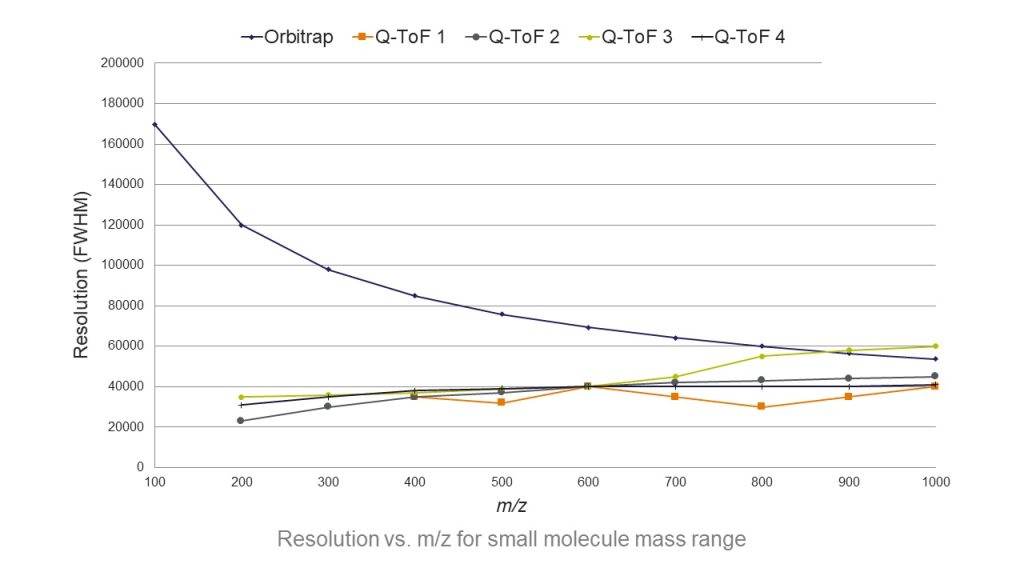
The advent of orbitrap mass spectrometry has transformed analytical testing workflows across a range of applications, including mycotoxin testing. Orbitrap mass spectrometers offer ultra-high resolution (figure 1) and accurate mass measurements, together with high dynamic range. These instruments can, therefore, better resolve the lowest-level analytes from background interferences in crowded matrices, as well as elucidate the fine isotopic structures needed for more confident analyte identification. Orbitrap instruments have significant productivity benefits too, being able to perform both quantitative and qualitative analyses of multiple analytes in a single platform, and often in a single run—all while maintaining high sensitivity.

Orbitrap curve
Figure 1: Across a broad m/z range, orbitrap mass spectrometers offer superior resolution relative to other mass spectrometry systems, such as quadrupole time-of-flight (Q-TOF) instruments.

Perhaps most important, though, is the value of orbitrap systems for unknown analysis. Orbitrap systems can generate full-scan high-resolution accurate mass data during untargeted analysis, enabling analysts to capture information from all ions in the run. When this data is compared against extensive high-resolution spectral fragmentation libraries (such as the mzCloud), labs can more easily and confidently identify novel compounds such as emerging mycotoxins. Even when no direct spectral match is available, analysts can now tap into advanced data analysis algorithms that provide the best candidate structures for unknown compounds.

Toward Multi-residue, Multi-panel Workflows

Recent studies have demonstrated the success of several advanced LC-MS and LC-MS/MS solutions and workflows for fast, economical, and highly sensitive multi-residue mycotoxin analysis. For example, one recent study looked at quantifying 48 myco- and phytotoxins (either currently regulated or under discussion for regulation in the EU) in cereal in a single analytical run. In the experiment, researchers used a UHPLC system coupled to a QQQ instrument, and cereals were extracted with acetonitrile/water, followed by evaporation and sample reconstitution.

The results demonstrated that sample preparation is simple, fast, and economical for this method. And, for all legislated mycotoxins, the limits of quantitation were lower than the maximum residue limits (MRL) established by regulations. Researchers also noted good precision and reproducibility across five replicates at the limit of detection. The authors therefore concluded that this method is suitable for the quantitation of all 11 legislated mycotoxins and 37 more that are either already legislated in feed or are prospects for further legislation.

Another study demonstrated the value of an orbitrap-based workflow for efficiently detecting a range of unknown food contaminants, including mycotoxins. In the study, researchers analyzed vegetables, fruits, nuts, and cereals, preparing samples using the Swedish ethyl acetate method (SweEt). In terms of equipment, the team used an UHPLC system connected to an orbitrap mass spectrometer, and analyzed data using a qualitative software tool. To help identify unknown compounds, the software used isotopic pattern recognition, fragments, and isotope distribution data to search spectral libraries for matches.

The results showed SweEt to be an effective generic sample preparation approach to analyze different compound classes, and the workflow enabled the team to successfully identify many unwanted contaminants, including pesticides, mycotoxins, and food additives. As a result, the researchers concluded that the method was a suitable and efficient way to find unexpected and unwanted multi-group analytes in complex food matrices. Researchers have increasingly sought such multi-group analysis methods in recent years, owing to the significant efficiency gains they can offer to analytical labs.

Meeting the Needs of Modern Mycotoxin Testing

Mycotoxin contamination in food has significant consequences for human and animal health, as well as the reputation of food producers and suppliers. But mycotoxin testing is inherently complex, and several factors make testing increasingly difficult—from emerging mycotoxin threats to tightening regulations and growing pressure for greater efficiency.

Advanced LC-MS and LC-MS/MS solutions have the potential to address these challenges and transform mycotoxin testing workflows, delivering unprecedented sensitivity, confidence, and productivity. By adopting these high throughput, high-resolution solutions, testing labs can better meet the needs of today, while optimally positioning themselves for the future. Ultimately, these advanced approaches will help ensure the safety of the global food supply, for a healthier, safer world.

Nuts, tree nuts

Q3 Hazard Beat: Nuts, Nut Products and Seeds

By Food Safety Tech Staff
No Comments
Nuts, tree nuts

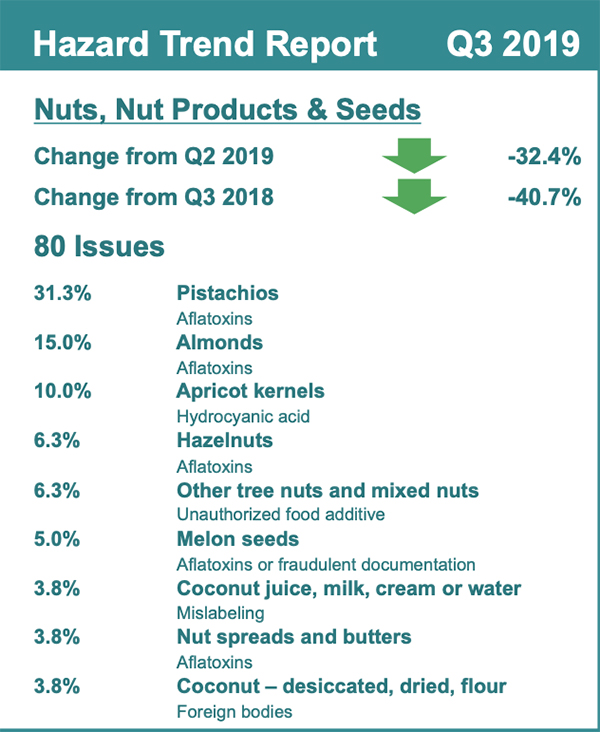
The following infographic is a snapshot of the hazard trends in nuts, nut products and seeds from Q3 2019. The information has been pulled from the HorizonScan quarterly report, which summarizes recent global adulteration trends using data gathered from more than 120 reliable sources worldwide. For the past several weeks, Food Safety Tech has provided readers with hazard trends from various food categories included in this report. This week’s hazard snapshot concludes the series.

Nut hazards, HorizonScan
2019 Data from HorizonScan by FeraScience, Ltd.

View last week’s hazards in Milk & Dairy Products.

Alert

Q3 Hazard Beat: Fruits & Vegetables

By Food Safety Tech Staff
No Comments
Alert

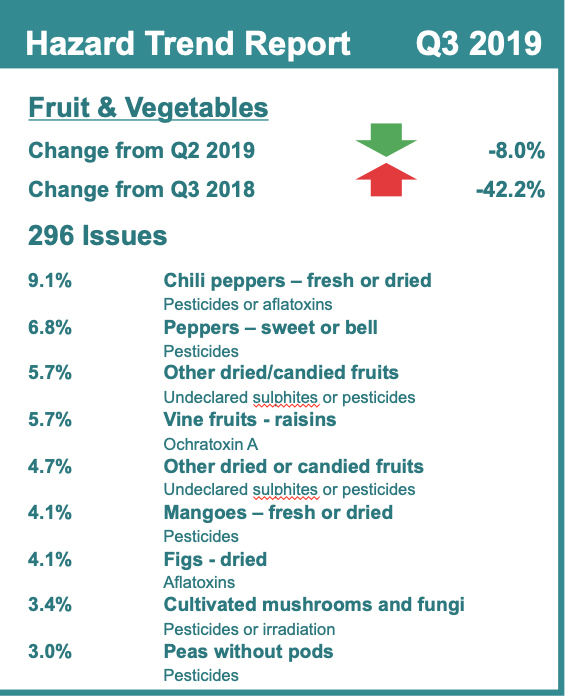
The following infographic is a snapshot of the hazard trends in fruits and vegetables from Q3 2019. The information has been pulled from the HorizonScan quarterly report, which summarizes recent global adulteration trends using data gathered from more than 120 reliable sources worldwide. Over the past and next few weeks, Food Safety Tech will provide readers with hazard trends from various food categories included in this report.

Hazards, fruits, vegetables, HorizonScan
2019 Data from HorizonScan by FeraScience, Ltd.

View last week’s hazards in seafood.