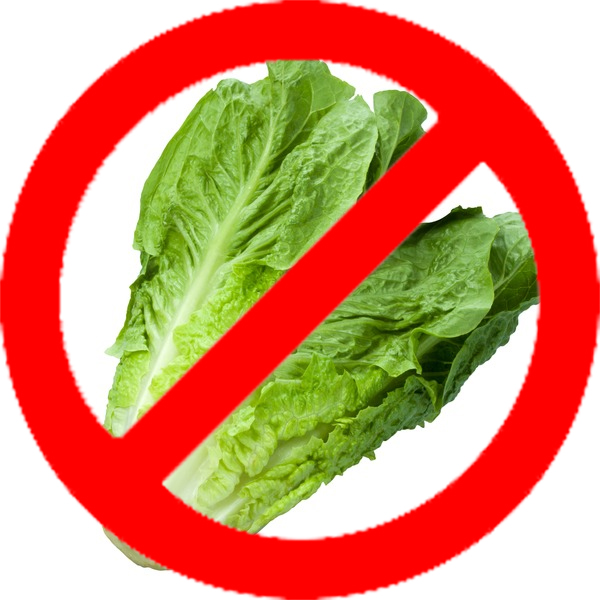
Yesterday FDA issued an update on the E.coli O157:H7 outbreak linked to romaine lettuce grown in California. The agency’s traceback investigation continues, and it is working with the Public Health Agency of Canada (PHAC) and Canadian Food Inspection Agency (CFIA), as there is a similar outbreak in Canada.
FDA stated that the contaminated lettuce likely originates from the Central Coast growing regions of northern and Central California (Counties of Monterey, San Benito, San Luis Obispo, Santa Barbara, Santa Cruz and Ventura).
“Traceback information from four restaurants in three different states so far has implicated 10 different distributors, 12 different growers, and 11 different farms as potential sources of rthe contaminated lettuce. The information indicates that the outbreak cannot be explained by a single farm, grower, harvester, or distributor.”
This year’s multistate outbreak of E.coli O157:H7 infections linked to romaine lettuce affected 210 people, killing five. Although the outbreak was officially declared over by the end of June, questions still remain as to the exact source. Given the widespread nature of the outbreak and the speed with which illnesses occurred, there are many lessons to be learned from the case.
During last week’s annual Food Safety Consortium, industry stakeholders from the FDA, CDC and produce associations gathered to discuss agency action upon learning of the outbreak and where there is room for improvement.
The investigation began in April 2018 when the New Jersey Department of Health contacted the CDC about a cluster of E.coli O157:H7 illnesses from people who said they ate salads at various locations of the same restaurant chain. Three days later, the agency was able to confirm eight O157 isolates from six states with the same patterns using PulseNet. And five days after that, the CDC posted a notice on its website about the investigation of 17 cases across seven states.
“We knew right away that this was going to get bad and that it would get bad quickly,” said Matthew Wise, deputy branch chief for outbreak response at the Outbreak Response and Prevention Branch of the CDC. “We saw illnesses ramp up quickly.” He added that the agency saw a lot of illness subclusters, all with romaine lettuce as the common ingredient.
The epidemiological evidence clearly indicated chopped romaine lettuce, and it appeared that all the affected romaine was coming from the Yuma, Arizona growing region, noted Stic Harris, director of the Coordinated Outbreak Response & Evaluation Network at FDA. But then things got even more confusing, as an Alaskan correctional facility was also investigating a cluster of cases. This allowed the agency to trace the source directly back to Harrison Farms as the sole supplier to the correctional facility. However, as the multi-agency investigation continued, they uncovered that the source was not just one farm. “There were three dozen farms in the Yuma region that supplied romaine lettuce,” said Harris, adding that we may never know which exact farm, and even if it was one farm, that was the source of the outbreak.
(left to Right) Stic Harris, FDA; Matt Wise, CDC; Dan Sutton, Pismo Oceano Vegetable Exchange; Scott Horsfall, California Leafy Green Products Handler Marketing Agreement
During June, July and August, the FDA sent a multidisciplinary team of 16-18 people to conduct an environmental assessment of the affected area. Upon taking 111 samples, they found 13 different Shiga toxin-producing E. coli strains, but only three matched the strain of the outbreak. Water from 14 locations, including discharge, reservoir and canal water, was also tested. The environmental assessment found pervasive contamination in the water. But here was the big problem, said Harris: “There was no smoking gun. We don’t know how the E.coli got into the water, and we don’t know how the water got onto the lettuce.” He added that additional research is needed, and that government and non-government work must continue to identify the source.
There are several challenges associated with the complexity of this type of produce outbreak, said Harris and Wise:
The production lot information disappears at the point of service
Having a commingled product hinders traceback
Records present a challenge because agencies try to look at each company and their individual records, and every company has their own way of doing things—this takes time
The breadth of the impacted area—trying to do an environmental assessment for that area was staggering work
People who eat lettuce eat it often
Many people don’t remember what type of lettuce they ate
The product has a short shelf life
Communication: The packaging isn’t transparent on where it’s grown
Scott Horsfall, CEO, California Leafy Green Products Handler Marketing Agreement, chimed in on the challenges posed by the complexity of the outbreak. “If you compare these numbers with the 2016 spinach outbreak…they’re very similar [in the] total number of illnesses [and] number of states involved. But in [the spinach outbreak], it led to a specific farm. What we saw this time was very different.”
Sponsored Content
When it comes to food safety compliance, learning lessons the hard way is never a good practice. Violations, non-compliance and documentation mishaps put a major damper on your business. From delays in production to the dreaded recall, these mistakes can cost thousands, if not millions, of dollars. Don’t learn these lessons the hard way. See our Case Studies and learn how companies are avoiding these costly mistakes with TraceGains.
One of the large successes in dealing with the outbreak is that the agencies issued public warnings quickly, said Wise. The produce industry also came together to form the Leafy Greens Food Safety Task Force. In addition, FDA is expanding its sampling for the coming harvests, according to Harris. “I think that in terms of the speed of the environmental assessment, we need to be quicker with that. We apparently hadn’t done one in quite a long time at FDA,” he said.
Harris and Wise also stressed that for industry to work more effectively together, they need to work with the FDA and CDC before there is an outbreak.
“This outbreak was a frustrating experience for all of us,” said Horsfall. “We have to communicate more and better when we can. And as an industry, stop these outbreaks from happening.”
Yesterday FDA released the initial phase of its findings of a 10-year nationwide study that looks at the relationship between food safety management systems, certified food protection managers, and the occurrence of risk factors and food safety behaviors/practices, and how this contributes to foodborne illness outbreaks in retail establishments. This first phase collected data from 2013–2014; subsequent data collection will be from 2017 and 2021. The entire span of the study is 2013–2023.
Restaurants had the most effective control over ensuring there is no bare hand contact with RTE foods as well as cooking raw animal foods (including meat, poultry and eggs) to the required temperature
Unsafe food behaviors in fast food and full-service restaurants. Improvement needed in:
Employee hand washing (knowing when and how to do it)
Proper temperature control of foods that require refrigeration to limit pathogen growth
Study results will be used to help advise retail food safety initiative and policies, industry partnerships and specific intervention strategies that target foodborne illness risk factors. It will also aid in providing technical assistance to state, local and other regulatory professionals. FDA put together a factsheet with highlights of the study.
The following Duncan Hines cake mixes were recalled by Conagra Brands over concerns of Salmonella. (Click to enlarge)
–UPDATE–
“FDA and the CDC informed Conagra Brands that a sample of Duncan Hines Classic White Cake Mix that contained Salmonella Agbeni matched the Salmonella collected from ill persons reported to the CDC. This was determined through Whole Genome Sequencing, a type of DNA analysis. The sample was collected by Oregon health officials. Based on this information, Conagra Brands is working with FDA to proactively conduct a voluntary recall of Duncan Hines cake mixes from the market. The FDA is conducting an inspection at the Conagra Brands-owned manufacturing facility that produced the cake mixes. The FDA is also collecting environmental and product samples.” – FDA, November 7, 2018
–END UPDATE–
After a retail sample tested positive for Salmonella, Duncan Hines issued a recall of four varieties of its cake mixes. The sample that tested positive for the pathogen was the Classic White cake mix, but out of an “abundance of caution”, the company recalled its Classic Butter Golden, Signature Confetti and Classic Yellow cake mixes that were manufactured during the same period of time.
“Several of the individuals reported consuming a cake mix at some point prior to becoming ill, and some may have also consumed these products raw and not baked. Consumers are reminded not to consume any raw batter. Cake mixes and batter can be made with ingredients such as eggs or flour which can carry risks of bacteria that are rendered harmless by baking, frying or boiling.” – Conagra Brands
The recalled products have a “Best If Used By Date” ranging from March 7 to March 13, 2019 and were distributed to U.S. retailers as well as exported internationally (on a limited basis). Consumers are advised to return the recalled products to the store in which they were purchased.
Yesterday FDA released the final guidance on its mandatory recall authority under FSMA. Although the agency has only taken a mandatory recall action once since 2011—in April, FDA issued a recall of Triangle Pharmanaturals Kratom Products—the FDA’s authority to recall products “plays an important role in ensuring that potentially dangerous food products are removed from the marketplace,” states the agency in a release. “The agency remains committed to working with firms to facilitate the orderly and prompt voluntary removal of potentially dangerous products from the food supply. FDA Recall Coordinators are available to assist firms during the recall process.”
FDA Commissioner Scott Gottlieb, M.D. also released a statement about the agency’s commitment to keeping unsafe products off the market. “When issues arise that would put consumers at risk, we won’t hesitate to mandate the removal of a product from the market using the full extent of our authorities. It’s our responsibility. And it’s critical to our mission to ensure the safety of Americans,” stated Gottlieb in a press release. He added that most companies are cooperative in closely working with FDA to initiate voluntary recalls.
FDA will be making additional moves to enhance its recall policies, according to Gottlieb.
Today it was announced that FDA Deputy Commissioner for Foods and Veterinary Medicine Stephen Ostroff, M.D. is retiring and Frank Yiannas, vice president of foods safety at Walmart, will join FDA as the Deputy Commissioner for Food Policy and Response.
FDA Commissioner Scott Gottlieb, M.D. made the announcement in an email to agency employees. Yiannas will have a different title than Ostroff’s, which is reflective of the reorganization at the agency—FDA will reportedly be creating a new office called the Office of Food Policy and Response. Yiannas will also reportedly take on the role of senior scientific advisor to Commissioner Gottlieb on issues related to food safety and supply chain.
Ostroff will retire in January 2019 and will assist in the transition of Yiannas into his new role at FDA.
Is the FDA Unified and Listing Systems (FURLS) system with its newly updated electronic Export Listing Module (ELM) a pathway to overseas markets or just one more regulatory hurdle that has been put in place by the U.S. government to impede export of U.S.-processed foods? A review of the new updates is needed to provide the answer to this question.
Regardless of the answer to this question, whether your company is already participating in this program or is looking for new markets outside the United States in countries that do not require the FDA listing of U.S. food companies, you must understand how the FURLS system works, how to electronically register and better understand the regulatory challenges of the importing country.
The FDA recently released a notification that their FDA Unified and Listing Systems (FURLS) system has been updated to include an Export Listing Module (ELM). This update allows U.S. food manufacturers to electronically submit, and for FDA to receive and process requests for inclusion on the export lists for FDA-regulated food products and present these lists to countries that require them, whether your company is already participating in this program or is looking for new markets outside the United States.
As background, the FDA has established and maintains export lists for countries that require some assurance that U.S. food manufacturers exporting to these countries, at a minimum, meet all applicable food safety regulations enforced by FDA. These lists, in an unofficial way, serve as a “certification” by the FDA, representing the U.S. government, that either included facilities have provided information to the FDA to assert they are in compliance with the importing country’s regulations and requirements or, more likely, that the U.S. food manufacturer is meeting the currently applicable U.S. laws and regulations.
Other options for U.S. food manufacturers that are interested or already exporting to countries that do not require the FDA lists, include the FDA’s export certificates, which give the agency’s official attestation concerning a product’s regulatory or marketing status. The fact that FDA has issued an export certificate does not preclude FDA from taking appropriate regulatory action against a product covered by the certificate. CFSAN issues “certificates of export” for seafood, food additives and food contact substances. CFSAN issues “certificates of free sale” for land food, dietary supplements, infant formula, medical foods and foods for special dietary use. U.S. firms wishing to apply for an export certificate for a food product may log in to FDA Industry Systems and submit an online application through the Certificate Application Process.
Need to learn more about supplier verification? TraceGains is here to help! Download our Foreign Supplier Verification Program Guidebook to learn the ins and outs of this complicated FSMA addition. TraceGains enlisted the help of Marc Sanchez, regulatory attorney specializing in FDA and USDA law, and Shawn Stevens, a global food safety lawyer, to provide insight and break down some of the confusion.
Back to the FDA list option. It is important to note that companies may request to be included on these lists at any time; however, updates to the lists are only published quarterly by the FDA. Additionally, final listing decisions are made by the competent authority of the importing country. This is to say, there can be a short or lengthy process between the time when FDA updates the list for a particular country and when that country formally accepts the updated list. Since there is no downside for a company to appear on one FDA list or many (lists maintained for each country), this potential delay in official acceptance of the list should drive U.S. food companies to apply to be on all of the country lists, before there is a specific need to do so. Remember the old adage, “When you are in a hurry, inevitably you end up standing in the slowest line.”
Market access for U.S.-manufactured dairy products to the EU, China and Chile, for example, are subject to these listing requirements in order to gain market access. Do ensure you have verified that your dairy product meets the standards and labeling requirements for the country to which you wish to export, as it is likely that a foreign country’s dairy product requirements will not necessarily be the same as what is found in the United States. Another example is that in order to export U.S.-manufactured collagen and gelatin products to the EU, companies must provide a laboratory report from an accredited, private laboratory demonstrating that the products comply with the established criteria. For exporters of U.S.-manufactured/processed seafood products to the EU or China, inclusion on the FDA-maintained list is required, as well as an export certificate which is provided by the National Oceanic and Atmospheric Administration (NOAA) Seafood Inspection Program after FDA listing has been completed.
Finally, U.S.-manufactured infant formula exports to China are also subject to listing requirements. It should be noted that the China Certification and Accreditation Administration (CNCA) defines infant formula as food intended for children up to 36 months of age, known as “infant and young children formula”. This differs from the U.S. definition. Please be advised that CNCA requires new applicants to submit evidence of third-party certification of compliance with Chinese laws and regulations as part of the application process. CNCA also requires that infant formula manufacturers/processors submit an Establishment Registration Application with additional information to CNCA.
One of the most important keys to gaining access to overseas markets is to get your company enrolled on as many of these FDA lists as possible, obtain FDA certificates of free sale ahead of time, and make sure you update your information and keep it current within the various FDA electronic database systems.
Whether your company faces a foreign market access challenge via being a part of the FDA List or needing to get an FDA “Certificate of Free Sale” or just have questions related to moving product out of a U.S. port and into a foreign port, contact a reputable consulting firm for assistance.
The serious outbreaks over the past few months indicate that industry continues to experience “significant food safety problems”, said Stephen Ostroff, FDA deputy commissioner for foods and veterinary medicine at the IAFP annual meeting last week. He referred to the most recent sizable produce-associated outbreaks involving romaine lettuce, pre-cut melon and veggie trays, as well as the Kellogg Company recall of Honey Smacks cereal and the Rose Acres eggs recall, both of which were due to Salmonella. “We have a lot of work to do,” said Ostroff, adding that the numerous recalls involving kratom products is concerning.
These issues highlight how the increasingly complex supply chain further complicates problems once they arise. Ostroff emphasized the necessity of end-to-end tracing, from product origination to where the consumer can access the product, and that it needs to be efficient, standardized and rapid, especially for commodities. Regarding the E. coli O157:H7 outbreak involving romaine lettuce, FDA is still trying to determine the source and mode of the contamination. And while the recent finding of the outbreak strain in the irrigation canal water is important, it still does not answer the question of how the contamination got into the canal, said Ostroff.
The latest FDA update on the outbreak investigation stated that additional samples are being analyzed on an ongoing basis and any new matches would be publicly disclosed. As of June 28, the CDC announced that the outbreak was over.
Under the FSMA Preventive Controls Animal Food rule, certain animal food manufacturers that receive raw materials and ingredients must develop and implement a risk-based supply chain program. This is required if the facility determines that a supply-chain-applied control is the appropriate preventive control for a hazard of an incoming ingredient. In order to better help animal food facilities meet these requirements, the FDA released a draft guidance, “Guidance for Industry #246: Hazard Analysis and Risk-Based Preventive Controls for Foods for Animals: Supply-Chain Program”.
According to an agency news release, the draft guidance will help facilities in the following areas:
“Determine whether they need a supply-chain program;
Identify and implement the appropriate supply-chain program activities required to approve their suppliers and verify their supplier is controlling the hazard in raw materials or other ingredients;
Establish frequency of supplier verification activities;
Meet documentation and recordkeeping requirements; and
Recognize situations that necessitate or allow for flexibility or different supplier verification activities.”
In addition, the document offers clarification for receiving facilities that are animal food importers and subject to the supply-chain program requirements of the FSVP rule.
The FDA is accepting public comments on the draft for the next 180 days.
FDA has launched a new section of its Data Dashboard to help food importers, manufacturers and processors meet supply chain requirements put forth by FSMA (specifically FSVP, and the PC rules). The dashboard provides ease in finding compliance and enforcement information related to companies.
Do you trust your suppliers? What about your supplier’s suppliers? | Food Safety Supply Chain Conference | June 12–13, 2018 | Learn more“The Foreign Supplier Verification Programs rule requires importers to perform risk-based activities to verify that their suppliers are meeting applicable U.S. food safety standards. One such activity is an evaluation of a supplier’s performance and the risk associated with the food, a process that includes evaluating a supplier’s compliance with FDA regulations such as whether the supplier is subject to an FDA warning letter, import alert, or other FDA compliance action related to food safety. The Preventive Controls rules require manufacturers/processors to perform supplier approval if the ingredient supplied contains a hazard requiring a supply-chain applied control. Supplier approval includes consideration of the supplier’s compliance with food safety laws and regulations.” – FDA
The agency also made improvements to its supplier evaluation resources page and added it to the dashboard so that companies can simultaneously search several databases. Users can search for information about warning letters, import refusal and import alerts.
This website uses cookies so that we can provide you with the best user experience possible. Cookie information is stored in your browser and performs functions such as recognising you when you return to our website and helping our team to understand which sections of the website you find most interesting and useful.
Strictly Necessary Cookies
Strictly Necessary Cookies should be enabled at all times so that we can save your preferences for these cookie settings.
We use tracking pixels that set your arrival time at our website, this is used as part of our anti-spam and security measures. Disabling this tracking pixel would disable some of our security measures, and is therefore considered necessary for the safe operation of the website. This tracking pixel is cleared from your system when you delete files in your history.
We also use cookies to store your preferences regarding the setting of 3rd Party Cookies.
If you visit and/or use the FST Training Calendar, cookies are used to store your search terms, and keep track of which records you have seen already. Without these cookies, the Training Calendar would not work.
If you disable this cookie, we will not be able to save your preferences. This means that every time you visit this website you will need to enable or disable cookies again.
Cookie Policy
A browser cookie is a small piece of data that is stored on your device to help websites and mobile apps remember things about you. Other technologies, including Web storage and identifiers associated with your device, may be used for similar purposes. In this policy, we say “cookies” to discuss all of these technologies.
Our Privacy Policy explains how we collect and use information from and about you when you use This website and certain other Innovative Publishing Co LLC services. This policy explains more about how we use cookies and your related choices.
How We Use Cookies
Data generated from cookies and other behavioral tracking technology is not made available to any outside parties, and is only used in the aggregate to make editorial decisions for the websites. Most browsers are initially set up to accept cookies, but you can reset your browser to refuse all cookies or to indicate when a cookie is being sent by visiting this Cookies Policy page. If your cookies are disabled in the browser, neither the tracking cookie nor the preference cookie is set, and you are in effect opted-out.
In other cases, our advertisers request to use third-party tracking to verify our ad delivery, or to remarket their products and/or services to you on other websites. You may opt-out of these tracking pixels by adjusting the Do Not Track settings in your browser, or by visiting the Network Advertising Initiative Opt Out page.
You have control over whether, how, and when cookies and other tracking technologies are installed on your devices. Although each browser is different, most browsers enable their users to access and edit their cookie preferences in their browser settings. The rejection or disabling of some cookies may impact certain features of the site or to cause some of the website’s services not to function properly.
Individuals may opt-out of 3rd Party Cookies used on IPC websites by adjusting your cookie preferences through this Cookie Preferences tool, or by setting web browser settings to refuse cookies and similar tracking mechanisms. Please note that web browsers operate using different identifiers. As such, you must adjust your settings in each web browser and for each computer or device on which you would like to opt-out on. Further, if you simply delete your cookies, you will need to remove cookies from your device after every visit to the websites. You may download a browser plugin that will help you maintain your opt-out choices by visiting www.aboutads.info/pmc. You may block cookies entirely by disabling cookie use in your browser or by setting your browser to ask for your permission before setting a cookie. Blocking cookies entirely may cause some websites to work incorrectly or less effectively.
The use of online tracking mechanisms by third parties is subject to those third parties’ own privacy policies, and not this Policy. If you prefer to prevent third parties from setting and accessing cookies on your computer, you may set your browser to block all cookies. Additionally, you may remove yourself from the targeted advertising of companies within the Network Advertising Initiative by opting out here, or of companies participating in the Digital Advertising Alliance program by opting out here.