Tag Archives: food safety

Super Bowl Food Safety

By Sangita Viswanathan
No Comments

Despite all the excitement surrounding the big game, party hosts should be cognizant of potential lurking dangers in their food. No one wants to get sick off a few wings, jalapeno poppers, and mozzarella sticks – An interview with PURE Bioscience’s CEO, Hank Lambert.

With the Super Bowl this weekend, fans around the country are beginning to plan for their big parties, deciding who to invite and what food they’ll be serving. Some rough estimates predict that football fans, on an average will consume 2400 calories, just during the game.

Despite all the excitement surrounding the big game, party hosts should be cognizant of potential lurking dangers in their food. No one wants to get sick off a few wings, jalapeno poppers, and mozzarella sticks.

Hank Lambert, CEO of PURE Bioscience, Inc. spoke to Food Safety Tech about how costs can keep their food safe and precautions that can be taken to prevent Super Bowl fans from getting sick from the food.

PURE Bioscience develops and commercializes proprietary antimicrobial products based on patented, stabilized ionic silver, and Silver Dihydrogen Citrate (SDC). “The product is a food contact disinfectant that is effective in killing a broad range of pathogens, including norovirus (in 60 seconds). We are non-toxic compared to others that are ammonium or chlorine based, tasteless/ odorless and non-corrosive (with an EPA level 4 toxicity or lowest toxicity label),” describes Lambert.

Lambert warns that norovirus is particularly dangerous during this season, and is a risk at home entertaining as much as it is in a public restaurant or cruise ship. Following food handling and prep guidelines is always critical and Lambert provides a few tips to ensure this:

  • Ensure that hands are properly cleaned between preparing and serving, between handling raw and prepared foods. Proper hand washing by itself, can help halve half the risk of any foodborne illness, he points out.
  • Ensure food prep surfaces are cleaned, so that any cross contamination can be avoided. For instance after prepping raw chicken, make sure you properly wash and sanitize the surface before cutting veggies or cheese on it.
  • Keep raw and cooked foods separate, starting at the grocery store keep your chicken wings for instance in a separate bag from the carrots or celery or dip to minimize risk of cross contamination, and follow this at home in the refrigerator and during prep.
  • Cook your foods thoroughly. For instance, poultry (wings or tenders), make sure it’s cooked to internal temp of 165 F to kill potential bacteria.
  • Keep the foods at safe temperatures, whether it’s in the refrigerator (40 F or below) when storing or serving them to ensure bacteria won’t grow. Don’t leave prepared food out for more than two hours out at a time, Lambert mentions guacamole served in large bowls, left sitting out for hours at such parties. “Serve in a small bowl, refrigerate the rest, and replenish when needed to maintain safe temperatures,” he advises.

Another rule to remember: “If you have someone at home or a guest is sick, they should not be handling food or around food. Even if you think you are feeling better, you could still be shedding norovirus or other germs when you sneeze, perspire etc., for up to three days after you feel better. So be thoughtful of other guests,” Lambert cautions.

So which traditional Super Bowl foods are the most prone to food-borne illnesses? “A common culprit is often chicken products, which, if not cooked to proper internal temperature, carry the risk of spreading Salmonella. Raw vegetables can also be a leading cause if not properly washed, or if they have been cross contaminated,” lists Lambert.

So while you are reveling in your Super Bowl Party this weekend, eat safe and may the best team win!

Lawmakers Introduce Bill for Single “Food Safety Administration”

Food safety oversight is currently split up among 15 agencies in the Departments of Health and Human Services, Agriculture, and Commerce. The Safe Food Act of 2015 introduced in both houses of Congress on Wednesday, aims to consolidate all the authorities for food safety inspections, enforcement and labeling into the Food Safety Administration.

Senator Dick Durbin (D-IL) and Representative Rosa DeLauro (D-CT) introduced bills in Congress yesterday with a goal to establish a single, independent federal food safety agency. The aim is to improve food safety for consumers, while also cutting back on the costs of a dispersed system with overlapping responsibilities between agencies, according to Durbin.


“What the bill does is remedy the situation,” DeLauro said. “With a single agency, we believe our country will be able to have the ability to detect relatively minor problems before they become major outbreaks.”

The Act would provide the Food Safety Administration with mandatory recall authority for unsafe food, require risk assessments and preventive control plans to reduce adulteration, authorize enforcement actions to strengthen contaminant performance standards, improve foreign food import inspections, and require full food traceability to better identify sources of outbreaks.

DeLauro said the bill builds on the improvements made in FDA’s Food Safety Modernization Act (FSMA).

The federal agencies that would be incorporated into one include:

  • FDA’s Center for Food Safety and Applied Nutrition (CFSAN) and Center for Veterinary Medicine (CVM); 
  • The resources and facilities of FDA’s Office of Regulatory Affairs that administer and conduct inspections of food and feed facilities and imports; 
  • The resources and facilities of the Office of the FDA Commissioner that support CFSAN, CVM and inspections;
  • USDA’s Food Safety and Inspection Service;
  • The part of USDA’s Agriculture Marketing Service that administers shell egg surveillance services;
  • The part of USDA’s Research, Education, and Economics mission area related to food and feed safety;
  • The part of USDA’s Animal and Plant Inspection Health Service related to the management of animals going into the food supply; and
  • The part of the National Marine Fisheries Service of the National Oceanic and Atmospheric Administration of the Department of Commerce that administers the seafood inspection program. 

A single food safety agency is not a new concept, and the two lawmakers have sponsored Safe Food Acts five times before, though the most recent was in 2007. In addition, the Government Accountability Office has reported on the need for better coordination of food safety activities over the years.

DeLauro mentioned eggs as an example to show how complicated the current food safety landscape was: “One agency manages the health of hens, another oversees the feed that they eat, another sets egg quality standards but does not test them for Salmonella,” she said. “While still in its shell, the egg is the responsibility of the Food and Drug Administration, but once it’s processed into an egg product, it becomes the responsibility of Food Safety and Inspection Service.”

Durbin and DeLauro are hoping to build bipartisan support for the bills. Current cosponsors of the Senate Safe Food Act include Sens. Dianne Feinstein (D-CA), Richard Blumenthal (D-CT) and Kirsten Gillibrand (D-NY). Cosponsors in the House include Reps. Barbara Lee (D-CA), Louise Slaughter (D-NY), James Langevin (D-RI), Bobby Rush (D-IL), Charles Rangel (D-NY), Jim McDermott (D-WA) and Delegate Eleanor Holmes Norton (D-DC).

115 Sickened: Multistate Outbreak of Salmonella Enteritidis Infections Linked to Bean Sprouts

So far, 61 outbreaks have been associated with raw sprouts, sickening at least 11,179.

The U.S. Centers for Disease Control reports this outbreak appears to be over.

barfblog-raw-sprouts-Aug-2014A total of 115 people infected with the outbreak strains of Salmonella Enteritidis were reported from 12 states. Twenty-five percent of ill persons were hospitalized. No deaths were reported.

Collaborative investigation efforts of state, local, and federal public health and regulatory agencies indicated that bean sprouts produced by Wonton Foods, Inc. were the likely source of this outbreak.

In interviews, 61 (72 percent) of 85 ill persons reported eating bean sprouts or menu items containing bean sprouts in the week before becoming ill.

In November 2014, Wonton Foods Inc. agreed to destroy any remaining products while they conducted a thorough cleaning and sanitization and implemented other Salmonella control measures at their firm. The firm resumed shipment of bean sprouts on November 29, 2014.

Contaminated bean sprouts produced by Wonton Foods, Inc. are likely no longer available for purchase or consumption given the maximum 12-day shelf life of mung bean sprouts.

Although this outbreak appears to be over, sprouts are a known source of foodborne illness. CDC recommends that consumers, restaurants, and other retailers always follow food safety practices to avoid illness from eating sprouts.

Be aware that children, older adults, pregnant women, and persons with weakened immune systems should avoid eating raw sprouts of any kind (including alfalfa, clover, radish, and mung bean sprouts).

We count 61 outbreaks associated with raw sprouts, sickening at least 11,179.

How Safe is Consumer Handling of Raw Poultry Products at Home?

Between 1998 and 2008, 20 percent of Salmonella and 16 percent of Campylobacter foodborne disease outbreaks were associated with food prepared inside the home.

Salmonella and Campylobacter cause an estimated combined total of 1.8 million foodborne infections each year in the United States. Most cases of salmonellosis and campylobacteriosis are associated with eating raw or undercooked poultry or with cross-contamination.

Between 1998 and 2008, 20 percent of Salmonella and 16 percent of Campylobacter foodborne disease outbreaks were associated with food prepared inside the home.

A nationally representative Web survey of 1,504 U.S. adult grocery shoppers was conducted to estimate the percentage of consumers who follow recommended food safety practices when handling raw poultry at home.

The survey results identified areas of low adherence to current recommended food safety practices: Not washing raw poultry before cooking, proper refrigerator storage of raw poultry, use of a food thermometer to determine doneness, and proper thawing of raw poultry in cold water.

Nearly 70 percent of consumers reported washing or rinsing raw poultry before cooking it, a potentially unsafe practice because “splashing” of contaminated water may lead to the transfer of pathogens to other foods and other kitchen surfaces.

Only 17.5 percent of consumers reported correctly storing raw poultry in the refrigerator. Sixty-two percent of consumers own a food thermometer, and of these, 26 percent or fewer reported using one to check the internal temperature of smaller cuts of poultry and ground poultry. Only 11% of consumers who thaw raw poultry in cold water reported doing so correctly.

The study results, coupled with other research findings, will inform the development of science-based consumer education materials that can help reduce foodborne illness from Salmonella and Campylobacter.

Journal of Food Protection, Number 1, January 2015, pp. 4-234, pp. 180-186(7) Kosa, Katherine M.; Cates, Sheryl C.; Bradley, Samantha; Chambers IV, Edgar; Godwin, Sandria. 

Gina Kramer
Food Safety Think Tank

An Introduction

By Gina R. Nicholson-Kramer
1 Comment
Gina Kramer

This new column on Food Safety Tech is a B2B forum for food safety tech, food manufacturing, food distribution, food retailer service/sales, and chemical and tools manufacturing companies in our industry. One of the important efforts we all have in common in this industry is we must continually identify food safety risk (or gaps) in food manufacturing, distribution, and sales to develop improved systems, methods, chemicals, and tools to fill these gaps and reduce risk. In the near future, many of these efforts will be mandatory due to the new regulatory rules being developed through FSMA.

Food Safety Think TankMy goal for this column is to facilitate new thinking to stimulate innovative solutions in food safety for our industry. I have the experience of leading large chain food sales and food service food safety programs; working with business professionals within our respective food companies and with our vendors, to develop systems and tools to improve food safety.

How can this column be of value to our industry?

  • Follow the column. Subscribe to FST News, and receive notifications of the column in your inbox whenever we post something new.
  • Participate. The column should be more than just a source for useful information; I actually want to start a conversation with you – industry professionals. Respond to column posts and share what you know, ask questions, submit ideas, inform us of gaps you see in food safety, and share your efforts, etc.
  • Contribute. We are actively looking for industry professionals who want to share their work in food safety. Whether it’s benchmarking existing solutions or sharing your research that defines gaps and new opportunities for innovation, we need your contributions. Let’s invoke a broad range of new ideas across a wide range of issues to speed up new or improved tools, reduce cost, improve efficiency, and even develop new business models for food safety solutions. Write to me at Gina@SavourFoodSafety.com. I look forward to hearing from you. 

Apple Recall – Here are 5 Fruits and Veggies at Greater Risk

“Fresh fruits and vegetables are probably the biggest source of foodborne illness today in North America, and that’s because they’re fresh — we don’t cook them — so anything that comes into contact has the potential to contaminate.”

A Listeria outreak in apples has killed seven people and hospitalized 31, according the Centers for Disease Control and Prevention, which has trace the outbreak to Bidart Bros. apple-packing plant in California.

While apples are the second most popular fruit in America, according the Agricultural Marketing Resource Center, outbreaks linked to apples are rare, due to the natural hard surface of the fruit, which, prevents bacteria from entering the fruit, says Doug Powell, PhD, a former professor of food safety in the U.S. and Canada who publishes barfblog.com.

In a Yahoo! Health article, Amy Rushlow quotes Prof. Powell: “Fresh fruits and vegetables are probably the biggest source of foodborne illness today in North America, and that’s because they’re fresh — we don’t cook them — so anything that comes into contact has the potential to contaminate.” Powell especially sounds caution about the following five fruits and vegetables, which have been linked to a significant number of foodborne illness outbreaks over the past years:

1. Sprouts: A 2011 outbreak in Germany killed more than 50 people and sickened more than 4,000. In late 2014, more than 100 Americans became ill after eating sprouts tainted with E. coli. Sprouts are particularly prone to bacteria because they germinate in a high-temperature, high-moisture environment — the same environment where germs thrive. The CDC recommends that pregnant women, children, older adults, and people with weak immune systems avoid eating raw sprouts. Cooking sprouts destroys harmful bacteria.

2. Cantaloupe: Cantaloupes’ porous rinds allow bacteria to enter the fruit. In addition, the fields where cantaloupes are grown are often flooded, resulting in the fruits sitting in water that may have come downstream from a livestock operation.”

3. Leafy greens: Bacteria becomes trapped on the inner leaves as the head is forming, and leafy greens are difficult to wash effectively. Over the past several years in the U.S., bags of romaine lettuce, prepackaged salad mix, spinach, and spring mix have all been linked to E. coli outbreaks.

4. Tomatoes: There are several ways for germs to enter the fruit of the tomato, including via groundwater or through the water tomatoes are plunged into to give them a little shine.

5. Garnishes, such as green onions, cilantro, and parsley: Green onions and other herbs and vegetables used as garnishes are at high risk for outbreaks because we typically don’t cook them.

However, Powell advises that while there is no one measure that will keep you completely safe, a few small steps can add up such as rinsing fresh produce, and cooking then when you can.

Source: Yahoo! Health

Gary Smith, Eurofins’ Food Safety Systems

Moving from GMP to GFSI Audits

By Sangita Viswanathan
1 Comment
Gary Smith, Eurofins’ Food Safety Systems

Ask any one in the food safety and quality sectors of the F&B industry and they all talk about one uniform concern: Audits. The sheer number of audits, supplier audits, GFSI audits, FDA audits, unannounced audits, the work involved in preparing for these, and the possibility of still things not working as planned on the actual day of the audit.

Dispelling some of these concerns, Gary Smith, who leads the strategic development and oversight of Eurofins’ Food Safety Systems division, including auditing, certification, and training programs, spoke to Food Safety Tech about how companies can be better prepared; challenges in moving from traditional GMP audits to GFSI recognized certification audits; role of management; and what do you if you disagree with the auditor.

Food Safety Tech: What is the biggest challenge for a company moving forward from traditional GMP audits to GFSI recognized food safety certification audits?

Smith: A good GMP audit program has probably got about 80 percent of the full GFSI scheme. It’s a great precursor. But there are some aspects that are not addressed in GMP audits which are facility-specific, such as would we know if the floor is in bad shape etc.? With GFSI you can’t have any non-conformance. Internal audit programs, corrective action management, root cause analysis, all of these are a must for GFSI. So it’s much more advanced than what’s required in GMP.

The audits are also difference from a validation stand point. For instance, with GMP audits, you need to have six elements of a Pest Control program and a facility can say, I have all six, so I am set. But with GFSI certification programs, you need to have these six elements, but you also have to prove that these are effective.

GMP audits provide a snapshot in time, a look behind the curtain to make sure you are following all the requirements. With certification, it’s a more consistent and continuous process – you are always looking for ways for improvement, and ensuring the standards and systems are working the way they are supposed to.

FST: What is the role of management in the audit process – whether GMP or GFSI?

Smith: There’s a big difference when it comes to management participation with both these sets of audits. Management needs to understand that with GFSI certification, management is required to have a culture of continuous improvement, where they are constantly looking for issues to manage and ways to get better. Leadership has to drive that change and a lot of folks struggle with this. QA managers should focus on training them to bring managers to embrace and communicate that culture.

FST: For companies first looking into certification services, what criteria should they be using while selecting a certification body?

Smith: The most basic requirement according to me is auditor availability. You need to identify a certification body that has more than one or two certified auditors. While price should be a consideration, it shouldn’t be the top priority.

As companies move to certification versus auditing, it is also important to look for a food safety partner, one who can service many of your foods safety needs such as testing, consulting, training etc., versus just auditing. For instance, can you call the Certified Body in case you have a recall or a food safety incident, and can the CB help you minimize the issue and solve the problem? Of course, customer service is an important consideration; the auditor and the team have to be responsive and polite.

FST: What steps can a company take prior to an audit to give themselves the best chance for success on the audit?

Smith: Training is critical. The facility and the personnel concerned with the audit process need to thoroughly understand the standard against which they are being audited, what will be asked and assessed for. Companies need to be harder on themselves than the auditor will be. Get others in maintenance and product involved in the facility and ask them questions that an auditor may ask. Train them to answer those questions.

Have strong internal auditing programs so you are prepared. You should know your issues and some auditor shouldn’t be telling you what the gaps are. All this is time and energy consuming, but it’s worth it.

Taking pictures both internal and external can also help, and can be a great training tool. When you have actual pictures from the facility and the processes, there can’t be too much room for debate.

FST: If the company disagrees with an auditor or the audit findings, what should they do?

Smith: The first thing I would say is don’t be afraid to ask the auditor questions. It is okay to say, ‘show me in the standard where it says this is a nonconformance.’ Remember to ask them before they leave. In most cases, asking such questions can help solve 75 percent of the issues.

Auditors can help describe why something is a nonconformance. If as a facility there’s still disagreement, you can go to the CB and provide a written description with as much information as you can, specific to the standard, about why you disagree with the audit. You can do an investigation and in many cases, probably 40 percent of the time, the auditor could have made an error, and gone beyond the standard. Remember that for the CB also, it’s important for them to get it right. So sites shouldn’t be worried about asking auditors questions, and CBs should respond to them – all in the process of continuous improvement.

Unfortunately, in some instances, it gets escalated beyond the CB to the standard owner. Though it’s a really drastic step, it has happened with SQF. As the final step, the site can still contact the Accreditation body, the American National Standards Institute.

FST: What are some other concerns regarding audits against the backdrop of FSMA proposed rules and GFSI?

Smith: As the industry is still waiting for final FSMA rules, one requirement that is causing some concern is auditors having to inform FDA when they see a nonconformance during a consultative audit. There is some concern that such a requirement would discourage people to try and get better. Industry is also waiting to see how FDA views certification audits. Can this be a process to ease imports, or, for domestic suppliers, be a risk-reduction tool? For instance, if there are two food facilities that make the same product, one that uses a GFSI scheme and one that doesn’t, can the one that uses be considered lower risk and not require as much resources to assess risk? Can inspections be done less frequently for such a facility? Will FDA accept such factors in the final requirements?

Ultimately, we need to remember that certification in the food industry in the U.S. is only about six years old. We all need to collectively continue to drive the process forward.

Katie Moore, Intelligent Platforms’ Global Industry Manager for Food & Beverage, GE

Big Picture Understanding for Better Food Safety

By Sangita Viswanathan
No Comments
Katie Moore, Intelligent Platforms’ Global Industry Manager for Food & Beverage, GE

Having worked in the food & beverage industry as a plant manager, Katie Moore knows just how important food safety is to a company’s brand and profits. As GE Intelligent Platforms’ Global Industry Manager for Food & Beverage, she uses today’s connected technology to help prevent food safety issues and expensive recalls.

Companies want to do the right thing and try to control what is known. They want to mitigate risks when possible. But without a clear and complete line of sight to real-time process data and information, like whether or not your HACCP processes have been followed, correctly, each and every time as stated in your HACCP Plan, how can you truly have peace of mind going to sleep every night? That’s the gap that’s plaguing food companies and managers, says Moore.

Against the backdrop of evolving food safety rules under the Food Safety Modernization Act, Moore sees manufacturers in the food and beverage industry in a wait-and-watch mode.

“Since these rules are still in the process of being finalized, everyone’s waiting to see what the final regulations will look like. This is the right time for manufacturers to educate themselves, and implement new steps and programs to assess and mitigate risk,” she explains. Moore feels larger companies are much better at addressing these changes, because of having greater resources or collaborations with industry associations, while small and medium sized companies are continuing to implement HACCP and GFSI standards, but are a step or two behind their larger counterparts.

There is a lot of risk management going on, and it all begins with HACCP, says Moore. But a gap she’s noticing is a lot of records still being paper-based.

“There is still a lot of work being done on paper. And data is not being transferred automatically. Because of this, there is no way to go back and learn from what’s going on and identify trends and issues. There is truly no electronic capture of data. This lack of learning and understanding of trends and changes is a big gap,” Moore adds.

A lot of recent recalls are due to supplier problems, so everyone focuses on that. Companies are managing the biggest risk, which is their suppliers, and there are a lot of solutions available to manage supplier compliance. “But true value can be realized when this is tied in with your manufacturing processes and specifications. How is the food handled in my line, my tanks and my processing facility…. If companies have this continuous visibility it will contribute to food safety and quality improvements growing by leaps and bounds. And also companies will be able to track and trace throughout the process, and react a lot quicker,” she describes.

Mergers and acquisitions in the F&B space

These days, there is a lot of consolidation happening in the F&B space. Historically, whenever there is a merger of two food companies, there is a challenge to have in place a sound business continuity plan. For instance, Moore asks, if there’s a recall, then how do we react? If there is an issue isolated to one facility, how can we cover our bases and mitigate risks? How can we make sure our customers get our products? From an IT perspective also, there are some challenges that need to be addressed. For instance, what GFSI scheme are we using? Do we merge these two standards and our supporting IT infrastructure, or continue to work with two separate standards? The key in making this decision is to utilize big data analytics to determine which process has been working most efficiently and to factor in the cost of replacing or retrofitting the extremely expensive manufacturing equipment.

According to Moore, F&B managers need tools that can help them improve compliance to food safety, have better visualization and hence greater visibility either on the plant floor or via mobile platforms, have the ability to pull up a wide range of information and share it with people. F&B companies usually handle a wide range of project management systems, typically working on different software from different vendors.

At GE Intelligent Platforms, Moore says, the products ‘talk’ to different systems and data management software to try and address the challenge of collecting, managing and trending large amounts of data.

So are companies embracing technology solutions to better manage food safety and quality? Moore feels that a driving force is lacking.

“Once something happens and FDA has to react, the chips will start to fall. There will be a lot of recourse to technology that will be required, but right now there’s no driving force. Once FDA puts the hammer down on electronic documentation, F&B companies will start to move faster,” she sums up.

Why GFSI? And How Can It Help?

By Jennifer Brusco
No Comments

The Global Food Safety Initiative or GFSI, simply explained, is a business-to-business Food Safety and Modernization Act (FSMA). It operates quietly and privately within the marketplace between the customers and their suppliers. It operates on not only a global basis, but also on a regional and local basis.

“Although people look at the [GFSI] program and see a lot of multinational corporate logos, frankly the majority of our operations are small and medium size facilities at the local level. So we welcome facilities of all natures – large, medium, and small, across the food to fork continuum,” Karil Kochenderfer, North American representative, GFSI, said during a recent webinar.

GFSI has approximately 25 benchmarked guidances, with some of the latest scope expansions include:

  • Packaging and animal conversion – August 2011;
  • Animal feed – June 2012;
  • Storage and distribution – October 2013;
  • Food brokerage/agents, retail/wholesale – early 2014; and
  • Catering, equipment manufacturing, food safety services – 2015.

Where are these guidances coming from? How can you be sure that these guidelines are science-based, risk-based, and address the issues in your plant/facility?

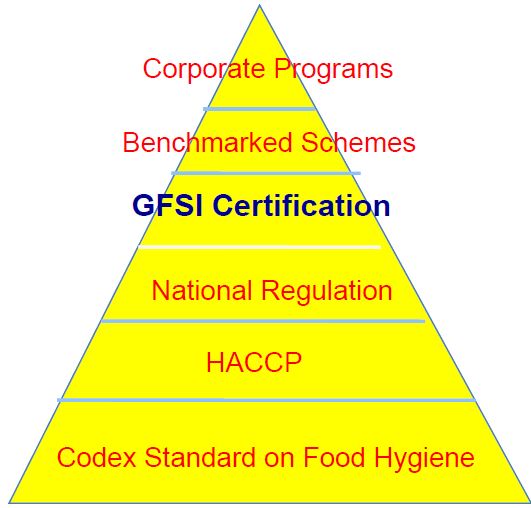
Why-GFSI-June2014At the very base of our efforts that are ensconced within these guidance on a sector by sector basis, are the international standards of science based within the Codex Standard on Food Hygiene. On top of that are Hazard Analysis and Critical Control Points or HACCP standards. Above HACCP are National Regulations, which includes FSMA in the U.S. and the Safe Food for Canadians Act in Canada. In Europe it’s something different, in Japan it’s something different, but all have iterative levels of science-based regulation in place to ensure the safest control of the food and management of the food. Above National Regulation is GFSI Certification.

“We go above and beyond the science of Codex, HACCP, and national regulation to perform at the highest level of industry. And our benchmarked schemes [eg. BRC Global Standards (BRC), Food Safety System Certification (FSSC 22000), International Featured Standards (IFS)] go beyond us and corporate programs go even further,” Kochenderfer highlighted.So what you have are several layers of protection that will help protect both consumers and companies.

What are some of the shared benefits for industry?

There are several benefits, which include:

  • Meet the requirements for one, meet the requirements for all;
  • Reduce duplication of audits;
  • Have comparable audit approach and outcomes;
  • Ensure the continuous improvement and customer opportunity for those GFSI-benchmarked companies;
  • Enhance trade opportunities;
  • Improve customer confidence in food safety; and
  • Gain cost efficiencies throughout the supply chain.

“We have now built confidence in third-party certification because we have reduced inefficiency in the food system. Now, it’s ‘Once Certified, Accepted Everywhere,'” stated Kochenderfer.

John Kukoly, Director of BRC in the Americas, added that companies should pursue GFSI certification for a number of reasons:

  • Customer mandate;
  • FSMA;
  • Nearly a 40 percent reduction in product non-conformance;
  • Competitiveness; and
  • Superiority in the market.

Right now, only a third of the industry has achieved GFSI certification, which leaves the remaining two-thirds either still at the starting line or just a few steps into their journey. How do you choose a GFSI-recognized scheme and get started?

Karil Kochenderfer shared a chart to allow users to see where they fall on the farm-to-fork continuum and further determine which scheme(s) would work for them.

Further, we have developed four GFSI checklists for the four major schemes that apply to food manufacturers, co-produced with the respective scheme owners to ensure accuracy and usability. The checklists are complimentary and may serve as a great resource on your journey toward GFSI certification.

Additional Resources:

Training in the Food Safety Industry

By Sangita Viswanathan
No Comments

Dr. John Surak food safety trainer and Warren Hojnaki of SGS talk about trends they see in food safety training, areas of focus, how to keep training relevant and useful, and what they are expecting to see in the future.

FDA, FSMA, FSMS, HACCP, GFSI, BRC, SQF, IFS, FSSC… The food safety sector is a cornucopia of new regulations, abbreviations and standards. Helping navigate this maze are food safety training courses and the instructors. However, the success of training programs depends on how applicable these courses and the curriculum are to the industry and the specific client, and how experienced and knowledgeable the instructor is in understanding current regulations, specifications of standards, hazard profiles and compliance requirements of that client. 

In an interview with FoodSafetyTech.com, Dr. John Surak, food safety trainer, and Warren Hojnaki of SGS, talk about trends they see in food safety training, areas of focus, how to keep training relevant and useful, and what they are expecting to see in the future.

John Surak, Ph.D., is principal of Surak and Associates, a full service food safety and quality consulting service. He works with the food processing industry in developing food safety and quality management systems, designing and implementing process control systems, and implementing Six Sigma and business analytics systems. Warren Hojnacki is Training Manager, for SGS North America. His department delivers training services for North American clients. 

FoodSafetyTech.com: What are some broad trends in food safety training that you are noticing?
Hojnacki: What we are seeing is a lot of clients needing foundational training. For instance, our most popular training programs are still HACCP, implementation for FSSC 22000, SQF etc. On the other side, clients are still very confused about what they should do regarding new and proposed food safety regulations. While they are following the directives that they receive from their customers, currently there still is a wait-and-see mentality. 

Dr. Surak: I notice the focus on food safety moving up the food chain. About 5 to 7 years ago, our primary clients for food safety training programs were food processing companies. Now our clients are suppliers to these companies as food companies are pushing the requirement for training on them. These supplier companies then need to make decisions on what schemes they want to be certified under. Most of the time, the customer accepts any GFSI-recognized scheme, but sometimes the customer names a specific scheme. Different GFSI schemes have different sweet spots and advantages. They all assume different knowledge about food safety and some are more prescriptive than the others. Clients have to figure out which scheme would be the best fit for them. 

FST: What kind of training courses are most popular, most asked for?
Hojnacki: When clients and companies decide on getting audited or certified against a particular food safety standard, training for that standard is a common requirement. Auditors specifically want to be trained to build their skill level, whether it’s getting trained for HACCP or FSSC 22000. A number of our clients also come to us saying that when they have a 3rd party audit, the most common non-conformances pertain to a less than robust internal audit system, so auditor training is a critical area that our clients ask for. 

Dr Surak: One of the biggest aspects of training that I try to focus on is lead auditor training. This course is designed to help an individual get certified in a particular audit scheme. We cover the same information for internal auditor training. However, the difference in this case is that for the internal auditor, the goal is to get his company certified. If a company has a strong internal auditor, they can reap substantial benefits. We also focus on, as part of our training, doing mock audits. This is more than going into a course or workshop and giving a lecture. For mock audits, you are put into a spot where you have to make real decisions on the floor. When we conduct such practice audits with our clients, in addition to our regular food safety training courses, we find a high level of involvement and interaction from the attendees and appreciation from the client. 

FST: What are some of the gaps in the training that you notice?
Hojnacki: What we see in general is people not covering the topic in-depth enough. Many training courses (outside those offered by SGS) seem to cover the topic in a very superficial manner and this doesn’t help. 

Dr. Surak: Many of the attendees who come to an audit training class have never taken the time to familiarize themselves with the standard. So what you are doing in that time is teaching them the standard and then teaching them how to audit. If the participants already know the standard, then you focus on just reviewing the standard and cover how to go about doing the audit. 

FST: What are some common questions attendees ask at ‘implementation/auditor’ training?
Hojnacki: Attendees very much want to know application to their respective situation. As an auditor, you need to know the right open-ended questions to ask when you are conducting an internal audit, and in our training, we provide examples for that. 

Dr. Surak: Our training focuses on enabling auditors to get the participant in a conversation and be able to answer questions during an audit. We are not in the business of writing traffic tickets, we are out to assess if the food safety system meets the standard, and also to identify the areas where it needs to be strengthened. Things that participants typically want to know are, going into a 3rd party audit, what is the auditor going to do? How is he going to react? And how can they present themselves in the best possible way to have a good audit? Also the instructor or auditor needs to understand the differences in the standards and the different hazards. There are unique challenges for different suppliers – or where along the supply chain they are, for instance are they a retailer, a supplier or a processor. It’s not a one size fits all situation. If you are looking at ingredient suppliers, the hazards are very different than what a retailer would be looking at, for instance. 

FST: How do you identify the best training company or program for you?
Hojnacki: We go through this everyday with every client call and we understand that we are not the only resource, our clients have several options. We first evaluate the trainer to understand what’s their educational and work experience background? Does it correlate to the industry you are in? Are they practitioners or just theorists? Food industry is a very big growth area right now, and we are seeing a proliferation of tutors coming into this field. Some of them have varied backgrounds, such as in automobile or aerospace industry. Often times, clients will make a decision based on prices quoted, and then realize that it didn’t work out the way they had anticipated. We (SGS) have often had to go to that client and redo things. Today, more than ever, the decision to choose a trainer/ training vendor, needs to be based on their competence, experience, and skills. 

Dr. Surak: I was recently at a client where they had completed certification training. When I asked to see the materials and bios of the instructor, I noticed that he had no prior experience in the food industry. I wondered how you could teach internal auditing in a food processing industry if you did not know about food processing! It’s imperative that clients look at the trainer’s background and experience. 

FST: Food safety training in 2015 – what will change?
Hojnacki: Food safety training curriculum will have to increasingly show greater applicability to clients to meet their needs. It has to be a round peg and in a round hole type of situation. Especially with FSMA rules getting finalized, clients are going to expect more out of their training. They are going to expect their instructors to be a resource, and to be up to date on the respective regulations and be able to tell clients how these rules will apply to them, and what they need to do differently. 

Dr. Surak: Processors are going to ask questions such as ‘I am certified to a GFSI scheme, so now do I have to do anything additional to meet new requirements’ or ‘are there areas where we have done some basic groundwork, and we have to raise the bar higher because of new regulations,’ and trainers need to be able to answer these.