

Tag Archives: FSMA

Elise Forward, Forward Food Solutions
FST Soapbox

Embracing the New Direction

By Elise Forward
No Comments
Elise Forward, Forward Food Solutions

Food safety and quality assurance professionals are called upon to be change agents and leaders. It is important to embrace change, growth and continuous improvement, as these are the keys to success. With the arrival of FSMA, the culture of the food industry as a whole is going to get a boost, and we need to embrace the change that is coming. We are called to be cheerleaders for change and to encourage others to assist as changes are made. The food safety culture of an organization is reflected in how a company responds to necessary changes.  However, it is often more than the systems that can use improvement; the culture could use some reinforcement as well.

Elise Forward will be speaking at the 2016 Food Safety Consortium, December 6–7 in Schaumburg, IL | LEARN MOREIn part two of a series on food safety culture, we continue to look at how food safety professionals can positively influence the food safety and quality culture of our respective organizations. In Part I, the people of the organization were recognized as critical to the food safety culture. In Part II, we will discuss the remaining items that affect food safety: access to resources, systems and opportunities for growth.

Access to Resources

Doing a job properly, efficiently and well is very difficult without the proper resources. One of the greatest challenges is to convince upper management that there is a need for additional labor, equipment and/or resources. Food safety culture is not about being the best; it is about going above and beyond and thinking outside of the box. Do not let the customers, FDA or CDC’s Pulsenet “catch” an issue. It is imperative to be proactive, look for problems and be innovative. This is part of the food safety/QA job, and support is needed from upper management. People, equipment and infrastructure must be connected to food safety issues and have a dollar amount put on them. The focus should not be on how much these activities or resources cost, but rather the savings that will occur because these food safety measures are preventing problems.

Considerations: Could a lack of resources lead to less cleaning? Could this cause a build-up of biofilms of unwanted and problematic bacteria, leading to a recall? Often production resources can be quantified as lost product produced. If production and quality have a new person, make sure that drains get extra scrubbing during downtime or that the walls and corners where the extra hoses are stored get added attention. What about any peeling paint? Or, dust on the overhead pipes? Who is attending to these items? Do you need a quality management system to manage the flow of information? Could a lack of this be severely detrimental in the event of a supplier withdrawal or recall? What is the value of time spent versus the benefits that a company-wide system could bring?

Systems

All food safety systems are under the microscope and getting an overhaul thanks to FSMA. As with any time that change is in the air, having a plan of action is helpful. The Plan-Do-Check-Act (PDCA) cycle is an easy-to-remember resource that can be useful when managing changing systems. Using this method provides the backbone to assist in the documentation of the change as well as evaluating the change and ensuring effectiveness.

  1. Plan. Create and document a plan for the changes. Include who, what, where, when, why and how in the plan.
  2. Do. Execute the plan and remember to document the actions.
  3. Check. Make observations, conduct interviews and audit the changes that were made. Document your findings.
  4. Act. Make any modifications to the system based on audits, interviews and observations. Document the actions taken and any required follow-up.
  5. Repeat the cycle until the results are satisfactory. Keep in mind that the goal is continuous improvement and should not be considered a one-time task.

In all things food safety and quality related, documentation of your efforts is critically important. The old adage, “if it is not documented, it was not done” rings true. The systems will be enhanced and people in the organization will see the importance of the changes and their role in the improvement of the systems if these items are documented.

Embracing Opportunities for Growth

Many people balk at change, probably because they cannot see the opportunities on the other side. Food safety and quality professionals also need to be able to communicate to all levels of the organization when change needs to happen. We need to talk about the changes, and whether they are required or desired. It is important to talk about the benefits, which help employees see beyond the uncomfortable time during the change. Do this through meetings with executives, doughnut days with shift employees, and pizza lunches with middle management. Implement incentive programs to reward people who are making good decisions and showing food safety leadership.

Since everyone will be impacted, it means that as quality professionals we need to band together. We are each other’s best customers. Let’s rise to the top, work together and expect the best of each other. If your customers are asking for stronger food safety systems than what is currently in place, use this to support your efforts in bettering the organization’s programs. If your organization cannot meet your customer’s food safety and quality requirements, will you have adequate sales? Probably not.

Being a cheerleader for change and improvement can be tough! Create a support group for yourself. Being the problem solver, leader and change agent can be draining at times, especially with a very small team. Ensure the renewal of the food safety team and yourself by connecting with other professionals through trainings, conferences, trade associations, etc. At a minimum, read leadership blogs in addition to the food safety and quality blogs and groups that are available. All of these avenues can provide support, encouragement and connection to others in the industry as well as serve as a resource for best practices.

Conclusion

How do you implement the changes that need to occur with FSMA? Slowly and surely. Plan the strategy for implementation. Be persistent. Communicate with all levels of the organization by being a teacher, coach and leader; avoid being a cop. FSMA requires changes to the food safety programs of every food company that supplies products to the U.S. food market. We must not sit by the wayside but rather constantly teach, mold and shape the leaders who are in current management as well as the future managers who are just starting their careers. Before we know it, we have again been change agents, not in the bold and loud way, but in the soft and subtle way that can create a lasting effect and will forever positively influence the food safety and quality decisions in our organization.


Food Lab count

Infographic: How Many Food Labs Are in the United States?

By Food Safety Tech Staff
No Comments
Food Lab count

Food Safety Tech: Earlier this year in “Counting Food Laboratories”, you discussed the fact that there is an unknown amount of food laboratories in the United States and an inconsistency in how we account for the labs testing our food. What impact does this have on the industry?

Robin Stombler, president of Auburn Health Strategies: There is limited information available on the presence and quality of food laboratories in the United States. Without this essential accountability, the health of the public, the economy and our nation’s security are at risk. For example, when a new food pathogen emerges, we do not have a system for contacting and educating all existing food laboratories on how to detect it. Frankly, we do not know where all food laboratories are located, so we do not know if they are properly equipped to handle the detection, monitoring or verification responsibilities. The lack of data also makes it difficult for industry to plan, track testing trends, and improve quality.

Counting Food Labs
Infographic courtesy of Auburn Health Strategies; Credit: Justin Stombler
Alert

How Safe Is Your Facility from Threats?

By Maria Fontanazza
No Comments
Alert

Vulnerability assessments are a key provision of the FSMA final rule, Mitigation Strategies to Protect Food Against Intentional Adulteration. With this requirement comes the “identification of vulnerabilities and actionable process steps” that must be taken to mitigate potential threats. During the IAFP annual meeting Lance Reeve, senior risk management consultant for food safety and defense at Nationwide Agribusiness Insurance Co., reviewed the important and sometimes-overlooked areas that companies should be looking at when conducting vulnerability assessments.

Inside the Plant

To start, vulnerability assessments should be conducted at different times of the day, and the process should involve a team approach, said Reeve. Food defense cannot effectively be managed by a single person within a facility: It needs to involve all departments, from human resources to IT to production to warehousing, and extend to outside suppliers and vendors. How is the flow of employees and visitors around the facility managed? Do staff members wear color-coded badges? Some companies have a color-coding plan to prevent contamination, but it is also a useful tool to ensure that unauthorized employees, outside contractors and visitors aren’t in restricted areas. For example, the maintenance shop may contain deadly food contaminants—do you really want general employees to be able to get into this area? Consider using electronic technology such as biometric access control to limit access based on employee/security credentials.

Working with the human resources department is a critical part of protecting a facility. Does your company have the capability to conduct thorough background checks on all employees? In addition, with all the different types of contractors and vendors who enter your facility it’s important to find out whether your contracting companies are doing the same level of background checks as your organization when they hire employees.  And finally, examine how the culture within the organization. Do employees challenge the presence of visitors who shouldn’t be on the premises?

Outside the Facility

In many cases, companies will look at the inside of their facility for potential hazards and vulnerabilities, but what about the perimeter? How are you controlling the people who are coming onto company property? While this may seem obvious, Reeve recommended physical objects to establish authority: Fences (establish physical border), signs (establish where control begins), and CCTV cameras (establishes security). And when looking at the outside of the building itself, how secure is the roof? What access does a potential attacker have into the facility via the roof? How often are security checks conducted here (if at all)?

Throughout any given day, a company can receive several cargo shipments from a variety of different suppliers. Are you familiar with the food safety programs of your suppliers? They play a critical role in food defense strategies. And when your company receives shipments, Reeve advised that companies go beyond looking at the seals on trucks and examine the transportation system itself. Is cargo removed in a secure area? Is an authorized employee supervising the process or is it left in the hands of the third-party driver?

And finally, a critical part of your mitigation strategy should be to challenge the system. Once you think you may have found all the vulnerabilities, conduct penetration testing.

Stephen Ostroff, FDA

Pathogens, Partnerships and FSMA: Where FDA Is Headed

By Maria Fontanazza
No Comments
Stephen Ostroff, FDA

This year is a big year for food safety at FDA. All seven of the FSMA rules have been finalized, and the first compliance date is right around the corner (compliance with the Preventive Controls for Human Food rule starts in September for large companies). Stephen Ostroff, M.D., just took the helm from Michael Taylor as the agency’s deputy commissioner for foods and veterinary medicine. And finally, FDA is taking a hard line in both improving the tools and methods used to detect outbreaks as well as working with the Department of Justice to prioritize enforcement actions against companies that introduce adulterated foods into the supply chain.

Yesterday Ostroff provided an update on FDA’s recent initiatives and its plan of action to achieve success in FSMA implementation and pathogen detection at the IAFP annual meeting in St. Louis. Ostroff highlighted several tenets of FSMA:

  • Keys to FSMA success will be dependent upon achieving high rates of compliance
  • Domestic and import parity
  • Education before and while regulating (establishment of training and education networks)
  • Taking a risk-based approach to inspection and planning
  • Partnerships are critical
Stephen Ostroff, FDA
FDA’s Stephen Ostroff will be the opening keynote at the 2016 Food Safety Consortium, December 7 in Schaumburg, IL. LEARN MORE

Industry can expect three more rulemakings as required by FSMA in the areas of lab accreditation, a reportable food registry and product tracing. In addition, FDA is working on guidances related to the preventive controls, produce, and foreign supplier verification program rules. “We’re tantalizingly close so stay tuned,” Ostroff said.

Expect to see more program alignment with the Office of Regulatory Affairs as well. The inspection and compliance staff will be trained as specialists and there will be horizontal integration of programs between field activity and agency headquarters. Although the next fiscal year will be a transition year, Ostroff is hopeful that changes that need to be made at the agency, along with program alignment, will be in place by fiscal year 2018.

Other notable actions at FDA over the past year include:

  • In response to the OIG’s conclusion that FDA’s food recall program is not efficient or effective, the agency is ramping up its use of the strategic CORE (Coordinated Outbreak Response and Evaluation) network in order to examine recalls that might not be moving as smoothly or quickly as the agency prefers. FDA is also leveraging greater application of whole genome sequencing (WGS).
  • GenomeTrakr network and WGS. More than 50,000 genome sequences have been added to the database (largely Salmonella). Ostroff called WGS a game changer that holds the opportunity to more quickly identify problems and detect outbreaks while they’re still quite small. In partnership with the CDC, FDA set up a successful module for WGS of Listeria and the agency hopes to expand the model for use with other pathogens.
  • Nutrition (Not just what consumers are eating, but how much of it): The move that declared partially hydrogenated oils as no longer GRAS with compliance required by 2018.  The agency also issued a final guidance on menu and vending labeling in May, issued levels for arsenic in infant rice cereal, made determination for folic acid fortification in corn/masa, made revisions to nutrition facts labels that takes effect in 2018, issued a draft guidance on voluntary sodium reduction, and will continue to exam the terms “natural” and “healthy”.
  • Genetic engineering. FDA approval of GE salmon following one of the longest reviews in the history of FDA (20-year review), along with issuing voluntary labeling guidance.
  • Monitoring antimicrobial resistance through NARMS  (National Antimicrobial Resistance Monitoring System). FDA will be collecting antimicrobial sales by species and, in cooperation with USDA, hopes to release farm-based data about antimicrobial use at the farm level.

Ostroff emphasized FDA’s strategic 10-year plan, released this year, pointing to public health as a first priority, maintaining partnerships as a key to success (including re-establishing overseas offices), continuing research as a foundation, and maintaining transparently.

Bill Bremer is Principal, Food Safety Compliance at Kestrel Management LLC
FST Soapbox

Managing GFSI Certification a New FSMA Requirement

By Bill Bremer
1 Comment
Bill Bremer is Principal, Food Safety Compliance at Kestrel Management LLC

Compliance to FSMA requires companies to meet existing program requirements and new ones being published or face regulatory consequences. A part of FSMA also requires that companies follow established food safety plans, which includes GFSI certification.

With these changes, GFSI-level programs must integrate into an aligned Food Safety Management System (FSMS) and strategy. Key considerations include sustainability, multi-year planning, effective organizational structures and expectations, well-defined roles and expectations, compliance, and business objectives.

The value of GFSI certification depends on how the company uses its organizational resources to maximize return on investment, while meeting the changing FDA requirements. Effective management of a GFSI-certified FSMS can have a significant impact on FDA/FSMA compliance. The risk of not meeting established programs while implementing new FSMA programs must be measured, and attention must be given to addressing FSMA compliance, while maintaining established programs.

Complying with FSMA Food Safety Programs
The implementation of FSMA-compliant programs requires having an established GFSI FSMS and demonstrating conformance with one’s own policies. Programs must be maintained and improved as the FSMA requirements are developed and implemented. Each of the GFSI schemes has been vetted to meet a significant level of FDA/FSMA requirements—a key benefit to these industry programs.

Developing a compliant FSMS with proper alignment of your existing programs to FSMA must be assessed. For example, companies with more than 500 employees must include requirements in their programs for the FSMA Preventive Controls rule, which is set for compliance September 19, 2016. In this regard, registered food facilities must evaluate and implement preventive control provisions and meet the requirements by the approaching deadline. This requires effectively updating current programs, establishing key imperatives including cGMPs (Section 117), identifying a Preventive Control Qualified Individual (PCQI), and implementing a Food Safety Plan.

The following areas are all included under the FSMA requirements:

  • cGMP, Controls and Preventive Controls. Must be identified, modified, and implemented to further minimize or prevent the occurrence of hazards based on Section 117 requirements.
  • Food Safety Plan, Hazard Analysis, and HACCP. Companies must identify and evaluate changes in their existing programs to include FSMA Preventive Controls.
  • Qualified Individual. Must be trained with authority to oversee Preventive Control program aspects, developments and impacts.
  • Written Programs and Documentation. Up-to-date GFSI-level FSMS provides documented programs, procedures, and records for meeting requirements under FDA/FSMA.
  • Management & Monitoring. All controls, including under FSMA and existing GFSI-level, must be monitored, validated, and verified for effectiveness.
  • Management of Corrective Actions. Procedures including traceability response for addressing failures of procedures, GMPs and controls must be under management review and confirmed for prevention of adulterated food from entering commerce.
  • Recordkeeping. Records must be complete and accurate for all food production and safety activities and kept for two years, including the testing level verification of all programs under FSMA and GFSI-level programs.

Self-Diagnostic Assessment Tool

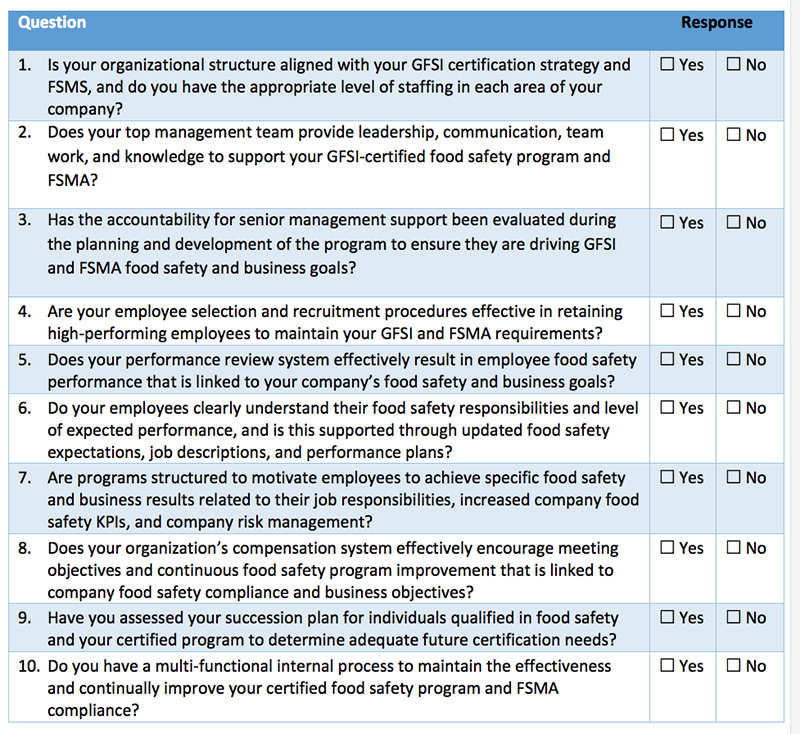
The following self-diagnostic assessment tool can help organizations better determine their current state of planning when it comes to GFSI-level programs meeting FSMA. To complete your own planning assessment, review your progress compared to the questions in Table I.

FSMA, GFSI
Table I. Kestrel Management’s self-diagnostic tool can help a company assess its level of FSMS and GFSI preparedness for FSMA compliance.

Get Compliance-Ready

Companies must have their existing food compliance and GFSI programs in good standing to comply with FSMA or face possible violations, fines and penalties under FDA enforcement. The questions in Table I will help companies identify the areas in which they need to focus attention. Kestrel can also help answer questions, provide input on solutions, discuss how to better manage GFSI certification—and change “No” responses into “Yes” responses that promote best practices for FSMA compliance.

Randy Fields, Repositrak
FST Soapbox

Sanitary Transportation Rule: Ignore at Your Own Peril

By Randy Fields
1 Comment
Randy Fields, Repositrak

FDA posted the FSMA rule on the Sanitary Transportation of Human and Animal Food in April. The majority of retailers, wholesalers, suppliers and carriers will have one year to comply with this new rule. The sanitary transportation rule sets out to prevent practices that would introduce contamination risk during the transportation of food through the supply chain.

For retailers, wholesalers, suppliers and carriers, the final rule is really the sleeper regulation among the new FSMA laws. You probably have your HAACP plans and preventative control procedures in place, but do you have the necessary documents in place with your carriers to meet the FDA’s requirements?  And, are those documents easily accessible?

Under FSMA, you must address all FDA record inquiries within 24 hours, and these inquiries can go back two years, plus 12 months beyond the expiration of related service agreements. Failure to respond to an FDA records inquiry is considered a “prohibited act” and can land you in hot water with both the FDA and Department of Justice, which acknowledged they will enforce FSMA through civil and criminal penalties. That’s a game changer.

You are now required to ensure that transportation equipment does not cause the food it is carrying to become unsafe. You must also maintain adequate temperatures throughout your portion of the supply chain and prevent cross contamination. And, you must train your personnel in sanitary practices. All of these factors—processes and procedures, agreements and formal training of personnel—must be documented and made available to the FDA. Put simply, compliance with FSMA is proven through documentation because according to the FDA, if it is not documented, it did not happen!

So what’s the best way to comply with the new rules? Having the information on paper in filing cabinets simply won’t do. Can you imagine searching for specific confirmation that an employee received the proper training in a bank of file cabinets? Even with an efficient system, that could be like looking for a needle in a haystack. Collecting the information in spreadsheets is only slightly better, as it simply digitizes the disorganization.

Retailers, wholesalers, suppliers and carriers need to start their compliance process by reviewing and understanding all of the FSMA rules, guidance procedures and responsibilities. You ignore them at your own peril.

Then, consider automating your recording keeping system.  It is really the only way to efficiently collect and manage the documentation needed to comply with the new law.  When reviewing technology options, make sure you choose a system that is not only easy to use by frontline workers, but also provides sophisticated reporting and alerts to point out potential problems in real time. And, if possible, the solution should do more than just report on food safety activities. As long as you’re investing in a technology to meet FSMA requirements, you might as well implement a system that can potentially save money in other areas such as managing business or training documentation, new vendor approvals, or carrier optimization.

The bottom line is that the sanitary transportation rule will require that you devote additional resources to make the entire extended grocery channel more risk free for consumers and companies alike. And the best way to do that is to implement new technology that gives visibility to product transfers from point of production or processing to the point of purchase, and documents each step along the way.

Deirdre Schlunegger, CEO of STOP Foodborne Illness
Food Safety Culture Club

We Know the Why

By Deirdre Schlunegger
No Comments
Deirdre Schlunegger, CEO of STOP Foodborne Illness

Food safety culture is not just a catchy phrase or the right thing to say. It is the right thing to embrace and the right thing to implement. But how is it achieved? It is relevant to start with understanding “The Why” behind food safety. Why is it important?  Do people really get sick and die? Why does that happen, and what is our role in preventing it?  How do we integrate aspects of FSMA with a culture that embraces a robust food safety culture, and how do we create passion around the culture?  I continue to address this issue, because at nearly every meeting I attend, in committees in which I serve and in simple conversations with colleagues, I hear the frantic voices of those who have so much to do, results to produce, bosses to please, and staff to supervise, and the why behind food safety is rarely mentioned.

STOP Foodborne Illness, Why Behind Food Safety
We need to truly understand the “why: behind food safety.

I speak to and read about individuals daily who have been sick or lost children or parents to this preventable problem. I see the photos of their children and hear about their loving attributes, yet this aspect is often neglected in the equation of the busy lives of those involved in growing, producing and distributing our food. I get it—who wants to talk about the problem when there is a product to promote and sell? But in reality, the only reason any of us live this frantic life with a long to-do list is because people get sick and die from foodborne illnesses, and because it is our job to do what we can to prevent the illnesses. And while consumers can practice safe food handling, there is nothing they can do about Salmonella in peanut butter, or Listeria in ice cream, cantaloupe or caramel apples. Let’s start the conversation of HOW to change and sustain a strong food safety culture and include the why as our rationale in the conversation.  STOP Foodborne Illness is interested and will devote more time to the how, and I hope you will join us in this conversation and endeavor. I would love to hear your thoughts.

FDA

FDA Finalizes Rule on Food Facility Registration

By Food Safety Tech Staff
1 Comment
FDA

As part of FSMA implementation, FDA has announced a final rule, effective today, that will better protect public health by improving accuracy of the food facility registration database. The Amendments to Registration of Food Facilities will also help the agency more efficiently use its resources to conduct inspections and aid in a faster response to food-related emergencies.

The final rule adds provisions to the current regulations to codify certain provisions of FSMA that were self-implementing and effective upon enactment of the regulation, according to an FDA update. Provisions require:

  • Email address for registration
  • Registration renewal every two years
  • Registrations must have assurance that FDA will be allowed to inspect the facility at any time

Important dates:

  • Final rule effective July 14, 2016. Registrations must contain type of activity conducted at the facility for each food product category.
  • Requirement of electronic submission of facility registrations takes effect January 4, 2020.
  • As part of registration proves, food facilities must provide unique facility identifier (UFI) beginning October 1, 2020.

Go Beyond the Classroom to Improve Employee Performance

By Maria Fontanazza
No Comments

Employee training continues to be a hot topic as companies in the food industry gear up for FSMA compliance. Many are working with a much leaner staff and have several different generations of employees, many of whom absorb information in very different ways.

In a Q&A series with Food Safety Tech, Laura Nelson, vice president of business development at Alchemy Systems, discusses how training programs that may have historically been successful are no longer an effective means to educate today’s employees. “A vast majority of employees are doing what we ask and are doing it consistently. But the reality is that we have a subset of folks [who] aren’t doing that,” says Nelson. “I don’t think you can classroom train them to the point that they get it—I think some need that coaching and demonstration; they’re the kinesthetic learners that need to see you do it and then you watch them do it.”

Food Safety Tech: Where are the gaps in how food companies conduct employee education and training today?

Laura Nelson: It can be summarized in three areas.

1. Recognizing that the legacy training programs that food companies have is not effective. Companies are acknowledging that their historical training programs are not entirely effective in driving consistent behaviors. In [a recent] global food safety training [survey], we asked: “Despite our efforts in food safety classroom training, we still have employees not following our food safety program on the plant floor”. Over 60% said they agreed—yes, we still have employees not following our food safety programs. The survey involved 1200+ food safety professionals, so that’s a large number of folks acknowledging that their food safety training programs—largely classroom training—is not delivering the desired results and reducing inherent food safety risks.

There are so many things challenging the food industry and everyone is trying to manage these expanding expectations with their lean teams. The industry is changing dramatically—[from the perspective of] employee demographics, the business itself, pervasiveness of social media and exposure that it brings, and the different regulations—so a static food safety program established two, five or ten plus years ago is not going to address these changes.  But who has the time and resources to continually update content, embrace technology and apply the latest behavioral science to the instructional design of new training content?  Because of the lack of resources and time challenges, many in the industry are still trying to operate on their legacy training program. It might be old DVDs, PowerPoints, etc. —trainers are covering food safety, workplace safety and operational topics via PowerPoints in all-day sessions, sending around a sign-up sheet and ticking off their training compliance checkbox.  Training has to be improved and enhanced for many key reasons—whether it’s considering different cultures, updating languages, engaging millennials or focusing on those critical employee behaviors that present a risk to an individual operation.

2. Understanding that training expands beyond the classroom. The industry as a whole continues to think that classroom training is their training program and that once the classroom training is complete and [the employee is] on the operations floor, that the training and education job is done. The reality is, it’s not. There’s lots more training happening beyond the classroom. Understanding that we need to formalize the extension of the classroom training and manage the ‘plant floor’ training aspect is really important. The industry is starting to embrace this [concept]. Anywhere from formal coaching and mentoring by frontline supervisors to posters and digital signage and short reminders to monthly campaigns on key critical items around food safety. Companies are starting to embrace the power of this holistic approach to training, leveraging new and emerging technology and tools to optimize employee behaviors.

3. Most people are not making the connection between training effectiveness and the ROI, the return on the investment. They think they don’t have the time to make improvements—yet, if they carved out time routinely to assess and evaluate best training practices to make training more effective and implemented these new and proven strategies, then all of a sudden the time and resource question becomes less of an issue because now you’re delivering on things like a decrease in food quality issues or reducing [employees] turnover, decreased downtime, reduced GMP non compliances, etc. It takes some time to establish those related training metrics, but once you’ve done that and have ensured that your holistic training program is current and behaviors are being exhibited consistently, you start to have fewer operational issues, enhanced customer satisfaction and motivated, engaged employees.

In part II of this Q&A series, Nelson shares her insights on training strategies based on employee demographics.

Patty Murray
FST Soapbox

Chilean Gourmet Food Companies Eager to Learn about FSMA

By Patty Murray
No Comments
Patty Murray

Whenever possible, I try to spread the word about food safety and share the knowledge gained from my years of experience in various sectors of the food industry, especially from my time managing the Food Safety Tech conferences and webinars. Recently, I even worked it into a presentation about social media marketing for a Pro-Chile Trade Board Event where food safety issues were hot topics throughout the day.

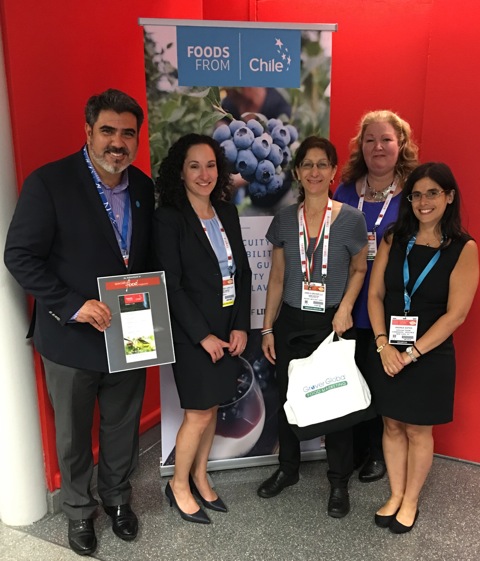
Representatives of more than 30 food manufacturers from Chile attended the event, which was held at the Summer Fancy Food Show in New York City and organized with The Food Institute and Grover Global Food Marketing.  Well established in Chile, these producers of gourmet specialty food products wanted to learn the intricacies of selling their cured meats, olive oils, edible flowers, teas, preserves, desserts and snacks in the United States.

(left to right) vent sponsor, Mauricio Banchieri, Trade Commissioner, Trade Commission of Chile in New York - ProChile, with speakers Lauren Handel, Janis Grover, Patty Murray and Andrea Sapag of the Trade Commission.
(Left to right) vent sponsor, Mauricio Banchieri, Trade Commissioner, Trade Commission of Chile in New York – ProChile, with speakers
Lauren Handel, Janis Grover, Patty Murray and Andrea Sapag of the Trade Commission.

The reason: Americans spend a lot on food—$1.5 trillion annually, which is 28% of all retail trade in the United States, according to Brian Todd, president and CEO of The Food Institute, a firm that provides industry news, data and trends. He shared that consumer spending was up 2.3% in 2014 to $6,759 per year per household. Products on the rise include fresh fruits and vegetables, dairy, olive oil, confections and beverages. Key qualities include grab-and-go/convenience, non-GMO, organic, all-natural, healthy, fortified, gluten-free and air-popped/baked.

Todd and other speakers addressed new U.S. government regulations including FSMA, food labeling (nutrition and front of package), bioterrorism, customs, facility registration and certifications.  Drilling down into many of the legal details was Lauren Handel, Esq., of Handel Food Law in New Jersey. Handel emphasized the importance of FSMA compliance, in particular, preventive controls, produce safety and foreign supplier verification.

Janis Grover, of Grover Global Food Marketing, who has more than 30 years experience in brand management, pointed out that non-U.S. food manufacturers have an extra hurdle to overcome with the new food safety laws. Grover explained that establishing food safety confidence in their brand with U.S. buyers is critical before they can begin negotiating any importing and distribution deals. According to Grover, to be successful, non-U.S. food manufacturers need to verify with U.S. buyers that they will comply will all U.S. food manufacturing and labeling laws, and that they have the required certifications and other quality control documentation to support their claims.

Sometimes at our FST conferences, speakers and attendees ask about the implementation of our new food safety laws. Will top management provide the funding for quality systems and traceability? Will companies be vigilant about the entire supply chain? Will there be significant and meaningful enforcement by government? Will foreign suppliers comply?  I was heartened by the tone and content of the Pro-Chile event and optimistic as I walked the Summer Fancy Food Show with another international client. One of the first statements made to us by a potential U.S. partner was “Do you have a GFSI certificate?” My client did.