Tag Archives: FSMA

Safe Food Coalition Calls on OMB and USDA to Release Revised Poultry Rule for Public Comment

By Food Safety Tech Staff
No Comments

The Safe Food Coalition wants the public to be given an opportunity to comment on the changes made to the proposal before the rule is finalized.

Members of the Safe Food Coalition called on the Office of Management and Budget and the U.S. Department of Agriculture to release a revised version of USDA’s proposed rule to modify its poultry slaughter inspection program, open the rule up for a comment period of 120 days, and hold public meetings on the revised rule.

Last week, USDA announced it was sending a revised version of its proposed poultry rule to the Office of Management and Budget for review. In doing so, USDA officials said that the rule had been significantly changed based on stakeholder feedback.

However, in a letter to USDA Secretary Tom Vilsack and OIRA Administrator Howard Shelanski, members of the Safe Food Coalition noted that “stakeholders have no information about what those changes entail. We have raised numerous concerns about the negative impact USDA’s proposal will have on food safety and consumer protection. Many other public interest groups, members of Congress and even other government agencies have raised concerns as well. Considering the importance of this rule, the public should be given an opportunity to comment on the changes made to the proposal before the rule is finalized.”

The groups noted that the Food and Drug Administration is carrying out just such an action: “FDA published a proposed rule in 2013 implementing the produce safety provision of the Food Safety Modernization Act. Following the close of the comment period and in response to widespread stakeholder concerns, FDA announced that it would revise its proposal and re-publish it for public comment. FDA’s approach would ensure that the public has an opportunity to comment on substantial changes to its proposed rule before it goes into effect.”

Members of the Safe Food Coalition have repeatedly expressed serious food safety concerns with USDA’s proposed rule. 

Sangita Viswanathan, Former Editor-in-Chief, FoodSafetyTech

Pet Food Safety: Regulations and Challenges

By Sangita Viswanathan
No Comments
Sangita Viswanathan, Former Editor-in-Chief, FoodSafetyTech

Alan Baumfalk is Pet Food Safety Specialist and food safety Auditor at Eurofins US Foods Division. After more than three decades of experience in human food production facilities, Baumfalk began inspecting and auditing pet food companies with a fresh pair of eyes and in his opinion, “pet food plants typically are very well maintained, embrace technology, are highly automated, have great productivity and are very efficient with their sanitation and production.”

In an interview with Food Safety Tech, Baumfalk talks about differences in production of human food and pet food; lessons learned from historical incidents such as melamine in pet food and contaminated chicken jerky; what are some gaps in pet food safety he’s noticing and impact of the Food Safety Modernization Act or FSMA on this sector.

Food Safety Tech (FST): What are the differences between the production of human food and pet food?
Baumfalk: In most cases, pet food facilities are dry facilities, making kibbles and similar products, and their cleaning sanitation processes are mostly sweeping and dusting, with very little water involved. When it comes to regulations covering pet food facilities, most of these fall under FDA jurisdiction, and pet food facilities need to have in place risk-based HACCP plans to ensure food safety. Some of the challenges involved in pet foods are how do you do sensory testing on dry pet food or test for taste or consistency? Pet food testers look at certain quality attributes such as color, look, smell and taste of the product. They look for data such as amount of protein in the food etc. They also need to consider if humans – especially the elderly, or children – would consume the pet food product, because this can have many food safety implications.

FST: Humans have allergic reactions to certain food ingredients. Do pets have similar concerns of allergens?
Baumfalk: We don’t know if pets suffer allergic reactions to any specific food ingredients similar to humans. Pet food manufacturers are not subject to allergens and are exempt under FDA’s allergen management regulations. However, there are strict GMPs maintained in pet food production facilities, so that known allergens are identified. Pet food manufacturers give attention to allergens though they are exempt because it’s possible that the allergens could get transferred to a human in the house who could be allergic to nuts or soy, and this could be a huge problem. In our experience, we have seen that pet food can be occasionally consumed by a child or an elderly pet owner, out of curiosity.

FST: How about pathogens such as Salmonella and E.coli, are pets susceptible to these?
Baumfalk: Pets are not typically affected by pathogens such as Salmonella or E.coli, and this goes back to their genetic background, which is, dogs coming from wolves, and cats from tigers and lions. These animals are used to eating things with pathogens, fecal matter etc. However, humans are at risk of infection by Salmonella and E.coli, so while the end consumer of pet foods are not affected by these pathogens, their handlers are. Hence, pet foods are tested for Salmonella and E.coli to make sure they are pathogen free. They have Critical Control Points (CCPs) and kill-steps just like human foods, and pet foods are diligently sampled before they are released in the market. Environmental monitoring is also strictly carried out – such as extensive swabbing of processing floor, walls etc. to test for Salmonella/ E.coli/ mycotoxins etc. If a raw material exceeds FDA guidance for mycotoxins, then they are rejected. Many manufacturers test for mycotoxin levels in finished product as well.

FST: Are there differences in auditing pet food companies versus human food manufacturers?
Baumfalk: All pet food companies are looking to get certified and audited under a GFSI-recognized scheme. SQF is probably the biggest standard though some choose BRC. Eurofins has close ties with the American Feed industry Association (AFIA) which recommends SQF, and so we follow the same standard when auditing pet food facilities. SQF has modules specific to pet food category and dry pet food products. There are a lot of similarities with requirements for human food – for instance, pest control within a pet food plant is the same as within a human plant. The commitment and requirement for compliance is the same.

FST: What are some gaps or challenges in pet food safety?
Baumfalk: Most of the folks working in the pet food industry have a background in human food and are very much aware of the technical and regulatory requirements for making human food, so they end up carrying it over to pet food production. They typically follow GMPs and HACCP, and safety plans to ensure there are no food safety gaps. While most pet food companies meet, or even exceed, compliance requirements, there are always some people in the industry that don’t get the message.

FST: When we think about pet food safety, the history of melamine contamination of pet food, and tainted chicken jerky from China come to mind. What are lessons learned and how can the pet food industry be prepared for the unknown?
Baumfalk: The melamine adulteration and chicken jerky contamination incidents have taught the industry to be on guard. The industry has to make sure that they are in close alignment with their industry association which speaks for them, read technical documents, hire and train knowledgeable staff – all of which helps constantly look for the next thing that we weren’t aware of. Apart from diligently monitoring the global supply chain, it would help to have strict audit specifications for global suppliers. If something is coming from the other part of the world, where there’s a history of food safety standards not always being up to par, the pet food industry needs to make sure to buy only from a known and approved entity. Also look for lessons that can be learned from the human foods industry. Read about recalls and withdrawals and find out why that happened, if the pet food industry has similar exposure, and how this can be addressed.

FST: What will be the impact of the proposed pet food safety rule under FSMA be on this industry?
Baumfalk: FSMA is going to tighten things up, paying a lot of attention to the global supply chain and any vulnerabilities. While regulations are still being finalized, the pet food industry is already aligning itself with these proposed regulations. The technical and regulatory folks in the industry are following it; they are reading food safety journals and interacting with their associations for guidance and for making comments on the regulations. We are also updating our auditing checklists to see how we can align better with new FSMA requirements.

For more information on Eurofins, it’s pet food and auditing capabilities, click here.

Dr. Jim Fredericks, Chief Entomologist & Vice President of Technical and Regulatory Affairs, National Pest Management Association
Bug Bytes

Why is Pest Management Critical to Food Manufacturing Operations

By Dr. Jim Fredericks
No Comments
Dr. Jim Fredericks, Chief Entomologist & Vice President of Technical and Regulatory Affairs, National Pest Management Association

Every manager of a food manufacturing plant knows that food safety cannot be compromised under any circumstances and that the entire process is dependent on a number of aspects working effectively, efficiently and in a healthy and safe manner. However, no process is foolproof and any breakdown in the manufacturing process could lead to contamination. Some of the most pervasive contaminants come as a result of insects, rodents and other pathogens finding their way into the plant. It is for this reason that pest management is critical to food manufacturing.

Depending on the type of food product and how it is processed, there are ample opportunities for pests to associate themselves into the food manufacturing life cycle – be it during the growth cycle, at harvest, within the mode of transportation, during material preparation and final processing.

Fortunately, today’s scientific equipment provides the ability to detect amounts of contaminated materials in a given finished product down to the nanogram and “zero” continues to get smaller and smaller with each advancement in chemical [contaminate] detection technology. However, as plant science and seed chemistry improve, so does yield production. With this production increase comes additional processes that create opportunity for pest threats to enter food-manufacturing operations. In order to maintain a safe and clean facility both the food manufacturing facility manager and pest management personnel must address each issue head on.

There are a number of factors that pose challenges to proper pest management in food facilities such as the time of operation [some pests prefer daytime, while others prefer nighttime], production cycles [season of harvest can denote degree of pest infestation], maintenance schedule [how often do lines or plants shut down for cleaning and up keep], delivery schedule and flow of raw materials [when and how they enter and leave] throughout the plant. The addition of other factors, like moisture levels and temperature extremes within the construction elements of the plant, can create ideal conditions for pest harborage and nesting areas.

The world is a smaller place today and food transportation can be accomplished by multiple sources; food products are now shared across borders and oceans in a much shorter time frame than before. Due to the potential introduction of a new pest species or plant disease, it is crucial that facilities and their pest management partners develop a common platform for risk assessment, analysis and preventive controls to achieve success. Having the ability, discipline and quality control processes in place to intercept or disrupt this potential hazard are extremely important. The pest management professional is a line of defense that supports the food manufactures by inspecting, performing audits, identifying and preventing, improving and correcting hazards or situations that could cause damage, contamination or illness.

The consequences of not taking pest management seriously can be devastating to a food manufacturing company – resulting in fines, production shutdowns, closures and even bankruptcy filings. Not to mention a tarnished reputation, shaken confidence and public scrutiny of the brand and finished product. Certain failures may even create a system wide product recall compounding the negative effects.

The words ‘and’, ‘team’, ‘partner’ and ‘critical’ to describe the approach of a pest management professional and food manufacturing facility management and are key in understanding the role each plays – one to cut the risks and the other to protect, both helping each other accomplish the desired level of food safety.

Being proactive about food safety, including pest management, is paramount in protecting life and health. In the food safety industry food manufacturers work with a lot of different standards, protocols and regulations, such as Good Manufacturing Practices (GMPs), Standard Operating Procedures (SOPs), and Hazard Analysis Critical Control Point (HAACP). The standards are risk-based in order to address the issues as risks to public health and food safety due to activities of pests.

FDA is trying to level the playing field on food safety with the implementation of the Food Safety Modernization Act (FSMA) – the biggest change to food safety laws since the 1930’s – helping to bring together the various practices and governing agencies under a common goal – preventing food borne illness with sustainable and accountable improvements in food safety using prevention based controls.

As part of FSMA compliance, the pest management professional must be an integrated member of the food safety team. Thorough knowledge of the plant’s quality programs, manufacturing practices, approved product lists and sanitation programs is critical to success. Both pest management professionals and food manufacturing operations managers should also be aware of new pest control products and application techniques to fully offer the facility the best pest management program possible.

In all food manufacturing facilities, the pest management professional and manufacturing operations facility manager should both be prepared to:

  1. Work together with open communication.
  2. Provide training to both sides, whereas the plant team trains the pest management professional on the facility and processes with expectations of the service agreed upon. The pest management professional trains the food manufacturing team on basic pest management and where this fits into their food safety program and HACCP system.
  3. Set written expectations of services, treatments as well as a process for proper documentation. Utilize an appropriate accountability system of mapping and numbering all points of inspection, monitoring and treatment.
  4. Both parties should remain open to conversation regarding new and innovative techniques and treatment options that utilize the preventive intent of FSMA in conjunction with the concept of Integrated Pest Management (IPM).

The bottom line is that foodborne illness is largely preventable if everyone can be held responsible and accountable at each step they own for controlling hazards that can cause illness.

Traceability Requirements and Best Practices

By Michael Biros
No Comments

What is a traceability system and how is it related to a recall plan? Will FDA require electronic record-keeping? What does FSMA require FDA and industry to do in terms of traceability? These questions and more are answered by The Acheson Group in the latest FSMA Fridays webinar.

What are the latest updates on FSMA?
In response to the substantive nature of the public comments, FDA plans on proposing new versions of the Preventative Controls Rules for Humans and Animals.

The proposed Preventative Control rule requires a recall plan. Is traceability covered through mock recalls?
A recall plan and a mock recall are not the same as a traceability system. A traceability system focuses on the ability to know what came in from where and where it was sent. A mock recall is a much more involved process that looks at production records and many other factors. However, in order to do a robust recall, you need a functional traceability system. The Preventative Control rule requires a recall plan and other parts of FSMA require traceability systems. The two are related, but they are fundamentally different.

How does FSMA address traceability and why is traceability a part of FSMA?
Traceability is distinct from a recall plan and FDA will have to address it separately from the Preventative Controls requirements. Traceability is covered in Section 204 of FSMA which describes the detection and response to food safety problems. While there’s an element of prevention in having a good traceability system, it really focuses on the response side. Traceability continues to be an Achilles’ heel for the regulators. Many of the statute components that are built into FSMA are based on prior experiences and situations. The biggest debacle with traceability was the tomato/pepper issue in 2008 where not only was the commodity wrongly identified, but it took close to eight weeks to figure out that it was wrong.

In this instance, FDA struggled with not having adequate records and being able to do the traceability components correctly and quickly. This and other similar issues has caused the food safety pendulum to swing.

Traceability is essential. FDA would love for the traceability requirements to be more robust, but they are limited by what is economically feasible and practical. Looking to the future, it’s entirely reasonable that traceability requirements could be strengthened.

What does FSMA require FDA to do in terms of traceability?
Pre-FSMA, there are record-keeping requirements in place related to traceability coming from the Bioterrorism Act. Basically, the current requirements are one-up, one-down: where did you get the product from, where did you send the product to? In developing the traceability requirements of FSMA, Congress required FDA to conduct pilot studies to determine what practices and technologies work and what doesn’t. FDA also needed to look at the cost/benefit related to technology and changes in traceability systems and what was current practice both domestically and internationally. FDA has the authority through FSMA to require additional records be kept for high risk foods. We expect FDA to issue a proposed regulation for traceability and record-keeping with high risk foods sometime in the future.

What did the traceability pilots recommend and are those recommendations now in effect?
Ten recommendations were made to FDA based on the results of the pilot studies and stakeholder input. The first recommendation was that all foods should be designated as traceable, not just those that are designated as high risk. Another recommendation was that FDA should accept electronic records rather than going in person and getting photocopies and that FDA should develop a system for processing traceability data. It was also recommended that FDA work collaboratively with industry. Over the past few years, there have been several industry led efforts with varying levels of adoption that are generally moving towards standardized and electronic records-keeping systems. Finally, it was recommended that FDA identify subject matter experts to help the agency understand specific industries for when there is an issue with the supply chain.

None of these recommendations are currently in effect because FDA hasn’t released a proposed rule yet and is still reviewing the report and public comments. The full report is available for the public to view, but ultimately it is up to FDA whether they accept the recommendations and if/how they put them into regulation.

Will FDA require electronic record-keeping?
The agency does not have the statutory authority to require companies to use electronic record-keeping. FDA recognizes that electronic record-keeping is the way of the future and prefers it, but they cannot require it. They will let companies keep their records how they want as long as they can be produced within 24 hours if requested.

What should companies do today to prepare and what do you think FDA will do next?
Companies should read the IFT report, read the recommendations, and consider how they would have fared if they participated in the pilot studies. They should give some critical thought to how they would perform if there was an outbreak and they were the focus of a traceability study. Traceability is a byproduct of good record-keeping. If a company has an opportunity to make improvements, consider how traceability can factor in to those changes. Companies should talk to supply partners and understand the whole supply chain. Ultimately, the company is connected to all the other links in the supply chain and any one of those links can impact you.

Why GFSI? And How Can It Help?

By Jennifer Brusco
No Comments

The Global Food Safety Initiative or GFSI, simply explained, is a business-to-business Food Safety and Modernization Act (FSMA). It operates quietly and privately within the marketplace between the customers and their suppliers. It operates on not only a global basis, but also on a regional and local basis.

“Although people look at the [GFSI] program and see a lot of multinational corporate logos, frankly the majority of our operations are small and medium size facilities at the local level. So we welcome facilities of all natures – large, medium, and small, across the food to fork continuum,” Karil Kochenderfer, North American representative, GFSI, said during a recent webinar.

GFSI has approximately 25 benchmarked guidances, with some of the latest scope expansions include:

  • Packaging and animal conversion – August 2011;
  • Animal feed – June 2012;
  • Storage and distribution – October 2013;
  • Food brokerage/agents, retail/wholesale – early 2014; and
  • Catering, equipment manufacturing, food safety services – 2015.

Where are these guidances coming from? How can you be sure that these guidelines are science-based, risk-based, and address the issues in your plant/facility?

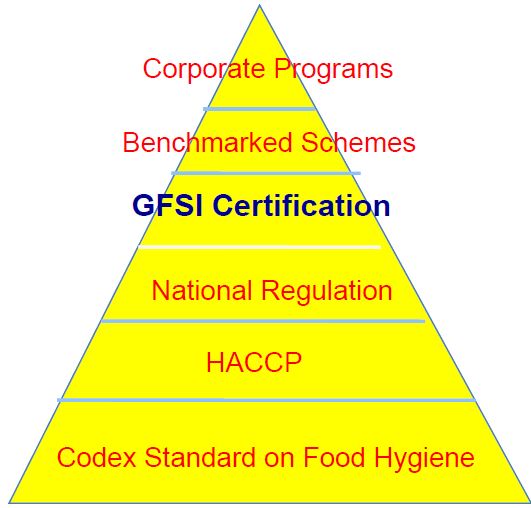
Why-GFSI-June2014At the very base of our efforts that are ensconced within these guidance on a sector by sector basis, are the international standards of science based within the Codex Standard on Food Hygiene. On top of that are Hazard Analysis and Critical Control Points or HACCP standards. Above HACCP are National Regulations, which includes FSMA in the U.S. and the Safe Food for Canadians Act in Canada. In Europe it’s something different, in Japan it’s something different, but all have iterative levels of science-based regulation in place to ensure the safest control of the food and management of the food. Above National Regulation is GFSI Certification.

“We go above and beyond the science of Codex, HACCP, and national regulation to perform at the highest level of industry. And our benchmarked schemes [eg. BRC Global Standards (BRC), Food Safety System Certification (FSSC 22000), International Featured Standards (IFS)] go beyond us and corporate programs go even further,” Kochenderfer highlighted.So what you have are several layers of protection that will help protect both consumers and companies.

What are some of the shared benefits for industry?

There are several benefits, which include:

  • Meet the requirements for one, meet the requirements for all;
  • Reduce duplication of audits;
  • Have comparable audit approach and outcomes;
  • Ensure the continuous improvement and customer opportunity for those GFSI-benchmarked companies;
  • Enhance trade opportunities;
  • Improve customer confidence in food safety; and
  • Gain cost efficiencies throughout the supply chain.

“We have now built confidence in third-party certification because we have reduced inefficiency in the food system. Now, it’s ‘Once Certified, Accepted Everywhere,'” stated Kochenderfer.

John Kukoly, Director of BRC in the Americas, added that companies should pursue GFSI certification for a number of reasons:

  • Customer mandate;
  • FSMA;
  • Nearly a 40 percent reduction in product non-conformance;
  • Competitiveness; and
  • Superiority in the market.

Right now, only a third of the industry has achieved GFSI certification, which leaves the remaining two-thirds either still at the starting line or just a few steps into their journey. How do you choose a GFSI-recognized scheme and get started?

Karil Kochenderfer shared a chart to allow users to see where they fall on the farm-to-fork continuum and further determine which scheme(s) would work for them.

Further, we have developed four GFSI checklists for the four major schemes that apply to food manufacturers, co-produced with the respective scheme owners to ensure accuracy and usability. The checklists are complimentary and may serve as a great resource on your journey toward GFSI certification.

Additional Resources:

FDA Access to Records Under FSMA

By Michael Biros
No Comments

What are the latest updates with FSMA and how has FDA’s access to records changed? Dr. David Acheson of The Acheson Group gives us the latest.

When it comes to latest updates regarding FSMA, the comment period on the proposed sanitary transportation rule has been extended to July 30, 2014.

What does FSMA change in terms of FDA access to records?

Before FSMA, FDA needed reasonable proof that a food would be adulterated and a threat of serious adverse health consequences or death to humans or animals (SAHCODHA) in order to access records.

Now, FDA needs reasonable probability that the use or exposure to a food, or any other articles of food that FDA believes is likely to be affected in a similar manner, would cause serious adverse health consequences. What FDA considers to be a reasonable probability will be determined on a case-by-case basis. These changes significantly expand the scope of what FDA can look at and lowers the threshold for records access.

Does FDA need to issue a formal request?

Formerly, FDA needed to invoke the Bioterrorism Act in order to gain access to records. This was a cumbersome process that required strict criteria to be met.

Currently under FSMA, FDA must provide written notice of what they are asking for. This documentation will be delivered by a credentialed FDA official.

Generally, access to records must be given as quickly as possible within 24 hours of the request. The records do not need to be in any particular format. Electronic records are still considered on-site records so long as they can be accessed from within the facility.

What can FDA ask for?

FDA has produced guidance documents that lists what they can ask for. FDA can request access to manufacturing records, ingredients receipt records, product distribution records, product inventory records, test records, recall records, reportable food records, customer distribution lists, and complaint/adverse event records.

There are some exceptions. FDA cannot request personnel records, financial records, recipes, some records from farms, and some records from restaurants.

How will FDA maintain the confidentiality of any protected information in records it obtains?

While some of these records may be accessible through the Freedom of Information Act (FOIA), FDA is responsible to protect and redact commercial confidential information in accordance with their own requirements. However, some of this sensitive information can be shared with other federal, state, local, and foreign authorities.

For more information, click here to see archived FSMA Fridays webinars, organized by SafetyChain Software

FSMA: What’s the Latest, and What Do You Need to Know

By Michael Biros
No Comments

Is your company ready for ‘TACCP?’ Do you know how long you will be required to retain your records? Is your carrier up-to-date on the sanitary transportation section of FSMA? Dr. Bob Strong, Senior Food Safety Consultant at SAI Global, gives an overview of the newest updates on FSMA.

Questions were raised recently by brewers and distillers about spent grains being sold as animal feed. FDA recognizes that hazards will be minimal, but charges facilities with protecting spent grains during storage awaiting collection and during transportation as required under FSMA Section 103. This will require protection against physical and chemical contamination and references the inadvertent addition of industrial waste oil to used fryer oil that exposed 100,000 chickens to PCBs. The comment period for this is closed and the final rule is expected to be published this summer. The final rule is scheduled to take effect by August 30, 2015.

Record retention and availability applies to anybody who processes, packs, transports, distributes, receives, holds, and imports human or animal food. However, farms, restaurants, USDA plants, personal consumption, non-food packaging, and food contact packaging manufacturers (but not users of this packaging material) are exempt from this requirement.

The length of record retention depends on the perishability of the food product. If the shelf life is less than 60 days, both the handler and transporter must retain records for 6 months. If the shelf life is between 60 days and 6 months or if the food is animal/pet food, both the handler and transporter must retain records for 12 months. If the shelf life is greater than 6 months, the handler must retain records for 2 years, but the transporter must retain records for only 12 months. Records must be available within 24 hours of a request by FDA and civil action may be taken if records are not kept or made available. This final rule was published on April 4, 2014.

FSMA section updates

These updates are confined to Section 106 — Intentional Adulteration of Foods; Section 111 — Sanitary Transportation of Human and Animal Food; and Section 204 — Designation of High Risk Foods Relative to Record-keeping for Traceability.

To recap, FSMA does not apply to facilities regulated by USDA (meat, poultry, and eggs). Also exempted are juice manufacturers, seafood processors, alcohol-related facilities, low-acid canning (except to expand their hazard analysis), and small businesses.

FDA is considering modified requirements for warehouses and having Preventative Controls only if they are storing refrigerated products.

Section 106 — Intentional Adulteration of Foods

The intent of the proposed rule is for companies to begin using a “qualified individual” to develop a written food defense plan. This plan will protect against intentional adulteration of food for the purpose of causing harm to consumers. The plan should focus on actionable process steps, mitigation strategies, monitoring, corrective actions, and verification.

The regulation exempts very small businesses, companies with a majority of sales to very small businesses, storage facilities (except for bulk liquid storage), alcoholic beverage manufacturers, and animal feed manufacturers and distributors.

Actionable areas and mitigation strategies:

Key actionable areas identified by FDA include: bulk liquid receiving and loading, bulk liquid storage and handling, secondary ingredient handling, and mixing and similar activities. Deliberate acts of contamination may come from acts of terrorism; disgruntled employees, consumers, or competitors; or economically motivated adulteration such as the melamine tainted milk incident.

Companies must identify and implement mitigation strategies, establish procedures to monitor these strategies, implement corrective actions, verify that monitoring is being conducted, train supervisors assigned to actionable process steps, and maintain records.

Examples of mitigation strategies include restricting access to potential adulteration points such as loading and receiving areas, bulk liquids, secondary ingredient handling rooms, and open processing points. Facilities must require tankers to be sealed after loading and the seals must be checked at receiving.

TACCP

FDA is asking for comments on using HACCP principles to develop food defense plans. They are considering calling a control point a TACCP (Threat Assessment Critical Control Point). They are also trying to identify the risk of adulteration to specific processes. Some examples of low risk foods that are hard to adulterate are: shell eggs, whole produce, game meats (not ground), peanuts/tree nuts, and sugar cane/beets. FDA has extended the comment period through June 30, 2014. 

Section 111 — Sanitary Transportation of Human and Animal Food 

This section builds upon the previously issued Sanitary Food Transportation Act of 2005. It has five major sections: vehicle and transportation equipment, transportation operations, information exchange, training, and records.

The regulation exempts shippers, receivers, and carriers that have less than $500k in total annual sales; the transportation of raw agricultural commodities by farm vehicles; food being shipped through the US to another country; food imported to be exported, but not consumed in the US; shelf stable foods that are completely enclosed in a container; the transportation of compressed gases; and the transportation of live animals.

Vehicles and transportation equipment

The proposed rule will establish requirements for the design and maintenance of vehicles and equipment to ensure that they do not cause contamination of the food being transported. This includes bulk and non-bulk containers, bins, totes, pallets, pumps, fittings, hoses, gaskets, and loading/unloading systems.

The regulation identifies the potential for cross-contamination from: incorrect use of packing materials (reusing wood containers for produce that once held raw meat); using the same hoses or pumps with different allergens or raw and ready-to-eat products; and pallets in poor condition (splintering or projecting nails).

The proposed rule will establish requirements for cleaning, inspection, maintenance, loading/unloading, and operation of transportation equipment to ensure no contamination or temperature abuse of the products during transport. This includes the growth of spoilage bacteria as well as pathogenic bacteria. This will be achieved by ensuring adequate temperature controls, separation of foods with different temperature requirements, and the cleanliness and physical condition of trailers, tankers, pallets, etc.

Communication

Carriers, shippers, and receivers will be required to exchange information regarding prior cargos, the cleaning of bulk transportation equipment, and temperature controls. A log of prior loads must be kept. FDA will not restrict what can be hauled. Rather, they will regulate the cleaning between loads. Wash tickets must be kept and shared with customers. Washing may include sanitizing where necessary.

The carrier must communicate with the shipper and receiver that temperature sensitive foods were transported under the required temperature conditions. This requirement can be waived for short hauls or if the shipper loads a temperature recording device with the shipped products. The shipper and receiver are required to specify in writing the temperature requirements to the carrier. The receiver must confirm compliance.

Training, records and waivers

Carrier personnel must complete training in sanitary transportation practices and must have documentation of this training. This will include personal hygiene for drivers and loading/ unloading workers, training in security, accessibility to hand washing, and avoiding cross contamination in handling mixed loads. Procedures, training, cleaning, prior cargos, and temperature control must be recorded and properly maintained.

Shippers, carriers, and receivers who hold valid permits and are inspected under the National Conference on Interstate Milk Shipments (NCIMS) Grade “A” Milk Safety Program may be waived from these requirements only when they are involved in shipping Grade A milk and milk products. Transportation of food relinquished to consumers may also be waived (such as the pizza delivery guy).

Section 204 — Designating High Risk Foods for the purpose of record keeping related to Traceability

This proposed rule designates high-risk foods based on known food safety risks. The criteria for modeling and scoring risk are:

  1. Frequency of Outbreaks and Occurrence of Illnesses: This must include chemical and microbiological food safety hazards. Chemical hazards include allergens, mycotoxins, pesticides, and heavy metals.
  2. Severity of Illness: This will take into account illness duration, hospitalization, and mortality.
  3. Likelihood of Contamination: This is based on number of recalls and contamination that has been known to occur.
  4. Pathogenic Growth Potential/Shelf Life: Strong growth potential is likely at temperature at which the food is intended to be held and stored, including refrigeration and room temperature. This will be coupled with shelf life where longer shelf life can increase risk.
  5. Manufacturing Process Contamination Probability/Intervention: High probability has recurring or frequent detection of contamination. Low probability has infrequent detection of contamination or where contamination is introduced post manufacturing. This will be coupled with the availability and implementation of control measures.
  6. Consumption: This is the percent of the population that consumes the food.
  7. Economic impact: Lower is defined as $100-500k impact per year and higher is greater than $10m per year.


What Constitutes a Successful FDA Audit?

By Sangita Viswanathan
No Comments

From the proposed third party accreditation rule, to GFSI audits, and needing more trained and experienced auditors, the process of auditing food facilities is undergoing a sea-change. What is the impact going to be on food companies, auditors, and the auditing process?

In a recent FSMA Fridays webinar, sponsored by SafetyChain Software, an expert team from The Acheson Group, comprised of Melanie Neumann, J.D., M.S., VP and Chief Financial Officer; Jennifer McEntire, Ph.D., VP and Chief Scientific Officer; Anne Sherod, M.S., Director of Food Safety and Valerie Scheidt, MBA, CP-FS, Director of Food Safety, answered key questions on conducting successful FDA audits. We present some excerpts below.  

How does the FSMA third party audit accreditation rule impact the audit process?


The purpose of the third party accreditation and certification audit is to issue a certificate for high risk foods or the voluntary qualified importer program. The main foundation of the standards that FDA is setting will come from the human preventative controls rule, the animal preventative controls rule, and the produce safety rule. Some standards may also come from the sanitary transportation rule and food defense rule. FDA will be appointing an accreditation body and this accreditation body will approve and monitor certifying bodies (CB). These CBs can be private companies or private individuals who will be authorized by the accreditation body to perform the audits and issue those certifications. 

 
Foreign governments can also be approved by FDA to act as a CB. Right now only New Zealand is approved and FDA is looking at approving Canada. We don’t anticipate any other country to be approved in the near future.;

Certifying bodies will have strict conflict of interest and reporting requirements to FDA. CBs must report to FDA within 45 days even if they’re just performing a consultative audit. They must also report to FDA if they see an issue that could lead to a Class I or Class II recall and they have to report to FDA before they report to the company that they are auditing.


Will a GFSI audit satisfy FSMA audit requirements?

GFSI audit requirements do not match the FSMA audit requirements, but they are not too different. Several of the schemes are very similar, and each scheme owner is making a concerted effort to become FSMA compliant. If an auditor is doing a GFSI audit, they do not need report to FDA before the company. The FSMA requirements of avoiding conflicts of interest, record keeping, and training may deter GFSI auditors from becoming Certifying bodies under FSMA. Unless FDA offers an incentive, there will be a shortage of FSMA CB auditors. 


What are the elements of a successful audit?

The number one goal of an audit is to identify risk. The audit needs to accurately describe the non-conformances against the audit standard to give your quality and operations team reliable and actionable data so they can mitigate that risk. The relationship between the auditor and the facility should be a partnership, add value, and build trust. The facility should learn from the auditor and the auditor should understand what the facility is doing to mitigate risk and promote food safety. Continuous improvement takes the feedback from the non-conformances and evaluates them against the organization’s goal around risk. Whether the results are from an announced, unannounced, internal, second, or third-party audit, continuous improvement is critical, and this requires commitment from management and will help the facility become audit ready. 


How can I ensure my auditor is up to the task?

Most audits use checklists. This goes for both the auditor and the audited. The checklist provides a standardized list of what’s expected and adds an element of order and control to the audit. It also allows for an effective way to quantify metrics. 

However, using a checklist alone can lead to minimum risk finding. The auditor needs to find a balance between being strategic and prescriptive. In order to be effective, audit protocols need to be periodically reviewed and updated. This is especially relevant with FSMA and holds true for internal and third-party audits. Check to see if the auditor’s checklist is pre-FSMA or post-FSMA. Ask the auditor when was the last time that they reviewed and updated their audit protocols. 


Will we have enough good auditors to meet the need?

No, we already don’t have enough good auditors. The implications of this are that we may get substandard audits from substandard auditors. The current model isn’t working and we need a new approach. Currently, most auditors have extensive prior experience working in industry and often become auditors after they retire.

We are creating auditors not through structured training. This model is not sustainable and has limited growth potential. It will not provide the level of training required for GFSI or FDA third party certification requirement. We need a training program for auditors who come right out of school. We need people to go to school for food safety and be able to become an auditor after graduation. Food safety needs to be incentivized at the university level. There should be a bachelors degree in food safety auditing. We need structured training and developmental opportunities for folks earlier in their career rather creating auditors at the end of their career.

Training in the Food Safety Industry

By Sangita Viswanathan
No Comments

Dr. John Surak food safety trainer and Warren Hojnaki of SGS talk about trends they see in food safety training, areas of focus, how to keep training relevant and useful, and what they are expecting to see in the future.

FDA, FSMA, FSMS, HACCP, GFSI, BRC, SQF, IFS, FSSC… The food safety sector is a cornucopia of new regulations, abbreviations and standards. Helping navigate this maze are food safety training courses and the instructors. However, the success of training programs depends on how applicable these courses and the curriculum are to the industry and the specific client, and how experienced and knowledgeable the instructor is in understanding current regulations, specifications of standards, hazard profiles and compliance requirements of that client. 

In an interview with FoodSafetyTech.com, Dr. John Surak, food safety trainer, and Warren Hojnaki of SGS, talk about trends they see in food safety training, areas of focus, how to keep training relevant and useful, and what they are expecting to see in the future.

John Surak, Ph.D., is principal of Surak and Associates, a full service food safety and quality consulting service. He works with the food processing industry in developing food safety and quality management systems, designing and implementing process control systems, and implementing Six Sigma and business analytics systems. Warren Hojnacki is Training Manager, for SGS North America. His department delivers training services for North American clients. 

FoodSafetyTech.com: What are some broad trends in food safety training that you are noticing?
Hojnacki: What we are seeing is a lot of clients needing foundational training. For instance, our most popular training programs are still HACCP, implementation for FSSC 22000, SQF etc. On the other side, clients are still very confused about what they should do regarding new and proposed food safety regulations. While they are following the directives that they receive from their customers, currently there still is a wait-and-see mentality. 

Dr. Surak: I notice the focus on food safety moving up the food chain. About 5 to 7 years ago, our primary clients for food safety training programs were food processing companies. Now our clients are suppliers to these companies as food companies are pushing the requirement for training on them. These supplier companies then need to make decisions on what schemes they want to be certified under. Most of the time, the customer accepts any GFSI-recognized scheme, but sometimes the customer names a specific scheme. Different GFSI schemes have different sweet spots and advantages. They all assume different knowledge about food safety and some are more prescriptive than the others. Clients have to figure out which scheme would be the best fit for them. 

FST: What kind of training courses are most popular, most asked for?
Hojnacki: When clients and companies decide on getting audited or certified against a particular food safety standard, training for that standard is a common requirement. Auditors specifically want to be trained to build their skill level, whether it’s getting trained for HACCP or FSSC 22000. A number of our clients also come to us saying that when they have a 3rd party audit, the most common non-conformances pertain to a less than robust internal audit system, so auditor training is a critical area that our clients ask for. 

Dr Surak: One of the biggest aspects of training that I try to focus on is lead auditor training. This course is designed to help an individual get certified in a particular audit scheme. We cover the same information for internal auditor training. However, the difference in this case is that for the internal auditor, the goal is to get his company certified. If a company has a strong internal auditor, they can reap substantial benefits. We also focus on, as part of our training, doing mock audits. This is more than going into a course or workshop and giving a lecture. For mock audits, you are put into a spot where you have to make real decisions on the floor. When we conduct such practice audits with our clients, in addition to our regular food safety training courses, we find a high level of involvement and interaction from the attendees and appreciation from the client. 

FST: What are some of the gaps in the training that you notice?
Hojnacki: What we see in general is people not covering the topic in-depth enough. Many training courses (outside those offered by SGS) seem to cover the topic in a very superficial manner and this doesn’t help. 

Dr. Surak: Many of the attendees who come to an audit training class have never taken the time to familiarize themselves with the standard. So what you are doing in that time is teaching them the standard and then teaching them how to audit. If the participants already know the standard, then you focus on just reviewing the standard and cover how to go about doing the audit. 

FST: What are some common questions attendees ask at ‘implementation/auditor’ training?
Hojnacki: Attendees very much want to know application to their respective situation. As an auditor, you need to know the right open-ended questions to ask when you are conducting an internal audit, and in our training, we provide examples for that. 

Dr. Surak: Our training focuses on enabling auditors to get the participant in a conversation and be able to answer questions during an audit. We are not in the business of writing traffic tickets, we are out to assess if the food safety system meets the standard, and also to identify the areas where it needs to be strengthened. Things that participants typically want to know are, going into a 3rd party audit, what is the auditor going to do? How is he going to react? And how can they present themselves in the best possible way to have a good audit? Also the instructor or auditor needs to understand the differences in the standards and the different hazards. There are unique challenges for different suppliers – or where along the supply chain they are, for instance are they a retailer, a supplier or a processor. It’s not a one size fits all situation. If you are looking at ingredient suppliers, the hazards are very different than what a retailer would be looking at, for instance. 

FST: How do you identify the best training company or program for you?
Hojnacki: We go through this everyday with every client call and we understand that we are not the only resource, our clients have several options. We first evaluate the trainer to understand what’s their educational and work experience background? Does it correlate to the industry you are in? Are they practitioners or just theorists? Food industry is a very big growth area right now, and we are seeing a proliferation of tutors coming into this field. Some of them have varied backgrounds, such as in automobile or aerospace industry. Often times, clients will make a decision based on prices quoted, and then realize that it didn’t work out the way they had anticipated. We (SGS) have often had to go to that client and redo things. Today, more than ever, the decision to choose a trainer/ training vendor, needs to be based on their competence, experience, and skills. 

Dr. Surak: I was recently at a client where they had completed certification training. When I asked to see the materials and bios of the instructor, I noticed that he had no prior experience in the food industry. I wondered how you could teach internal auditing in a food processing industry if you did not know about food processing! It’s imperative that clients look at the trainer’s background and experience. 

FST: Food safety training in 2015 – what will change?
Hojnacki: Food safety training curriculum will have to increasingly show greater applicability to clients to meet their needs. It has to be a round peg and in a round hole type of situation. Especially with FSMA rules getting finalized, clients are going to expect more out of their training. They are going to expect their instructors to be a resource, and to be up to date on the respective regulations and be able to tell clients how these rules will apply to them, and what they need to do differently. 

Dr. Surak: Processors are going to ask questions such as ‘I am certified to a GFSI scheme, so now do I have to do anything additional to meet new requirements’ or ‘are there areas where we have done some basic groundwork, and we have to raise the bar higher because of new regulations,’ and trainers need to be able to answer these.

FSMA Sanitary Transport Rule: What You Need to Know

By Michael Biros
No Comments

Who does the proposed Sanitary Transport rule apply to and what will be its impact on the various transportation industries? This Q&A offers some insights and key takeaways from the critical rule.

On January 31, 2014, FDA announced the “Sanitary Transportation of Human and Animal Food” rule which will require certain shippers, receivers and carriers who transport food by motor or rail vehicles to take steps to prevent the contamination of human and animal food during transportation. The proposed rule establishes requirements for vehicle and transportation equipment, transportation operations, the exchange of information, training, written procedures and records. The proposed FSMA rule is broad and comprehensive and will likely have far-reaching effects across the food transportation industry.

In a recent FSMA Fridays webinar, sponsored by SafetyChain Software, Melanie Neumann and Jennifer McEntire, from The Acheson Group, answered some questions about the extent and implications of this rule.  We present some excerpts below. 

Who does the Sanitary Transport rule apply to?

Compared to other FSMA rules, the Sanitary Transport Rule’s coverage is broad and comprehensive. It will apply to businesses regulated not just by FDA, but by USDA as well. It will apply to food for human consumption as well as animal consumption. It will apply to both intrastate and interstate commerce. 

However there are a few exemptions: Companies with annual sales less than $500,000 and foods that are fully packaged and shelf stable are exempt. 

What impact will this proposed rule have on various transportation industries?

When it comes to Shippers and Carriers, this rule will affect everyone. Shippers need to establish and communicate with carriers about specific conditions for the food such as temperature control, cross-contamination control, hand-washing facilities for loading and unloading, etc. Carriers need to ensure that they are meeting the shipper’s requirements. They need to make sure equipment is appropriate and clean. Like other FSMA rules, this rule will require documentation. Carriers also need to complete a fair amount of training to establish how they can achieve these expectations. 

Receivers, historically, haven’t had a lot of responsibility in ensuring sanitary food transport. Now they have a regulatory obligation to do so. This rule will apply to anyone receiving food including retailers, food service, and small convenience stores. They will be required to actively participate and are subject to more regulatory oversight than they have had ever before. 

What is a waiver in the context of this rule and who might be eligible?

There are opportunities to receive a waiver and waive out of this rule. Those who qualify for a waiver are those who can prove that they are under other practices, protocols, and ordinances that ensure safe transportation of the food. For instance, businesses that transport USDA Grade-A dairy and pasteurized milk may qualify for a waiver. 

What are some key takeaways about the Sanitary Transportation Rule?

A lot of industry members have already implemented many of the best management practices that will be mandated by the proposed rule. Companies will need to focus on documentation and training. Companies will need to develop procedures to communicate requirements across shippers, carriers, and receivers. They will also need to develop training regimens and validation systems to ensure that these requirements are being met. Documentation is critical. In the eyes of a regulator, if it isn’t documented, it didn’t happen.

More information visit www.SafetyChain.com/FSMA-Fridays.