Tag Archives: GFSI

Sangita Viswanathan, Former Editor-in-Chief, FoodSafetyTech

Pet Food Safety: Regulations and Challenges

By Sangita Viswanathan
No Comments
Sangita Viswanathan, Former Editor-in-Chief, FoodSafetyTech

Alan Baumfalk is Pet Food Safety Specialist and food safety Auditor at Eurofins US Foods Division. After more than three decades of experience in human food production facilities, Baumfalk began inspecting and auditing pet food companies with a fresh pair of eyes and in his opinion, “pet food plants typically are very well maintained, embrace technology, are highly automated, have great productivity and are very efficient with their sanitation and production.”

In an interview with Food Safety Tech, Baumfalk talks about differences in production of human food and pet food; lessons learned from historical incidents such as melamine in pet food and contaminated chicken jerky; what are some gaps in pet food safety he’s noticing and impact of the Food Safety Modernization Act or FSMA on this sector.

Food Safety Tech (FST): What are the differences between the production of human food and pet food?
Baumfalk: In most cases, pet food facilities are dry facilities, making kibbles and similar products, and their cleaning sanitation processes are mostly sweeping and dusting, with very little water involved. When it comes to regulations covering pet food facilities, most of these fall under FDA jurisdiction, and pet food facilities need to have in place risk-based HACCP plans to ensure food safety. Some of the challenges involved in pet foods are how do you do sensory testing on dry pet food or test for taste or consistency? Pet food testers look at certain quality attributes such as color, look, smell and taste of the product. They look for data such as amount of protein in the food etc. They also need to consider if humans – especially the elderly, or children – would consume the pet food product, because this can have many food safety implications.

FST: Humans have allergic reactions to certain food ingredients. Do pets have similar concerns of allergens?
Baumfalk: We don’t know if pets suffer allergic reactions to any specific food ingredients similar to humans. Pet food manufacturers are not subject to allergens and are exempt under FDA’s allergen management regulations. However, there are strict GMPs maintained in pet food production facilities, so that known allergens are identified. Pet food manufacturers give attention to allergens though they are exempt because it’s possible that the allergens could get transferred to a human in the house who could be allergic to nuts or soy, and this could be a huge problem. In our experience, we have seen that pet food can be occasionally consumed by a child or an elderly pet owner, out of curiosity.

FST: How about pathogens such as Salmonella and E.coli, are pets susceptible to these?
Baumfalk: Pets are not typically affected by pathogens such as Salmonella or E.coli, and this goes back to their genetic background, which is, dogs coming from wolves, and cats from tigers and lions. These animals are used to eating things with pathogens, fecal matter etc. However, humans are at risk of infection by Salmonella and E.coli, so while the end consumer of pet foods are not affected by these pathogens, their handlers are. Hence, pet foods are tested for Salmonella and E.coli to make sure they are pathogen free. They have Critical Control Points (CCPs) and kill-steps just like human foods, and pet foods are diligently sampled before they are released in the market. Environmental monitoring is also strictly carried out – such as extensive swabbing of processing floor, walls etc. to test for Salmonella/ E.coli/ mycotoxins etc. If a raw material exceeds FDA guidance for mycotoxins, then they are rejected. Many manufacturers test for mycotoxin levels in finished product as well.

FST: Are there differences in auditing pet food companies versus human food manufacturers?
Baumfalk: All pet food companies are looking to get certified and audited under a GFSI-recognized scheme. SQF is probably the biggest standard though some choose BRC. Eurofins has close ties with the American Feed industry Association (AFIA) which recommends SQF, and so we follow the same standard when auditing pet food facilities. SQF has modules specific to pet food category and dry pet food products. There are a lot of similarities with requirements for human food – for instance, pest control within a pet food plant is the same as within a human plant. The commitment and requirement for compliance is the same.

FST: What are some gaps or challenges in pet food safety?
Baumfalk: Most of the folks working in the pet food industry have a background in human food and are very much aware of the technical and regulatory requirements for making human food, so they end up carrying it over to pet food production. They typically follow GMPs and HACCP, and safety plans to ensure there are no food safety gaps. While most pet food companies meet, or even exceed, compliance requirements, there are always some people in the industry that don’t get the message.

FST: When we think about pet food safety, the history of melamine contamination of pet food, and tainted chicken jerky from China come to mind. What are lessons learned and how can the pet food industry be prepared for the unknown?
Baumfalk: The melamine adulteration and chicken jerky contamination incidents have taught the industry to be on guard. The industry has to make sure that they are in close alignment with their industry association which speaks for them, read technical documents, hire and train knowledgeable staff – all of which helps constantly look for the next thing that we weren’t aware of. Apart from diligently monitoring the global supply chain, it would help to have strict audit specifications for global suppliers. If something is coming from the other part of the world, where there’s a history of food safety standards not always being up to par, the pet food industry needs to make sure to buy only from a known and approved entity. Also look for lessons that can be learned from the human foods industry. Read about recalls and withdrawals and find out why that happened, if the pet food industry has similar exposure, and how this can be addressed.

FST: What will be the impact of the proposed pet food safety rule under FSMA be on this industry?
Baumfalk: FSMA is going to tighten things up, paying a lot of attention to the global supply chain and any vulnerabilities. While regulations are still being finalized, the pet food industry is already aligning itself with these proposed regulations. The technical and regulatory folks in the industry are following it; they are reading food safety journals and interacting with their associations for guidance and for making comments on the regulations. We are also updating our auditing checklists to see how we can align better with new FSMA requirements.

For more information on Eurofins, it’s pet food and auditing capabilities, click here.

Why GFSI? And How Can It Help?

By Jennifer Brusco
No Comments

The Global Food Safety Initiative or GFSI, simply explained, is a business-to-business Food Safety and Modernization Act (FSMA). It operates quietly and privately within the marketplace between the customers and their suppliers. It operates on not only a global basis, but also on a regional and local basis.

“Although people look at the [GFSI] program and see a lot of multinational corporate logos, frankly the majority of our operations are small and medium size facilities at the local level. So we welcome facilities of all natures – large, medium, and small, across the food to fork continuum,” Karil Kochenderfer, North American representative, GFSI, said during a recent webinar.

GFSI has approximately 25 benchmarked guidances, with some of the latest scope expansions include:

  • Packaging and animal conversion – August 2011;
  • Animal feed – June 2012;
  • Storage and distribution – October 2013;
  • Food brokerage/agents, retail/wholesale – early 2014; and
  • Catering, equipment manufacturing, food safety services – 2015.

Where are these guidances coming from? How can you be sure that these guidelines are science-based, risk-based, and address the issues in your plant/facility?

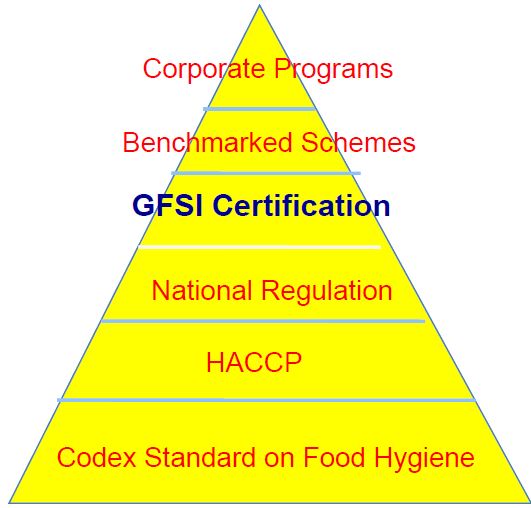
Why-GFSI-June2014At the very base of our efforts that are ensconced within these guidance on a sector by sector basis, are the international standards of science based within the Codex Standard on Food Hygiene. On top of that are Hazard Analysis and Critical Control Points or HACCP standards. Above HACCP are National Regulations, which includes FSMA in the U.S. and the Safe Food for Canadians Act in Canada. In Europe it’s something different, in Japan it’s something different, but all have iterative levels of science-based regulation in place to ensure the safest control of the food and management of the food. Above National Regulation is GFSI Certification.

“We go above and beyond the science of Codex, HACCP, and national regulation to perform at the highest level of industry. And our benchmarked schemes [eg. BRC Global Standards (BRC), Food Safety System Certification (FSSC 22000), International Featured Standards (IFS)] go beyond us and corporate programs go even further,” Kochenderfer highlighted.So what you have are several layers of protection that will help protect both consumers and companies.

What are some of the shared benefits for industry?

There are several benefits, which include:

  • Meet the requirements for one, meet the requirements for all;
  • Reduce duplication of audits;
  • Have comparable audit approach and outcomes;
  • Ensure the continuous improvement and customer opportunity for those GFSI-benchmarked companies;
  • Enhance trade opportunities;
  • Improve customer confidence in food safety; and
  • Gain cost efficiencies throughout the supply chain.

“We have now built confidence in third-party certification because we have reduced inefficiency in the food system. Now, it’s ‘Once Certified, Accepted Everywhere,'” stated Kochenderfer.

John Kukoly, Director of BRC in the Americas, added that companies should pursue GFSI certification for a number of reasons:

  • Customer mandate;
  • FSMA;
  • Nearly a 40 percent reduction in product non-conformance;
  • Competitiveness; and
  • Superiority in the market.

Right now, only a third of the industry has achieved GFSI certification, which leaves the remaining two-thirds either still at the starting line or just a few steps into their journey. How do you choose a GFSI-recognized scheme and get started?

Karil Kochenderfer shared a chart to allow users to see where they fall on the farm-to-fork continuum and further determine which scheme(s) would work for them.

Further, we have developed four GFSI checklists for the four major schemes that apply to food manufacturers, co-produced with the respective scheme owners to ensure accuracy and usability. The checklists are complimentary and may serve as a great resource on your journey toward GFSI certification.

Additional Resources:

What Constitutes a Successful FDA Audit?

By Sangita Viswanathan
No Comments

From the proposed third party accreditation rule, to GFSI audits, and needing more trained and experienced auditors, the process of auditing food facilities is undergoing a sea-change. What is the impact going to be on food companies, auditors, and the auditing process?

In a recent FSMA Fridays webinar, sponsored by SafetyChain Software, an expert team from The Acheson Group, comprised of Melanie Neumann, J.D., M.S., VP and Chief Financial Officer; Jennifer McEntire, Ph.D., VP and Chief Scientific Officer; Anne Sherod, M.S., Director of Food Safety and Valerie Scheidt, MBA, CP-FS, Director of Food Safety, answered key questions on conducting successful FDA audits. We present some excerpts below.  

How does the FSMA third party audit accreditation rule impact the audit process?


The purpose of the third party accreditation and certification audit is to issue a certificate for high risk foods or the voluntary qualified importer program. The main foundation of the standards that FDA is setting will come from the human preventative controls rule, the animal preventative controls rule, and the produce safety rule. Some standards may also come from the sanitary transportation rule and food defense rule. FDA will be appointing an accreditation body and this accreditation body will approve and monitor certifying bodies (CB). These CBs can be private companies or private individuals who will be authorized by the accreditation body to perform the audits and issue those certifications. 

 
Foreign governments can also be approved by FDA to act as a CB. Right now only New Zealand is approved and FDA is looking at approving Canada. We don’t anticipate any other country to be approved in the near future.;

Certifying bodies will have strict conflict of interest and reporting requirements to FDA. CBs must report to FDA within 45 days even if they’re just performing a consultative audit. They must also report to FDA if they see an issue that could lead to a Class I or Class II recall and they have to report to FDA before they report to the company that they are auditing.


Will a GFSI audit satisfy FSMA audit requirements?

GFSI audit requirements do not match the FSMA audit requirements, but they are not too different. Several of the schemes are very similar, and each scheme owner is making a concerted effort to become FSMA compliant. If an auditor is doing a GFSI audit, they do not need report to FDA before the company. The FSMA requirements of avoiding conflicts of interest, record keeping, and training may deter GFSI auditors from becoming Certifying bodies under FSMA. Unless FDA offers an incentive, there will be a shortage of FSMA CB auditors. 


What are the elements of a successful audit?

The number one goal of an audit is to identify risk. The audit needs to accurately describe the non-conformances against the audit standard to give your quality and operations team reliable and actionable data so they can mitigate that risk. The relationship between the auditor and the facility should be a partnership, add value, and build trust. The facility should learn from the auditor and the auditor should understand what the facility is doing to mitigate risk and promote food safety. Continuous improvement takes the feedback from the non-conformances and evaluates them against the organization’s goal around risk. Whether the results are from an announced, unannounced, internal, second, or third-party audit, continuous improvement is critical, and this requires commitment from management and will help the facility become audit ready. 


How can I ensure my auditor is up to the task?

Most audits use checklists. This goes for both the auditor and the audited. The checklist provides a standardized list of what’s expected and adds an element of order and control to the audit. It also allows for an effective way to quantify metrics. 

However, using a checklist alone can lead to minimum risk finding. The auditor needs to find a balance between being strategic and prescriptive. In order to be effective, audit protocols need to be periodically reviewed and updated. This is especially relevant with FSMA and holds true for internal and third-party audits. Check to see if the auditor’s checklist is pre-FSMA or post-FSMA. Ask the auditor when was the last time that they reviewed and updated their audit protocols. 


Will we have enough good auditors to meet the need?

No, we already don’t have enough good auditors. The implications of this are that we may get substandard audits from substandard auditors. The current model isn’t working and we need a new approach. Currently, most auditors have extensive prior experience working in industry and often become auditors after they retire.

We are creating auditors not through structured training. This model is not sustainable and has limited growth potential. It will not provide the level of training required for GFSI or FDA third party certification requirement. We need a training program for auditors who come right out of school. We need people to go to school for food safety and be able to become an auditor after graduation. Food safety needs to be incentivized at the university level. There should be a bachelors degree in food safety auditing. We need structured training and developmental opportunities for folks earlier in their career rather creating auditors at the end of their career.

Training in the Food Safety Industry

By Sangita Viswanathan
No Comments

Dr. John Surak food safety trainer and Warren Hojnaki of SGS talk about trends they see in food safety training, areas of focus, how to keep training relevant and useful, and what they are expecting to see in the future.

FDA, FSMA, FSMS, HACCP, GFSI, BRC, SQF, IFS, FSSC… The food safety sector is a cornucopia of new regulations, abbreviations and standards. Helping navigate this maze are food safety training courses and the instructors. However, the success of training programs depends on how applicable these courses and the curriculum are to the industry and the specific client, and how experienced and knowledgeable the instructor is in understanding current regulations, specifications of standards, hazard profiles and compliance requirements of that client. 

In an interview with FoodSafetyTech.com, Dr. John Surak, food safety trainer, and Warren Hojnaki of SGS, talk about trends they see in food safety training, areas of focus, how to keep training relevant and useful, and what they are expecting to see in the future.

John Surak, Ph.D., is principal of Surak and Associates, a full service food safety and quality consulting service. He works with the food processing industry in developing food safety and quality management systems, designing and implementing process control systems, and implementing Six Sigma and business analytics systems. Warren Hojnacki is Training Manager, for SGS North America. His department delivers training services for North American clients. 

FoodSafetyTech.com: What are some broad trends in food safety training that you are noticing?
Hojnacki: What we are seeing is a lot of clients needing foundational training. For instance, our most popular training programs are still HACCP, implementation for FSSC 22000, SQF etc. On the other side, clients are still very confused about what they should do regarding new and proposed food safety regulations. While they are following the directives that they receive from their customers, currently there still is a wait-and-see mentality. 

Dr. Surak: I notice the focus on food safety moving up the food chain. About 5 to 7 years ago, our primary clients for food safety training programs were food processing companies. Now our clients are suppliers to these companies as food companies are pushing the requirement for training on them. These supplier companies then need to make decisions on what schemes they want to be certified under. Most of the time, the customer accepts any GFSI-recognized scheme, but sometimes the customer names a specific scheme. Different GFSI schemes have different sweet spots and advantages. They all assume different knowledge about food safety and some are more prescriptive than the others. Clients have to figure out which scheme would be the best fit for them. 

FST: What kind of training courses are most popular, most asked for?
Hojnacki: When clients and companies decide on getting audited or certified against a particular food safety standard, training for that standard is a common requirement. Auditors specifically want to be trained to build their skill level, whether it’s getting trained for HACCP or FSSC 22000. A number of our clients also come to us saying that when they have a 3rd party audit, the most common non-conformances pertain to a less than robust internal audit system, so auditor training is a critical area that our clients ask for. 

Dr Surak: One of the biggest aspects of training that I try to focus on is lead auditor training. This course is designed to help an individual get certified in a particular audit scheme. We cover the same information for internal auditor training. However, the difference in this case is that for the internal auditor, the goal is to get his company certified. If a company has a strong internal auditor, they can reap substantial benefits. We also focus on, as part of our training, doing mock audits. This is more than going into a course or workshop and giving a lecture. For mock audits, you are put into a spot where you have to make real decisions on the floor. When we conduct such practice audits with our clients, in addition to our regular food safety training courses, we find a high level of involvement and interaction from the attendees and appreciation from the client. 

FST: What are some of the gaps in the training that you notice?
Hojnacki: What we see in general is people not covering the topic in-depth enough. Many training courses (outside those offered by SGS) seem to cover the topic in a very superficial manner and this doesn’t help. 

Dr. Surak: Many of the attendees who come to an audit training class have never taken the time to familiarize themselves with the standard. So what you are doing in that time is teaching them the standard and then teaching them how to audit. If the participants already know the standard, then you focus on just reviewing the standard and cover how to go about doing the audit. 

FST: What are some common questions attendees ask at ‘implementation/auditor’ training?
Hojnacki: Attendees very much want to know application to their respective situation. As an auditor, you need to know the right open-ended questions to ask when you are conducting an internal audit, and in our training, we provide examples for that. 

Dr. Surak: Our training focuses on enabling auditors to get the participant in a conversation and be able to answer questions during an audit. We are not in the business of writing traffic tickets, we are out to assess if the food safety system meets the standard, and also to identify the areas where it needs to be strengthened. Things that participants typically want to know are, going into a 3rd party audit, what is the auditor going to do? How is he going to react? And how can they present themselves in the best possible way to have a good audit? Also the instructor or auditor needs to understand the differences in the standards and the different hazards. There are unique challenges for different suppliers – or where along the supply chain they are, for instance are they a retailer, a supplier or a processor. It’s not a one size fits all situation. If you are looking at ingredient suppliers, the hazards are very different than what a retailer would be looking at, for instance. 

FST: How do you identify the best training company or program for you?
Hojnacki: We go through this everyday with every client call and we understand that we are not the only resource, our clients have several options. We first evaluate the trainer to understand what’s their educational and work experience background? Does it correlate to the industry you are in? Are they practitioners or just theorists? Food industry is a very big growth area right now, and we are seeing a proliferation of tutors coming into this field. Some of them have varied backgrounds, such as in automobile or aerospace industry. Often times, clients will make a decision based on prices quoted, and then realize that it didn’t work out the way they had anticipated. We (SGS) have often had to go to that client and redo things. Today, more than ever, the decision to choose a trainer/ training vendor, needs to be based on their competence, experience, and skills. 

Dr. Surak: I was recently at a client where they had completed certification training. When I asked to see the materials and bios of the instructor, I noticed that he had no prior experience in the food industry. I wondered how you could teach internal auditing in a food processing industry if you did not know about food processing! It’s imperative that clients look at the trainer’s background and experience. 

FST: Food safety training in 2015 – what will change?
Hojnacki: Food safety training curriculum will have to increasingly show greater applicability to clients to meet their needs. It has to be a round peg and in a round hole type of situation. Especially with FSMA rules getting finalized, clients are going to expect more out of their training. They are going to expect their instructors to be a resource, and to be up to date on the respective regulations and be able to tell clients how these rules will apply to them, and what they need to do differently. 

Dr. Surak: Processors are going to ask questions such as ‘I am certified to a GFSI scheme, so now do I have to do anything additional to meet new requirements’ or ‘are there areas where we have done some basic groundwork, and we have to raise the bar higher because of new regulations,’ and trainers need to be able to answer these.

Top 10 GFSI Non-conformances, and How to Avoid Them

By Michael Biros
No Comments

Are you ready for audit? Gary Smith, Director of training and improvement solutions at SAI Global, talks about the top 10 GFSI non-conformances for SQF & BRC audits.

1. Business Continuity Plan Components/Annual Testing and Review

Many companies do not know what a business continuity plan is. It is not a recall and performing a mock recall will not count as an annual test and review. It is the continuing of business with a disruption in the supply chain. What are your plans for a key supplier going out of business or being affected by a natural disaster? If there is a fire or accident at one of your facilities, how are you going to ensure that your customers will still get delivery of your product? 

2. Food Safety Plan

HACCP has been around for years, but this is still a major area of focus. HACCP must be implemented and individuals must be properly trained in HACCP. All Critical Control Points (CCPs) must be validated. Review supporting documents during annual check. Is the flow chart current? Is the hazard analysis still correct? Question your employees during your internal audit. Get your employees used to and comfortable with answering questions about the food safety plan. 

3. Equipment and Utensil Condition

Utensils (scoops, shovels, belts, etc), equipment, and all food contact surfaces must be designed and in good condition so as not to be a food safety risk. Implement a foreign material control plan. Have a preventative maintenance schedule. Focus the internal audit program on equipment, not just employees. Use a flashlight when conducting internal audits. Train, empower, and reward production employees to identify equipment defects. Do not have temporary repairs. 

4. Allergen Management

Allergens are the number one cause of recalls. You must have a good allergen control program and this program must be validated. Identify ingredients as allergens at receiving and have a label inspection program. Specific allergen proteins must be validated with surface testing and product testing. Allergens must be listed as hazards in hazard analysis with the control as the allergen management program. 

5. Internal Audit

Have a strong internal audit program that emphasizes proactive solutions to avoid non-conformances. Manage non-conformances with a corrective action program. Take photos of all findings during internal audits. Make the process as formal as possible. Dress like the auditor would and ask employees questions. 

6. Condition of Walls, Doors, Floors, and Ceilings

Tape, cardboard, and construction plastic sheeting must not be used as these surfaces cannot be cleaned. Doors and windows must be properly closed. 

7. Product Traceability and Mock Recalls

If an auditor asks you about a product, you must be able to list all the raw materials, where they came from, and how they were processed to create your product. Keep the recall team current. Have procedures for a mock recall and always perform it. Make the mock recall a real test. Include ingredients and packaging in all traceability programs. Perform product trace exercises during the internal audit. 

8. Records

Make sure that your records are legible, authorized, and that demonstrated activities are taken. 

9. Procedures for Product Disposition when Calibration is Out

This is a new standard. Companies are now required to have documented procedures in place for when calibration equipment is down. 

10. Stay Vigilant!

If you’ve achieved food safety certification, congratulations! However maintaining certification takes commitment and dedication. Be sure to maintain a strong food safety culture within your organization. Communicate well across all levels of the company. Have a strong internal audit program and don’t be afraid to identify issues and focus on corrective action management.

Sangita Viswanathan, Former Editor-in-Chief, FoodSafetyTech

How a Global Snack Powerhouse Follows Supply Chain Best Practices

By Sangita Viswanathan
No Comments
Sangita Viswanathan, Former Editor-in-Chief, FoodSafetyTech

Mondelez-International-Brands-March2014
Known for its global brands such as Oreo, Ritz, Cadbury, Toblerone, Trident and Tang, Mondelēz International is a global snacks powerhouse, with products marketed in 165 countries. 

The company, which was created in October 2012 with spin-off of Kraft Foods Group, earned net revenues of $35 billion in 2012, and is the No. 1 in biscuits, chocolate, candy and powdered beverages; and No. 2 in gum and coffee. Mondelēz also employs approximately 110,000 people and works with nearly 3000 raw material suppliers. 

Against this background, the primary goal for the company is to provide Food that is Safe to Eat, described Peter Begg, Sr. Director, Global Quality Programs, Mondelēz International. 

Talking about Global Supply Chain Best practices at the recent Global Food Safety Conference, Begg described that his company ensures that its consumers and customers can trust the products that they manufacture and provide by: 

  1. “Having a comprehensive Food Safety program that meets or exceeds regulatory requirements and ensures global consistency; 
  2. Benchmarking annually to ensure the robustness of our food safety program including 3rd party audits (GFSI);  
  3. Continuously evolving our global strategies on Food Safety, with goals to drive further progress; and 
  4. Leveraging Supply Chain initiatives to support the Food Safety program.” 

At Mondelēz, food safety management occurs at multiple levels, said Begg: “The International Board of Directors Level reviews food safety management; the Executive Team level assesses company risk profile and management programs; food safety and quality senior management establishes food safety policy, control programs, and compliance mechanisms; business units implement company food safety policies and programs, and ensure regulatory compliance; and the Special Situations management team assesses and proactively manages issues, issues prevention, and communication of lessons learned.” 

Begg stressed that “companies need to make food safety culture personal, so people don’t bypass it. Mondelēz has had 0 incidents, 0 defects and 0 losses – and this will not be possible without 100 percent employee involvement.” 

He described an Integrated Quality Management Approach that focuses on systems across key factors in the supply chain: “Risk categories (covering chemical, microbiology and physical risks) are addressed along several steps (Design, Procure, Covert, Distribute, Trade and Consumer) using various quality risk prevention programs such as design safety analysis; HACCP; allergen management; supplier QA; material monitoring; continuous improvement; traceability, complaint management, process capability/ Six Sigma; warehouse controls and labeling.” 

Begg described Mondelēz’ quality and food safety programs that help assess, manage, and mitigate risk: 

Risk Assessment:

  • Supplier approval and management: determines suppliers risk profile and ability to meet MDLZ standards before use and on an ongoing basis;
  • Design Safety Analysis: new/changed product concepts are evaluated to design out potential physical hazards;
  • Hazard Analysis & Critical Control Points (HACCP) – focused on prevention, identifies conversion risks, controls, and monitoring compliance; and
  • Third Party Validation – validation of key systems; Design, HACCP, Micro, Allergen, Supplier, Auditing. 

Risk Management:

  • Auditing – risk based approach to assesses compliance to policy and execution of programs leading to corrective/ preventive actions;
  • Material Monitoring – incoming material testing program to verify the effectiveness of preventative programs;
  • Training – drives awareness of policies, programs, roles & responsibilities and enhances organizational competency;
  • Traceability – programs to manage and trace materials thru finished goods; 
  • Spec Management – specification development and change management process for materials, processes, and finished goods; and
  • Contingency Planning for single/ sole source and regionally isolated ingredients. 

Risk Mitigation:

  • Special Situations Management – defined company-wide process for proactive and effective management of issues minimizing potential impact to the business. 

Mondelēz has made a strong commitment to the Global Food Safety Initiative. According to Begg, the company has asked its nearly 3000 raw material suppliers globally to get certified under a GFSI benchmarked standard by 2015. All internal manufacturing facilities will have a GFSI certification (FSSC 22000) by the end of 2015 as well (currently 80 percent of facilities are certified). The company is also promoting GFSI to its external partners including joint ventures and external manufacturers.