
Ask a food safety director whether the new system paid off, and you will hear about audit readiness, faster CAPA closure and the recall that never happened. Ask the CFO the same question, and you will get a different question back: how much? Both answers are sincere. They just aren’t the same answer. And the gap between them may be why so many food safety technology business cases die in the budget meeting.
The 2026 Food Safety Digital Maturity Benchmark surveyed 290 qualified food manufacturers on what they have deployed, what they set out to achieve and what they got back. For this article, Food Safety Tech Research (FSTR) went back into the raw responses and cross-tabulated the ROI question against everything else respondents told us. None of the cross-tabulations described in this article have been published before.
The ROI that isn’t
Let’s start with the good news: 72% of respondents say their digital food safety investment has produced a positive return: 30% call it strong and 42% call it moderate. The ‘moderate’ answer choice reads “benefits have somewhat exceeded costs,” and it is the single most popular answer in the survey. But that isn’t necessarily an ROI. It’s a mood.
Then there is everyone else. 80 of the 290 companies, or 28%, cannot say their technology has paid for itself. 12% call it break-even, 8% say it is too early to tell, 4% have not tried to quantify it, and 3% admit it lost money.
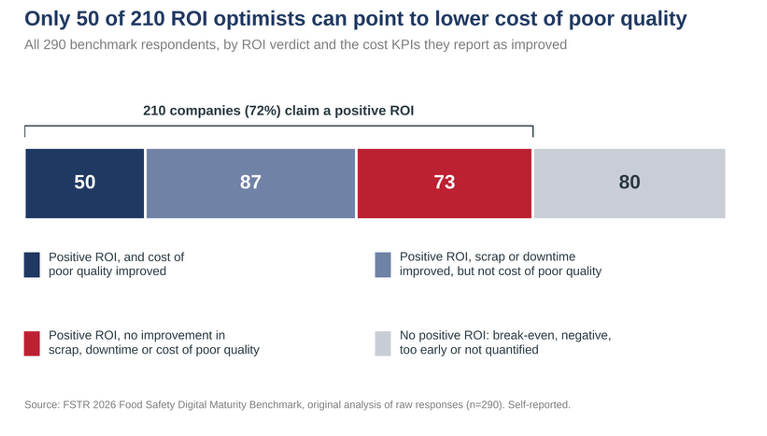
The more revealing number is hiding inside the optimists. Of the 210 companies that report a positive ROI, 160, or 76%, did not report an improvement in cost of poor quality. That is the one KPI on the list that is literally measured in dollars. More than a third of the optimists (35%) report no improvement in scrap, downtime or cost of poor quality at all. While the return may feel “real” from a food safety team KPI standpoint, it just doesn’t show up anywhere a controller would look for it.
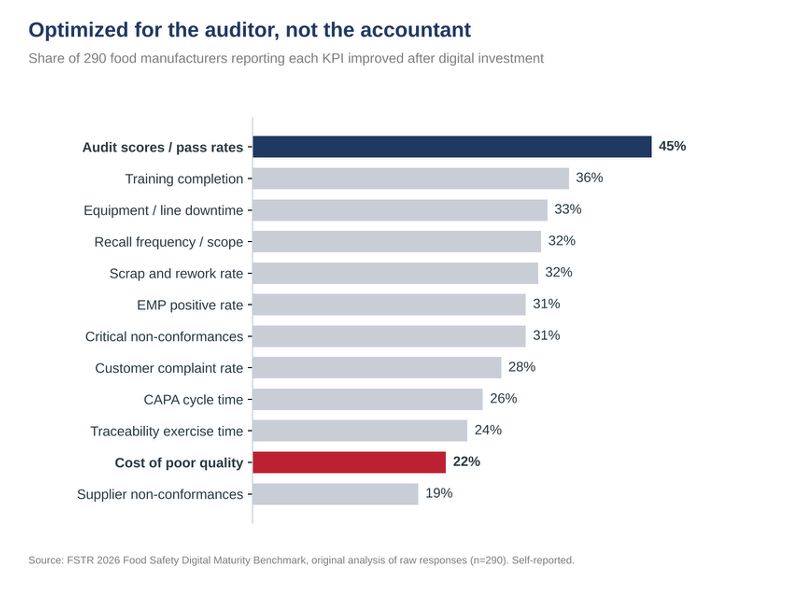
Across all 290 companies, the KPI most often reported as improved is audit scores (45%). Cost of poor quality ranks 11th of 12 (22%). The industry has optimized its technology for the auditor, not the CFO, and this is a real problem when it comes to justifying spend on new innovative tech.
And don’t think that the CFO doesn’t notice. Among companies reporting strong ROI, 82% say senior management fully supports digital investment. Among companies that call it too early to tell or haven’t quantified it, that figure falls to 17%.
Same mission, different scorecard
Food safety leaders and business leaders agree on the mission. About half of each group lists preventing contamination events as an investment objective. Where they part ways is the scorecard.
Compare the 94 respondents in food safety and quality leadership with the 42 executives and general managers who responded to the survey:
- Budget: 52% of executives call budget a barrier to digital investment, versus 31% of food safety leaders.
- Cost: 57% of executives set reducing scrap, waste and cost of poor quality as an objective, versus 38% of food safety leaders.
- Compliance: 44% of food safety leaders cite regulatory compliance as a driver, versus 29% of executives. (42% set GFSI certification as an objective, versus 26%).
The executive sample is small, so treat everything except the budget gap as “directionally significant”. But the direction is hard to miss. One side is buying insurance against a bad day. The other side is reading the invoice.
Here is where it gets uncomfortable. Business framing gets business results. Companies that cite at least one business driver (reducing waste, improving uptime, cutting labor costs or competitive differentiation) were roughly twice as likely to report improvement in a hard-dollar KPI: 67% versus 34%. Companies that set a scrap or cost objective: 71% versus 51%.
One more twist, before anyone blames the food safety department. When a VP or director of food safety or quality owns the investment decision, 83% of companies report a positive ROI, versus 68% when someone else owns it. That holds even when the person answering the survey isn’t in food safety (85% versus 69%). Those companies also report full senior management support more often (72% versus 58%).
Decisions made by cross-functional steering committees fare worst: only 55% report a positive return. Food safety leadership isn’t the problem. Translating its value into the CFO’s language is.
Misery has company
If it helps, food safety, or the food and beverage industry in general is not the only function struggling to put a number on the value of its technology investments.
- Deloitte: close to home, Deloitte’s 2025 Smart Manufacturing Survey of 600 manufacturing executives reported output gains of 10% to 20%. Yet only 42% said they were developing value targets and a measurement plan to assess progress.
- IBM: IBM’s 2025 CEO Study surveyed 2,000 CEOs across 24 industries. They reported that only 25% of AI initiatives had delivered their expected ROI, and 64% admitted that fear of falling behind drives investment before they clearly understand the value.
Next to these cohorts, food safety looks like a star: 72% positive ROI. But notice the difference in the question. IBM asked whether initiatives met expected ROI. Deloitte asked about gains and KPIs. Our survey asked whether benefits exceeded costs and let respondents decide what counted as a benefit. Either food safety is the most ROI-efficient function in global industry, or it is grading on a curve. The cost-of-poor-quality numbers suggest the curve.
How to stop grading on a curve
None of this means food safety technology doesn’t pay. It means the industry is bad at proving that it does. The fix is less about technology than about bookkeeping.
- Baseline before you buy. Record the cost of poor quality, scrap, downtime and hold-and-release times before the system goes live. You can’t show an improvement against a number nobody wrote down.
- Translate prevention into dollars. “We avoided a recall” is a story. Your own cost of a hold, a write-off or a customer chargeback is a number. Finance will accept a conservative estimate with a source over an inspiring story without one.
- Retire qualified metrics from your vocabulary. Report a figure, even a range, with its assumptions in plain sight. A business case with a range invites a conversation. A business case with an adjective invites a no.
- Give the investment one owner who keeps two scorecards. The data favors food safety ownership over committees. But that owner needs to report the CFO’s metrics alongside the auditor’s.
The food safety function has spent decades learning to prove a negative: the outbreak that didn’t happen. That is hard, valuable work. The next step is learning to prove a positive, in dollars, to the people who sign the checks. Until then, “somewhat exceeded costs” will keep getting what it deserves: somewhat of a budget.
About the data
The 2026 Food Safety Digital Maturity Benchmark surveyed 290 qualified food and beverage manufacturers between July 22 and September 16, 2026. All benchmark figures are self-reported. The cross-tabulations in this article are original FSTR analysis of the qualified survey responses and have not been published before. Differences described as significant were tested with Fisher’s exact test at p<0.05; others are directional.
Sources
- Food Safety Tech: Food Safety Tech Research Completes Inaugural Digital Maturity Benchmark (October 7, 2026)
- Deloitte: 2025 Smart Manufacturing Survey (May 1, 2025)
- IBM: IBM Study: CEOs Double Down on AI While Navigating Enterprise Hurdles (May 6, 2025)
The Food Safety Digital Maturity Benchmark findings report can be downloaded from the Food Safety Tech Research (FSTR) site: https://foodsafetytech.com/research/contact-2/
Related Articles
-


Study ties digital maturity to measurable ROI and food safety performance; 290 food manufacturer respondents, full findings debut at the Food Safety Consortium, October 21-23 in Washington, D.C.
-

Here we propose a dual scoreboard, comprised of leading and lagging statistics taken from actual operations and the system's output -- as expressed through recall and outbreak incidents. The work is the first application of the concepts on top of…
-

With so much confusion over the FDA’s FSMA food traceability requirements, companies need to begin considering standardization. This is especially true for companies with long supplier lines.
-

This series examines food safety as business infrastructure: the business decisions, governance structures, and operational conditions that determine whether technical food safety systems can hold under production pressure. The first three articles followed the record inward—from the corrective-action log, through…