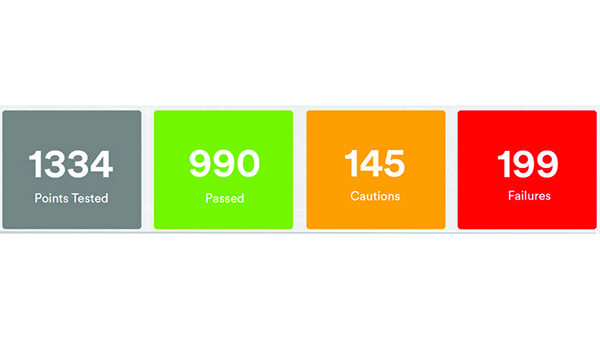
Managers in food processing facilities are under more pressure than ever to get their product out the door quickly, but they cannot sacrifice safety. A new technology developed by 3M can help them quickly identify potential contamination in their facility, which can help them determine whether to stop production. The Clean-Trace Hygiene Monitoring and Management System is a handheld luminometer that was developed with the help of food manufacturing professionals in positions from plant floor operators to company executives.
“We involved customers throughout the development and design of the entire system to automate and streamline what is in many cases a tedious, manual process of selecting test points, assigning them daily, conducting tests, documenting results, managing sample plans, and developing quality improvement measures,” said Tom Dewey, 3M Food Safety global marketing manager in a press release.
3M Clean-Trace Hygiene Monitoring and Management System (Photo courtesy of 3M)
The company made improvements to the device’s industrial design to make it more durable and user friendly. Other features include reengineered optical technology with photomultiplier detectors; upgraded software with a streamlined dashboard; and the capability to transfer data between the luminometer and the software via Wi-Fi and Bluetooth connections.
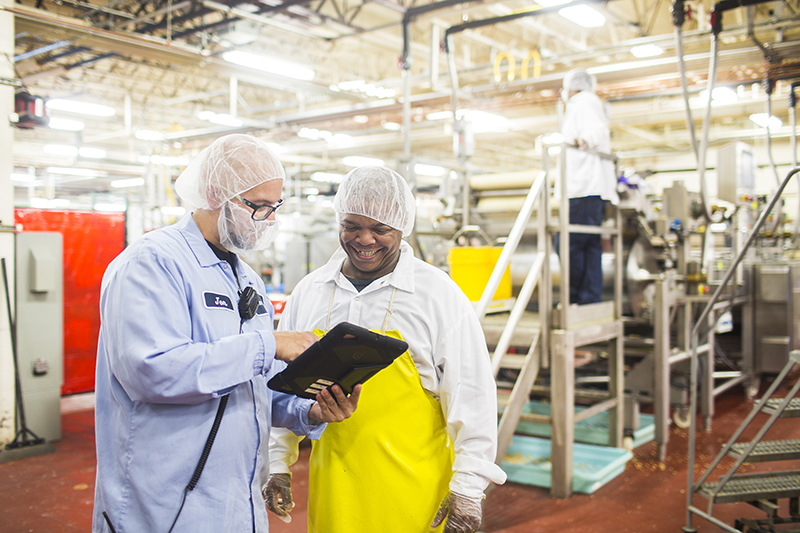
Employee training continues to be a hot topic as companies in the food industry gear up for FSMA compliance. Many are working with a much leaner staff and have several different generations of employees, many of whom absorb information in very different ways.
In a Q&A series with Food Safety Tech, Laura Nelson, vice president of business development at Alchemy Systems, discusses how training programs that may have historically been successful are no longer an effective means to educate today’s employees. “A vast majority of employees are doing what we ask and are doing it consistently. But the reality is that we have a subset of folks [who] aren’t doing that,” says Nelson. “I don’t think you can classroom train them to the point that they get it—I think some need that coaching and demonstration; they’re the kinesthetic learners that need to see you do it and then you watch them do it.”
Food Safety Tech: Where are the gaps in how food companies conduct employee education and training today?
Laura Nelson: It can be summarized in three areas.
1. Recognizing that the legacy training programs that food companies have is not effective. Companies are acknowledging that their historical training programs are not entirely effective in driving consistent behaviors. In [a recent] global food safety training [survey], we asked: “Despite our efforts in food safety classroom training, we still have employees not following our food safety program on the plant floor”. Over 60% said they agreed—yes, we still have employees not following our food safety programs. The survey involved 1200+ food safety professionals, so that’s a large number of folks acknowledging that their food safety training programs—largely classroom training—is not delivering the desired results and reducing inherent food safety risks.
There are so many things challenging the food industry and everyone is trying to manage these expanding expectations with their lean teams. The industry is changing dramatically—[from the perspective of] employee demographics, the business itself, pervasiveness of social media and exposure that it brings, and the different regulations—so a static food safety program established two, five or ten plus years ago is not going to address these changes. But who has the time and resources to continually update content, embrace technology and apply the latest behavioral science to the instructional design of new training content? Because of the lack of resources and time challenges, many in the industry are still trying to operate on their legacy training program. It might be old DVDs, PowerPoints, etc. —trainers are covering food safety, workplace safety and operational topics via PowerPoints in all-day sessions, sending around a sign-up sheet and ticking off their training compliance checkbox. Training has to be improved and enhanced for many key reasons—whether it’s considering different cultures, updating languages, engaging millennials or focusing on those critical employee behaviors that present a risk to an individual operation.
2. Understanding that training expands beyond the classroom. The industry as a whole continues to think that classroom training is their training program and that once the classroom training is complete and [the employee is] on the operations floor, that the training and education job is done. The reality is, it’s not. There’s lots more training happening beyond the classroom. Understanding that we need to formalize the extension of the classroom training and manage the ‘plant floor’ training aspect is really important. The industry is starting to embrace this [concept]. Anywhere from formal coaching and mentoring by frontline supervisors to posters and digital signage and short reminders to monthly campaigns on key critical items around food safety. Companies are starting to embrace the power of this holistic approach to training, leveraging new and emerging technology and tools to optimize employee behaviors.
3. Most people are not making the connection between training effectiveness and the ROI, the return on the investment. They think they don’t have the time to make improvements—yet, if they carved out time routinely to assess and evaluate best training practices to make training more effective and implemented these new and proven strategies, then all of a sudden the time and resource question becomes less of an issue because now you’re delivering on things like a decrease in food quality issues or reducing [employees] turnover, decreased downtime, reduced GMP non compliances, etc. It takes some time to establish those related training metrics, but once you’ve done that and have ensured that your holistic training program is current and behaviors are being exhibited consistently, you start to have fewer operational issues, enhanced customer satisfaction and motivated, engaged employees.
USDA’s Food Safety and Inspection Services (FSIS) has announced a plan to share more information about food safety at domestic slaughter and processing facilities. The Establishment-Specific Data Release Strategic Plan will serve to help consumers make more informed food choices, encourage facilities to improve performance, and provide more insights into the strengths and weaknesses of practices at the facilities.
“FSIS’ food safety inspectors collect vast amounts of data at food producing facilities every day, which we analyze on an ongoing basis to detect emerging public health risks and create better policies to prevent foodborne illness,” said USDA Deputy Under Secretary for Food Safety Al Almanza in an agency release. “Consumers want more information about the foods they are purchasing, and sharing these details can give them better insight into food production and inspection, and help them make informed purchasing decisions.”
The datasets will be published quarterly on data.gov, beginning 90 days after they are published in the Federal Register. FSIS will provide information about processes used at each facility, along with facility codes to allow for the combination of future datasets by facility. The agency will also release results for Listeria monocytogenes and Salmonella in ready-to-eat and processed egg products; Shiga Toxin-producing Escherichia coli and Salmonella in raw, non-intact beef products; Salmonella and Campylobacter in young chickens and turkeys, comminuted poultry and chicken parts; testing data of routine chemical residue in meat and poultry; and advanced meat recovery test data.
Do you have a background in science and policy? Are you interested in produce safety? Do you want to work for the FDA? If you answered ‘yes’ to these three questions, then FDA might have a job for you.
The agency is looking for eight experts to help build the Produce Safety Network, which will support implementation of the FSMA produce safety rule. These folks will be part of the first phase of new FDA hires to support compliance with the rule and will work with state public health and agricultural agencies throughout the United States.
If you’re interested in the consumer safety officer position, you’ll need to move quickly. According to the agency’s listing on usajobs.gov, the position listing closes on Friday, July 15.
Later this year FDA will hire 40 more consumer safety officers to work domestically and internationally on inspection, investigations and technical assistance.
Between 2009 and 2015 there was a 12% reduction in foodborne illnesses associated with meat, poultry and processed egg products. “We’re better now at keeping unsafe food out of commerce, whether it’s made unsafe because of dangerous bacteria, or because of an allergen, like peanuts or wheat,” said Agriculture Secretary Tom Vilsack in a USDA release. “Over the course of [President Obama’s] Administration, we have tightened our regulatory requirements for the meat and poultry industry, enhanced consumer engagement around safe food handling practices, and made smart changes to our own operations, ultimately moving the needle on the number of foodborne illness cases attributed to products that we regulate.”
USDA’s Food Safety and Inspection Service (FSIS) has implemented a number of initiatives since 2009, including:
Establishing a zero-tolerance policy for raw beef products that contain shiga-toxin producing E. coli: O26, O103, O45, O111, O121 and O145.
Labeling mechanically tenderized meat. The blades or needles used to tenderize meat an introduce pathogens into the meat.
First-ever pathogen reduction standards for poultry parts in order to reduce consumer exposure to Salmonella and Campylobacter. The standard is expected to prevent 50,000 cases of foodborne illness each year.
Requiring that all poultry facilities create a plan to prevent contamination with Salmonella and Campylobacter, instead of addressing the problem after it occurs. Poultry companies must collect samples at two points in the production line and test them to show control of enteric pathogens.
Requiring meat and poultry companies to hold all products that are undergoing lab analysis until USDA microbial and chemical tests for harmful hazards are complete.
Consumers should check their pantry. As a result of newly reported illnesses connected to raw dough or batter consumption, General Mills has expanded its recall of Gold Medal flour, Wondra flour and Signature Kitchens flour to include products made last fall. The FDA and CDC have warned consumers against eating any raw products made with flour.
According to the CDC, the multi-state outbreak of Shiga toxin-producing E. Coli O121 has sickened at least 42 consumers (with 11 hospitalizations) across 21 states. No deaths have been reported. The bacteria was isolated from samples of General Mills flour that was collected from the homes of those sickened in Arizona, Colorado and Oklahoma.
General Mills has already conducted a voluntary recall of 10 million pounds of flour (unbleached, all purpose and self rising). A full list of the products included in the recall are available on FDA’s website.
Training plays a crucial role in the FSMA Preventive Controls rule. As online learning becomes a more integral part of employee learning, companies may want to reexamine the methods they use to boost more effective outcomes. And for companies that currently use face-to-face training, investing in a virtual approach could encourage a more proactive employee learning experience.
“Industry research tells us that company leaders want training that is relevant, in which employees can apply skills right away.” – Kathryn Birmingham, ImEpik
“Under the [Preventive Controls for] Human Food rule we have legal roles that didn’t exist before—we must create smarter career pathways for these new positions and responsibilities, such as the Qualified Individual under the PCQI, the Preventive Controls Qualified Individual, and the auditor,” says Kathryn Birmingham, vice president, research and development at ImEpik. “The compliance required for these new positions is a great opportunity to use innovative and scalable training models. This becomes even more important for ROI (return on investment) in training, when turnover is likely or when companies want to attract new talent into the food safety industry.”
In a Q&A with Food Safety Tech, Birmingham explains how companies can navigate some of the additional training requirements under FSMA and how interactive online learning may offer both employees and companies more successful results.
Food Safety Tech:What employee training challenges do today’s food companies face?
Kathryn Birmingham: As an educator, business owner and researcher who has designed certification and degree programs for workforce training in several industries, I see [that] the food manufacturing industry must move from lifetime experience training to training standards. For the first time, the evidence of QI training and PCQI credential are owned by the person as they move from company to company.
Food companies need a cost-effective training system that can assess knowledge, skills and competency standards. Industry research tells us that company leaders want training that is relevant, in which employees can apply skills right away. They want to be able to test the knowledge of persons in these new roles who are accountable for regulatory compliance. Thus they expect valid assessments in their certification training.
The demand is for smarter pathways to reach these new legal roles in the legislation for the QI and PCQI. Assisting in this area, we need to remember that food manufacturing companies view their number one job as making food, not completing paperwork or digital documentation, so when it comes to FSMA we have to come up with relevant training that can be applied right away.
FST: In what areas do you think companies are unprepared for FSMA implementation and compliance?
Birmingham: Companies seem to be least confident in terms of training in a few areas: For the legal role of the PCQI, they seem to be least confident about the record keeping requirements and foreign supplier verification areas.
For the role of the QI, standardized training doesn’t exist, but we know from the PCQI training that if the QI is required to implement the food safety plan under the PCQI, then QIs must understand components of the food safety plan and the hazard analysis. So it follows that the QI must also understand some scientific and regulatory factors related to the preventive controls along with the new language that must be used in the food safety plan and documentation.
FST: What tools or technologies should companies leverage?
Birmingham: Research and successful practice in workforce training tells us a few things. In order to speed learning and verify the trainee’s learning, knowledge and competencies, we recommend instructional methods that are immediately relevant, engaging and motivating. Effective training for food safety regulatory compliance helps the learner with stronger critical thinking for decision-making and encourages the learner to apply the skills right away. Modular instruction allows time for practice and reflection while increasing the odds of retention of the material. Relevant work simulations can teach technical and scientific knowledge as well as communication skills.
We recommend online training that demonstrates proficiency and mastery rather than passive learning. The learner must engage and practice what they’re learning, show an understanding, practice critical thinking, and pass valid assessment exercises.
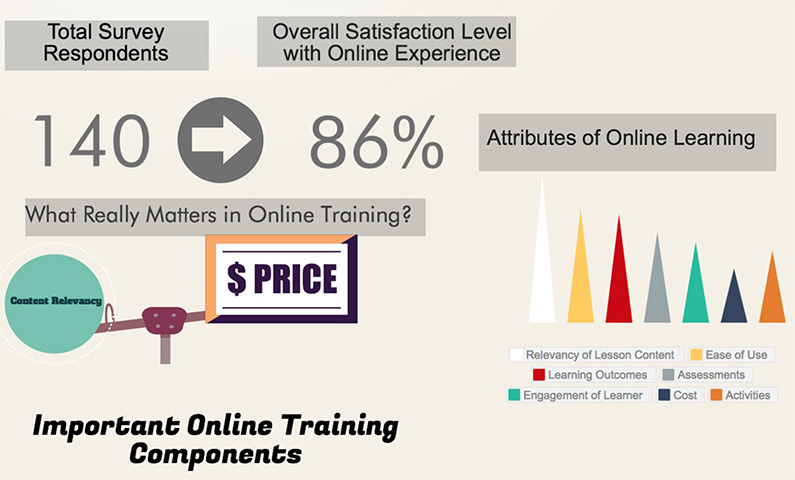
ImEpik’s survey aimed to understand expectations as well as effectiveness of online training. Infographic excerpt courtesy of ImEpik.
FST: Do you think a lot of passive learning is happening in the food industry?
Birmingham: [Birmingham cites a food safety online training survey conducted by ImEpik earlier this year; see Table I.] Survey responses from a sample of 140 companies are telling us that they’re not satisfied with lack of engagement in training offerings. Those overseeing training would like to see more valid assessments. In terms of passive learning, they don’t want to click through voice-over narration for training or have face-to-face training that is lecture style without a lot of engagement. They want to understand the learning outcomes and what they should be getting out of the curriculum as they move through the training.
Preference for Specific Online Learning Attributes
I Dislike It
I Can Tolerate
I Expect It
I Like It
Multi-languages
—
10%
Valid Assessments
—
—
91%
Research-based Instructional Methodologies
—
—
79%
Learner Engagement
—
—
77%
Interactive Activities
—
—
73%
Certificate of Completion
—
—
65%
Supplementary Manual
—
—
55%
Animation
—
—
35%
Learning Analytics
—
—
55%
Table I. Results from ImEpik survey about food safety online training. While animation and learning analytics are not as expected in online learning, these attributes are an important part of simulating the work experience in order to apply new knowledge, test specific content areas for clarity and assist the learner in remediation as needed. Data courtesy of ImEpik.
In the 2015 survey, 73% said they expect interactive activity in training while 91% expect valid assessment. People are looking for feedback as they progress through training. In the end they want to have the ability to prove what they know and can do.
With the emphasis now on FSMA, for companies to develop their entire food safety team, we need to rethink training and remember that it is possible to look at other industries and see what they’ve done with these career pathways for new roles that have been legislated. We can compare online training that is accessible anywhere and agile enough to train for new concepts quickly. Science and GMPs change. This is where a tool like online learning—not only full-course certification courses but also micro-learning modules—can really help the industry. And in the long run, it could be a better return on investment than face-to-face and long-term experiential learning.
The U.S. Senate Committee on Agriculture, Nutrition, and Forestry has come to an agreement on the first-of-its-kind nationwide mandatory labeling of food products that contain genetically modified organisms (GMOs). Although the deal requires labeling on far more products than those required under the Vermont GMO labeling law (which goes into effect July 1), the way in which disclosure of genetically engineered ingredients is revealed on food products is not as straightforward as it seems. Under the bill, disclosure methods of GMOs on labeling includes on the actual packaging; an electronic/digital link that a consumer can scan with a smartphone to retrieve more information online; or a phone number in which a consumer can call to get more information. Thus, companies are not required to include all of the information on the product label.
The Center for Food Safety estimates that 75% of processed foods contain genetically engineered ingredients.The Senate Agriculture Committee praises the bill as a “win for consumers”, but there are industry folks who disagree. “While we are pleased this proposal will finally create a national, mandatory GMO disclosure system, protects organic labels, and will cover more food than Vermont’s groundbreaking GMO labeling law, we are disappointed that the proposal will require many consumers to rely on smart-phones to learn basic information about their food.,” said Gary Hirshberg, chairman of Stonyfield Farm and advocacy group Just Label It in a release.
It hides in the crevices. Once it gets onto equipment, it can linger for years. It’s biofilm, a formation of bacteria that adheres to surfaces and can be quite difficult to eradicate. A host of microorganisms, including Listeria and Salmonella, are linked to biofilm contamination. The following are insights gathered from Dominique Blackman, general manager at Realzyme, LLC and Jeff Mitchell, vice president of food safety at Chemstar during Food Safety Tech’s recent Listeria Detection & Control Workshop.
Biofilm Facts
Protected by multiple layers of polysaccharides
Acts as binding site for antimicrobials as well as a diffusion site, protecting bacteria within
Mechanisms of dispersal
Active: Releases cells based on environmental changes
Passive: Occurs as a result of shear or agitation (i.e., when doing deep cleans or moving equipment)
Hot spots
Transfer points in facility
Product contact points on equipment
Drains
Seams in walls/floor-wall junctures
Door seals
Cart wheels
Overhead vents and pipes
Causes a variety of problems within food manufacturing facilities, including:
Product contamination = Economic loss (i.e., as a result of recalls)
Reduced product shelf life (i.e., result of recurring contamination)
Reduced productivity, especially when equipment isn’t cleaned properly
Bacterial resistance to disinfection
Surface corrosion (the longer biofilm is in one place, the more time it has to damage equipment)
Successful removal requires complete penetration of extracellular polymeric substance without inactivating any sanitizer
Outbreak illnesses and sporadic illnesses have similar traits. In addition, outbreak data can be used to assess the foods that are most frequently connected to particular foodborne illnesses. This analysis, all according to a recent study by the Interagency Food Safety Analytics Collaboration (IFSAC), could aid in improving the progression of science as well as provide a better understanding of the role of sporadic foodborne illnesses and their relation to an outbreak.
Available on the CDC’s website, key findings of IFSAC’s analysis include:
Campylobacter, Listeria monocytogenes, and E. coli O157 outbreak illnesses are not significantly different from sporadic illnesses with respect to patients’ illness severity, gender, and age.
Salmonella outbreak illnesses are not significantly different from sporadic illnesses with respect to illness severity and gender. For age, the percentages of outbreak and sporadic illnesses that occur among older children and adults are also similar. The percentage of outbreak illnesses in the youngest age category (0-3 years) was significantly lower compared to other age groups.
This website uses cookies so that we can provide you with the best user experience possible. Cookie information is stored in your browser and performs functions such as recognising you when you return to our website and helping our team to understand which sections of the website you find most interesting and useful.
Strictly Necessary Cookies
Strictly Necessary Cookies should be enabled at all times so that we can save your preferences for these cookie settings.
We use tracking pixels that set your arrival time at our website, this is used as part of our anti-spam and security measures. Disabling this tracking pixel would disable some of our security measures, and is therefore considered necessary for the safe operation of the website. This tracking pixel is cleared from your system when you delete files in your history.
We also use cookies to store your preferences regarding the setting of 3rd Party Cookies.
If you visit and/or use the FST Training Calendar, cookies are used to store your search terms, and keep track of which records you have seen already. Without these cookies, the Training Calendar would not work.
If you disable this cookie, we will not be able to save your preferences. This means that every time you visit this website you will need to enable or disable cookies again.
Cookie Policy
A browser cookie is a small piece of data that is stored on your device to help websites and mobile apps remember things about you. Other technologies, including Web storage and identifiers associated with your device, may be used for similar purposes. In this policy, we say “cookies” to discuss all of these technologies.
Our Privacy Policy explains how we collect and use information from and about you when you use This website and certain other Innovative Publishing Co LLC services. This policy explains more about how we use cookies and your related choices.
How We Use Cookies
Data generated from cookies and other behavioral tracking technology is not made available to any outside parties, and is only used in the aggregate to make editorial decisions for the websites. Most browsers are initially set up to accept cookies, but you can reset your browser to refuse all cookies or to indicate when a cookie is being sent by visiting this Cookies Policy page. If your cookies are disabled in the browser, neither the tracking cookie nor the preference cookie is set, and you are in effect opted-out.
In other cases, our advertisers request to use third-party tracking to verify our ad delivery, or to remarket their products and/or services to you on other websites. You may opt-out of these tracking pixels by adjusting the Do Not Track settings in your browser, or by visiting the Network Advertising Initiative Opt Out page.
You have control over whether, how, and when cookies and other tracking technologies are installed on your devices. Although each browser is different, most browsers enable their users to access and edit their cookie preferences in their browser settings. The rejection or disabling of some cookies may impact certain features of the site or to cause some of the website’s services not to function properly.
Individuals may opt-out of 3rd Party Cookies used on IPC websites by adjusting your cookie preferences through this Cookie Preferences tool, or by setting web browser settings to refuse cookies and similar tracking mechanisms. Please note that web browsers operate using different identifiers. As such, you must adjust your settings in each web browser and for each computer or device on which you would like to opt-out on. Further, if you simply delete your cookies, you will need to remove cookies from your device after every visit to the websites. You may download a browser plugin that will help you maintain your opt-out choices by visiting www.aboutads.info/pmc. You may block cookies entirely by disabling cookie use in your browser or by setting your browser to ask for your permission before setting a cookie. Blocking cookies entirely may cause some websites to work incorrectly or less effectively.
The use of online tracking mechanisms by third parties is subject to those third parties’ own privacy policies, and not this Policy. If you prefer to prevent third parties from setting and accessing cookies on your computer, you may set your browser to block all cookies. Additionally, you may remove yourself from the targeted advertising of companies within the Network Advertising Initiative by opting out here, or of companies participating in the Digital Advertising Alliance program by opting out here.