Experts cited management buy-in, employee satisfaction, and information sharing as the critical factors for success.
Food safety culture is not a program that is implemented at a company. It’s a living organism that’s either strengthened or weakened by the actions taken by an organization. “There’s no on/off switch,” said Lone Jespersen, director, Food Safety and Operations Learning at Maple Leaf Foods, at the GMA Science Forum held this week in National Harbor, MD.
Product safety and quality is a shared responsibility. However, fostering a positive environment in which employees embrace accountability starts at the top. “You need to have management commitment; then employee buy-in follows,” said Joseph Levitt, partner at Hogan Lovells US, LLP. “It’s a message people want to embrace.”
At Land O’Lakes, the company took a four-pronged approach to its food safety culture, focusing on a clear quality message and mindset, employee education and training, active leadership alignment and participation, and establishing effective metrics and objectives. Most significant to the company’s success was its ability to involve senior management and get their commitment to taking a product safety 101 course. Sara Mortimore, vice president, Product Safety, QA & Regulatory Affairs at Land O’ Lakes, advised the audience to take a one-on-one tactic when talking to senior management versus putting everyone together in the boardroom. Having that individual interaction with management members forces each person to commit to sharing perspectives.
Companies must focus on monitoring employee behavior and ensuring that employees feel motivated to have a positive impact on product safety and quality. It involves having a continuous improvement mindset versus complacency. Jespersen cited the antecedent-behavior-consequences model as a means to establish goals and metrics, define critical behaviors, and determine positive or negative consequences. Most important to the process is that a company keeps it foot on the pedal when improvements are being made, as a lack of consistency is what causes lapses in progress forward. She also pointed to the Food Maturity Model, a method she developed with industry stakeholders, as a guide for companies to measure employee behavior as it relates to food safety culture across an organization.
A culture of food safety is built on a set of shared assumptions, behaviors and values that organizations and their employees embrace to produce and provide safe food. Employees must know the risks and hazards associated with their specific products, and know why managing these hazards and risks in a proactive and effective manner is important. In an organization with a strong food safety culture, individuals and peers behave in a way that represents these shared assumptions and value systems, and point out where leaders, peers, inspectors, visitors and others may fail to protect the safety of both the consumers and their organizations.
A number of factors influence these organizations, such as changing consumer demographics, emerging manufacturing hazards, and the regulatory environment. The United Nations predicts that the number of people over 60 years will double by 2035, the number of diabetes patients will increase by 35% (International Diabetes Federation), and the number of individuals living with dementia will increase by 69% (Alzheimer’s Disease International). This poses an increased urgency for food manufacturers, as these population cohorts are more susceptible to foodborne infections or may have challenges with food preparation instructions.
Much has been published on food safety culture, and we owe it to the front-runners to use their work to go deep into practical, everyday challenges and to continuously strengthen organizational and food safety culture.1 An element common to most of these publications is a reference to the importance of behaviors.2-8
There is a renewed recognition of the importance of individual behaviors specific to food safety and personal self-discipline in food processing and manufacturing organizations. Employees throughout the organization must be aware of their role and the expected food safety behaviors, and held accountable for practicing these behaviors. Embedding food safety culture in an organization can be very challenging given the need to carefully define appropriate behaviors, the difficulty in changing learned behaviors, and the complexity of objectively evaluating the level of food safety culture in a company. This article is an attempt to define useful food safety behaviors and to describe a behavior-based method that you can use to measure the maturity of your organization’s food safety culture.
Defining measurable behaviors
Behaviors is the element that, when combined with results, creates performance.9 Behaviors, if used to measure and strengthen food safety culture, must be defined carefully in a consistent, specific, and observable manner. Martin Fishbein and Icek Ajzen, authors of multiple publications on the Reasoned Action Approach, teach us how these three factors can be used to predict and explain human behavior, attitude, perceived norms and perceived control.10 They also teach us that behaviors can be defined consistently by including four elements (Figure 1).
Figure 1: Four components to a consistently defined behavior
Case: CCP operator on a baked chicken line. I work in a chicken processing company and am responsible for monitoring the internal cook temperature of chicken breasts after the product has gone through the oven. One of the important behaviors for my role could be defined as “Measure temperature of chicken after oven at predetermined time intervals”. This behavior is consistent, as it includes all four elements of the behavior definition (Table 1). The content of the behavior is defined in a way that makes it relevant for me, the CCP operator, and I am clear on the assumptions made by others on the processing line about my behavior. The behavior is observable and most people would be able to enter the processing area, observe the behavior and assess if it is performed as needed, YES or NO.
Leaving out any of the four elements of a behavior definition or becoming too general in your statements leads to poorly defined behaviors that are difficult to use as an assessment of behaviors, and ultimately as a measure of the sites for food safety culture (Table 1).
Scenario
Behavior
Action
Context
Target
Timing
Consistent, relevant, and observable
Measure and record temperature of three chicken pieces every hour at end of oven
Measure and record temperature
End of oven
Three chicken pieces
Every hour
Missing definition elements
Measure temperature at pre-determined intervals
Measure temperature
Not defined
Not defined
Pre-determined time intervals
Not specific
The product is cooked and checked every hour
Not defined
Not defined
The product
Every hour
Not observable
The product is cooked and check to see if it meets standard
Checked
Not defined
The product
Not defined
Table 1: Scenarios of defining behaviors
Behaviors are observable events and for this to be true, a behavior must be defined objectively in a language clear to everyone involved. It can be helpful to target a grade-six readability level, as it forces everybody writing the behavior to avoid words that are not understood in plain language.
Using behaviors to measure food safety culture
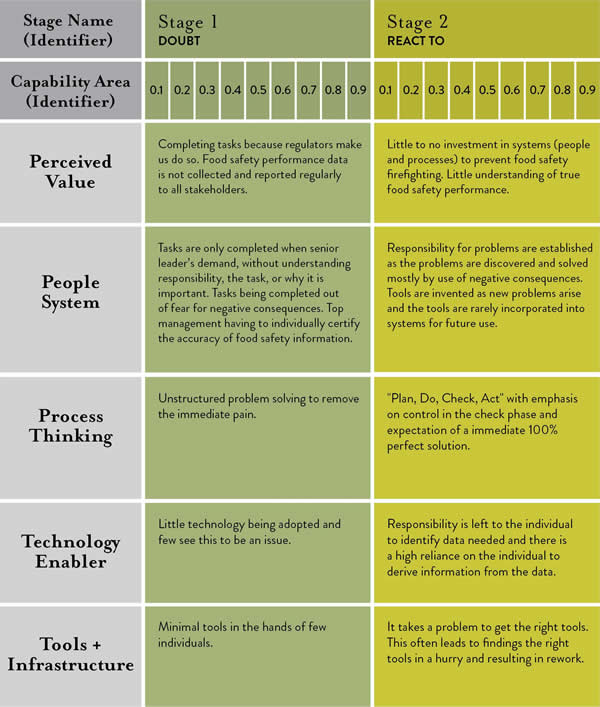
Assuming that behaviors are defined in a consistent, specific, and observable format, how do we decide the critical few behaviors that get measured? A suggested method is the use of the food safety maturity model (Table 2). The model outlines five capability areas that a processor or manufacturing company can use to measure its current state and to set priorities and direction. One capability area is Perceived Value that describes how an organization might see the value of food safety. The maturity level ranges from a low level of maturity of “Checking the box because regulators make us” to a high level of maturity for “food safety is an enabler for ongoing business growth and improvement”. Consistent, specific, and observable behaviors can be defined for each of these stages of maturity. By assessing the performance of these behaviors we can aggregate these assessment scores into a site or organization measure of the maturity of the site or organizational food safety culture. It is important to note that the maturity score does not measure “good or bad” culture. The measure is one of progression along the food safety maturity model scale, and can therefore be used to highlight areas of strength and help prioritize areas of improvement for the individual organization.
Table 2: Food Safety Maturity Model. The Food Safety Maturity Model was developed by Lone Jespersen in collaboration with Dr. John Butts, Raul Fajardo, Martha Gonzalez, Holly Mockus, Sara Mortimore, Dr. Payton Pruett, John Weisgerber, Dr. Mansel Griffiths, Dr. Tanya Maclaurin, Dr. Ben Chapman, Dr. Carol Wallace, and Deirdre Conway.
For more details on the food safety maturity model, visit www.cultivatefoodsafety.com.
Call to Action
The organization’s culture will influence how individuals throughout the group think about safety, their attitudes towards safety, their willingness to openly discuss safety concerns and share differing opinions with peers and supervisors, and, in general, the emphasis that they place on safety. However, to successfully create, strengthen, or sustain a food safety culture within an organization, the leaders must truly own it and promote it throughout the organization.8
The call-to-action for food industry leaders and regulators is to embrace a standardized measure of food safety culture to allow for comparison and sharing within an organization and between companies. “Food safety is everybody’s responsibility” was the theme of the recent GFSI Global Food Safety Conference in Kuala Lumpur, but to act on this with food safety culture as the ultimate outcome, we must adopt standardized measure. The GFSI benchmarking technical working group is an ideal forum to continue this dialogue.
During the upcoming GMA Science Forum April 12-15, 2015 join the conversation at a practical and detailed level. The preconference Food Safety Culture workshop takes place April 12, with facilitators from leading organizations; the Food Safety Culture Signature Session on April 13 will discuss what our industry requires to enable this level of standardization and collaboration. For more information and to sign-up, visit http://www.gmaonline.org/forms/meeting/Microsite/scienceforum15.
References
Schein, E. H. (2010). Organizational culture and leadership. San Francisco: Jossey-Bass.
Ball, B., Wilcock, A., & Aung, M. (2009). Factors influencing workers to follow food safety management systems in meat plants in Ontario, Canada. International Journal of Environmental Health Research, 19(3), 201-218. doi:10.1080/09603120802527646.
Hanacek, A. (2010). SCIENCE + CULTURE = SAFETY. National Provisioner, 224(4), 20-22,24,26,28-31.
Hinsz, V. B., Nickell, G. S., & Park, E. S. (2007). The role of work habits in the motivation of food safety behaviors. Journal of Experimental Psychology: Applied, 13(2), 105-114. doi:10.1037/1076-898X.13.2.105.
Nickell, G. S., & Hinsz, V. B. (2011). Having a conscientious personality helps an organizational climate of food safety predict food safety behavior. Food Supplies and Food Safety,189-198.
Jespersen, L., & Huffman, R. (2014). Building food safety into the company culture: A look at maple leaf foods. Perspectives in Public Health, (May 8, 2014) doi:DOI: 10.1177/1757913914532620.
Seward, S. (2012). Assessing the food safety culture of a manufacturing facility. Food Technology, 66(1), 44.
Yiannas, F. (2009). In Frank Yiannas. (Ed.), Food safety culture creating a behavior-based food safety management system. New York: Springer, c2009.
Braksick, L. W. (2007). Unlock behavior, unleash profits (Second ed.) McGraw-Hill.
Fishbein, M., & Ajzen, I. (2009). Predicting and changing behavior: The reasoned action approach. London, GBR: Psychology Press.
Food safety poses a global health problem. According to the World Health Organization, contaminated food can cause more than 200 diseases – and food- and water-borne diseases that cause diarrhea are estimated to kill two million people each year worldwide.
And food safety is not just someone else’s problem.
“Foodborne illnesses are a significant problem in the United States, with massive impacts on public health and the economy,” says Ben Chapman, a food safety expert and researcher at NC State. And the numbers back Chapman up.
According to a 2012 report from researchers at the Emerging Pathogens Institute, Resources For the Future, and the U.S. Department of Agriculture’s Economic Research Service, foodborne illness is estimated to cost the U.S. more than $14 billion annually. (The estimate takes into account factors such as medical costs and productivity losses.)
And a 2011 report from the U.S. Centers for Disease Control and Prevention (CDC) reported an estimated 9.4 million episodes of foodborne illness each year in the U.S. from known pathogens. An additional 38.4 million cases are estimated to come from unspecified or unknown pathogens. In total, foodborne illnesses are thought to contribute to 48 million illnesses annually – resulting in more than 128,000 hospitalizations and 3,000 deaths. It is, in short, a big deal.
So what are these foodborne illnesses? And how much damage does each of them cause? In advance of World Health Day, we wanted to explain a handful of the relevant pathogens implicated in foodborne illness.
Campylobacter fetus bacteria Image credit: CDC. Obtained via Wikimedia Commons.
Campylobacter
Campylobacter is a genus of bacteria, many of which can cause an illness called campylobacteriosis in humans, with symptoms including diarrhea and abdominal pain. People can contract campylobacteriosis from undercooked chicken, from cross-contamination via raw chicken, or from drinking unpasteurized milk.
According to the 2012 paper, campylobacteriosis affects 845,000 people annually in the U.S., costing the nation an estimated $1.747 billion every year and leading to 8,463 hospitalizations.
Listeria monocytogenes
This is a bacterium that causes listeriosis, which is characterized by fever, muscle aches, and sometimes by gastrointestinal problems, such as diarrhea. Listeriosis can be contracted from an incredibly broad range of foods.
According to the 2012 study, listeriosis costs the U.S. $2.577 billion annually, despite the fact that there are only 1,591 illnesses per year. But 1,455 of those illnesses require hospitalization – and 255 result in death.
Norovirus
Noroviruses are the most common cause of foodborne illness in the U.S., affecting an estimated 19-21 million people each year. Symptoms range from vomiting and diarrhea to fever and headache. Transmission comes from ingesting infected feces or vomit particles – for example, by touching a contaminated surface and then touching food or touching your mouth.
According to the 2012 study, noroviruses cost the U.S. $2 billion per year, with more than 14,000 hospitalizations and approximately 150 deaths annually. NC State is a leader in norovirus research, and home to NoroCORE – the Norovirus Collaborative for Outreach, Research, and Education. NoroCORE pulls together norovirus research from 18 institutions, with funding from the U.S. Department of Agriculture.
Salmonella enteritidis Image credit: U.S. Department of Agriculture. Obtained via Wikimedia Commons.
Salmonella enterica
This is one species of the pathogen that has myriad of subspecies and types – more than 1,400 of which are known to cause human illness. Infection with Salmonella species causes salmonellosis, with symptoms including diarrhea, fever, and cramping. Salmonellosis can be contracted from a variety of sources, ranging from poultry to peanut butter to mangoes.
According to the 2012 study, the subspecies within S. enterica alone costs the U.S. $3.3 billion each year, causing more than one million hospitalizations and almost 400 deaths annually.
What are researchers doing about this?
The four pathogens listed above are just a few of the rogue’s gallery of bacteria and viruses that can cause foodborne illness. But researchers are constantly learning more about these health risks.
“New technology and new research on pathogens, practices and prevention are improving our ability to identify and address foodborne illness,” Chapman says. “The field is really opening up. It’s an exciting time to be involved in food safety research.”
Between now and April 7, we’re planning to publish a series of posts on various aspects of food safety – what we know, what we don’t know, and what we’re working on. We also hope to offer insights to help folks lower the risk of contracting foodborne illnesses. We hope you’ll learn something new.
Batz, Michael B., Sandra Hoffmann, and J. Glenn Morris, Jr. “Ranking the Disease Burden of 14 Pathogens in Food Sources in the United States Using Attribution Data from Outbreak Investigations and Expert Elicitation” Journal of Food Protection, Vol. 75, No. 7, 2012, Pages 1278–1291. doi:10.4315/0362-028X.JFP-11-418
Scallan, Elaine, et al. “Foodborne Illness Acquired in the United States—Major Pathogens” Emerg Infect Dis, Vol. 17, No. 1, 2011. doi:10.3201/eid1701.P11101
This website uses cookies so that we can provide you with the best user experience possible. Cookie information is stored in your browser and performs functions such as recognising you when you return to our website and helping our team to understand which sections of the website you find most interesting and useful.
Strictly Necessary Cookies
Strictly Necessary Cookies should be enabled at all times so that we can save your preferences for these cookie settings.
We use tracking pixels that set your arrival time at our website, this is used as part of our anti-spam and security measures. Disabling this tracking pixel would disable some of our security measures, and is therefore considered necessary for the safe operation of the website. This tracking pixel is cleared from your system when you delete files in your history.
We also use cookies to store your preferences regarding the setting of 3rd Party Cookies.
If you visit and/or use the FST Training Calendar, cookies are used to store your search terms, and keep track of which records you have seen already. Without these cookies, the Training Calendar would not work.
If you disable this cookie, we will not be able to save your preferences. This means that every time you visit this website you will need to enable or disable cookies again.
Cookie Policy
A browser cookie is a small piece of data that is stored on your device to help websites and mobile apps remember things about you. Other technologies, including Web storage and identifiers associated with your device, may be used for similar purposes. In this policy, we say “cookies” to discuss all of these technologies.
Our Privacy Policy explains how we collect and use information from and about you when you use This website and certain other Innovative Publishing Co LLC services. This policy explains more about how we use cookies and your related choices.
How We Use Cookies
Data generated from cookies and other behavioral tracking technology is not made available to any outside parties, and is only used in the aggregate to make editorial decisions for the websites. Most browsers are initially set up to accept cookies, but you can reset your browser to refuse all cookies or to indicate when a cookie is being sent by visiting this Cookies Policy page. If your cookies are disabled in the browser, neither the tracking cookie nor the preference cookie is set, and you are in effect opted-out.
In other cases, our advertisers request to use third-party tracking to verify our ad delivery, or to remarket their products and/or services to you on other websites. You may opt-out of these tracking pixels by adjusting the Do Not Track settings in your browser, or by visiting the Network Advertising Initiative Opt Out page.
You have control over whether, how, and when cookies and other tracking technologies are installed on your devices. Although each browser is different, most browsers enable their users to access and edit their cookie preferences in their browser settings. The rejection or disabling of some cookies may impact certain features of the site or to cause some of the website’s services not to function properly.
Individuals may opt-out of 3rd Party Cookies used on IPC websites by adjusting your cookie preferences through this Cookie Preferences tool, or by setting web browser settings to refuse cookies and similar tracking mechanisms. Please note that web browsers operate using different identifiers. As such, you must adjust your settings in each web browser and for each computer or device on which you would like to opt-out on. Further, if you simply delete your cookies, you will need to remove cookies from your device after every visit to the websites. You may download a browser plugin that will help you maintain your opt-out choices by visiting www.aboutads.info/pmc. You may block cookies entirely by disabling cookie use in your browser or by setting your browser to ask for your permission before setting a cookie. Blocking cookies entirely may cause some websites to work incorrectly or less effectively.
The use of online tracking mechanisms by third parties is subject to those third parties’ own privacy policies, and not this Policy. If you prefer to prevent third parties from setting and accessing cookies on your computer, you may set your browser to block all cookies. Additionally, you may remove yourself from the targeted advertising of companies within the Network Advertising Initiative by opting out here, or of companies participating in the Digital Advertising Alliance program by opting out here.