


Tag Archives: FSMA

magnifying glass

Sanitation and FSMA: Is Your Program Deficient?

By Maria Fontanazza
1 Comment
magnifying glass
Bill Bremer is Principal, Food Safety Compliance at Kestrel Management LLC
Bill Bremer, Principal, Food Safety Compliance at Kestrel Management LLC

Proper sanitation plays a crucial role in the FSMA Preventive Controls rule, and FDA is paying more attention during facility inspections. However, many companies currently have deficient sanitation programs, according to Bill Bremer, principal at Kestrel Management, LLC. “It’s a key aspect of FSMA and requires that you have key personnel or a qualified sanitation manager either at each site or over each site (if it’s not local). That’s in FSMA,” he says. “In most cases, and for high-risk companies, sanitation must be supported by validated environmental testing programs (i.e., the typical swab-a-thons that FDA has done under FSMA). Sanitation chemicals that are used must be diligently approved for use and validated. In addition, chemicals must be appropriately applied, which is a big issue. These areas are key inspection points for FDA under FSMA, as well as for customer requirements. Sanitation has been elevated with FSMA and Preventive Controls, and it has to be addressed at a higher level—and for the most part, it isn’t.”

Bremer was invited by DNV-GL to discuss the importance of sanitation as a goal of FSMA in a Q&A with Food Safety Tech.

Food Safety Tech: Let’s first talk about the importance of a proper sanitation program. What are the factors at play here and what are the deficiencies with current sanitation programs?

Bill Bremer: We’re starting to conduct major sanitation program process improvements or process assessments for companies big and small. What we’re seeing in some of the key areas is that chemicals are not validated with the chemical provider. That includes the fit for use for them as well as the training of the people using them (i.e., if it’s liquid, it has to be diluted at right level and confirmed at right parts per billion).

Before you sanitize, you’re supposed to clean (in some cases it’s called debris removal). You can’t sanitize unless surfaces that are being sanitized are clean. We’re finding that cleaning isn’t done appropriately and thus companies are sanitizing over dirt, and you can’t sanitize over dirt or debris.

We’re also running into cases where the cleaning is done, and because it looks clean, a company is not sanitizing, so you run into another issue with those missed steps. And, this entire process needs to be validated and you must have records on it. You also have to support it with environmental programs, especially for high risk. So that means swabbing to make sure that once you clean and sanitize, you prove that the activities have ultimately removed any bacteria, germs or allergens from the process.

This is a high-profile area for FDA to inspect.

Some of the common deficiencies are with the program itself and the documented procedures to follow. It’s a weak area. Sometimes, a company will have different cleaning and sanitation programs documented (e.g., shift-by-shift or site-by-site), which leads to people who do the cleaning not following a standard set of instructions. It really gets down to both the programs and lack of qualified supervision and management of the cleaning and sanitation process.

Food Safety Tech: What methods should companies employ to meet FSMA requirements?

Bremer: This is an area where a diligent documentation program review is not always conducted. It’s assumed that we see the cleaning process—you see the foaming up of the cleaner, the sanitizer is all good—and we may see the cleaning record, but it’s not an SSOP, or standardized sanitation operating procedure.

However, when you look deeper and look at the documented programs, there very weak and unclear, and they need to be updated. That is one of the first things that we would investigate for a company. It’s also the qualification and training of the people—whether at the lower level or the management level, you have to be trained appropriately and the training has to be current.

Then we look at the physical process: Are they really doing debris removal in the cleaning process prior to sanitizing to make sure there’s no residue left for sanitation to be effective?

We also look at the environmental programs: Do they have a well-developed environmental program swab test? Are they using a third-party lab to validate their results? Today there are automatic test readers [that enable in-house] results. If you perform this in house, you need to have qualified people do it—and you should be checking those results with a third-party laboratory or service.

A proper sanitation program is an imperative. It’s an area where FDA is going to be investigating companies, even if they don’t have any record of products being recalled. If you look at the Blue Bell case, the big issue was that they didn’t do a good job of sanitizing their drains for Listeria, which got out of control and then it spread through the air system and to their suppliers, as well.

Melanie Neumann, Neumann Risk Services

Today’s Inspection and Audit Reality: The New Normal

By Melanie Neumann, JD, MS
2 Comments
Melanie Neumann, Neumann Risk Services

Food industry inspection and audit protocols are evolving at a rapid pace, and rightly so. This is not surprising given today’s regulatory, audit and ever-changing risk landscapes, which are driving further complexity and expansion of requirements to ensure the industry is, “audit ready, all the time.”

This evolution of inspections and audits has been primarily triggered by newer regulations such as FSMA and private standards, such as GFSI and its certification programme owners (CPO’s, fka Scheme Owners) like SQF, BRC, FSSC 22000, IFS, etc. Heightened customer demand and consumer visibility into food safety incidents –many thanks to mainstream and social media– and the resulting increased demand for information has also fueled this evolution, compelling industry to focus on higher levels of transparency, both internally and throughout the supply chain.

The changes above are driving the food industry to face a new reality. One where the following questions continue to rise to the surface:

  • How have “yesterday’s” inspection and audit expectations changed from what companies are experiencing today?
  • Based on this evolution, how will “tomorrow’s” inspection and audit expectations change?
  • In short, what does the new reality or the “new normal” look like now for inspection and audit readiness?

We will take a look at what some of the first inspections are shaping up to look like under the Preventive Controls for Human Food (PCHF) Rule and the Foreign Supplier Verification Program (FSVP) Rule. Some common themes and some tips to successfully manage regulatory inspections as well as audit readiness tips are set forth below.

More Inspectors

Roll out the welcome mat because more inspectors are coming to the party. We are seeing an average of three to upwards of six regulatory inspectors performing the inspections under the PCHF rule. This may cause an initial shock wave but when you stop to consider the rationale it has a certain level of reasonableness to it. Industry has invested in its personnel for nearly two years in updated training to meet new FSMA regulations such as preventive controls qualified individual (PCQI) training, updated current GMP training and perhaps qualified auditor training, if applicable. It makes sense that FDA needs to make a similar investment in its people to ensure its inspectors are prepared to knowledgeably perform FSMA-related inspections.

FDA has implemented a robust training program for its inspectors. Regarding PCHF inspections for example, only inspectors who have successfully completed the PCQI training plus FDA’s internal training will lead other inspectors through the facility inspections as an in-field training exercise. So, the good news is at least one inspector is fully trained under FDA’s training program standards. This said, with more inspectors, there are more eyes, and with more eyes, more opportunities to see risk through different perspectives. It’s best to be on your game, with a tested playbook so you have confidence you are prepared when the team of inspectors arrive at your facility. Conduct a mock inspection against your policies, procedures and food safety plan that have been updated for the new PCHF and other applicable FSMA requirements. You will be thankful you did.

Digging Deeper

Into Records: FSMA and the seven rules that comprise it requires more controls, monitoring and verification activities by the food industry, thus naturally giving inspectors more records to access and review. Further, FDA received expanded records access authority upon the signing of FSMA. FSMA allows FDA to access records relating to articles of food for which there is a reasonable probability that the use of, or exposure to, the article of food will cause serious adverse health consequences or death to humans or animals. Before FSMA the standard FDA had to meet to access records was “credible evidence”; now its “reasonable probability”—a standard that is far lower and subjective—allowing access to more types of records than before. Another new addition is FDA now may access records beyond those relating to the specific suspect food if the agency reasonably believes that other food articles are likely to be affected in a similar manner.

Example: If you have a potential problem on production line 1, and you firmly believe the issue is contained to line 1, but that line is in even arguably close physical proximity to line 2, depending on the issue an inspector may invoke this new authority and ask for all records associated with line 2 in addition to line 1 for the same time period to be sure that the situation indeed did not spread or otherwise impact line 2. (e.g. confirm no risk for cross contamination or allergen cross-contact).

This should not mean it’s open season on all your records, but it certainly means more records are open to review and scrutiny, so having a robust record retention and management system becomes mission-critical. How sound is yours? Record-keeping and document management have long been important to GFSI / CPO’s. However, many food companies do not have a certification from one of these entities, which begs the question whether the scope of your third-party audit, or that of a supplier you are currently evaluating for approval, adequately evaluates this important area.

Into your Hazard Analysis: Inspectors are spending significant time reviewing the adequacy of the hazard analysis performed as part of the requirement of the food safety plan under the PCHF Rule and as part of the foreign supplier verification plan requirement under the FSVP rule. If facilities do not identify all the hazards of concern that require a preventive control associated with their facility and foods they produce, then the rest of the food safety plan falls apart. If you work with peanuts to produce peanut butter and identify Salmonella as a hazard requiring a preventive control but not aflatoxin or peanut allergen you have likely missed the mark.You may not have the appropriate preventive controls, monitoring, verification activities, validations and corrective actions identified in your hazard analysis and food safety plan to control for the most significant hazards your facility / the finished food is facing from a food safety risk perspective. (note the identification of hazards requiring preventive controls is highly dependent on the food, facility, processing methods of the manufacturer, upstream supplier and will vary if products are RTE or nRTE)

How are auditors tackling this issue? Many third-party audit firms have invested in providing PCQI training for its auditors so they are better prepared to evaluate the sufficiency or gaps in the hazard analysis. It is a good idea to ask your audit firm what updated skills and training have been given to its auditors to ensure you are getting the assistance you need.

Continue to page 2 below.

Bill Bremer is Principal, Food Safety Compliance at Kestrel Management LLC
FST Soapbox

FSMA Checklist: Foreign Supplier Verification Program Requirements

By Bill Bremer
No Comments
Bill Bremer is Principal, Food Safety Compliance at Kestrel Management LLC

As all the FSMA rules move to enforcement status, food companies must prepare to best respond to requirements and, correspondingly, to develop required programs such as the Foreign Supplier Verification Program (FSVP) rule. The FSVP requires impacted companies to document specific verification steps to satisfy regulations and meet foreign-supplied shipment information requirements. These requirements took effect on May 30, 2017 for companies importing certain food products to the United States.

How much do you know about FSVP? Test your smarts by taking the FSMA FSVP IQ Test here Ultimately, the purpose of the FSVP is to document the shipping paperwork necessary to provide evidence and verification that a foreign supplier’s food-grade product shipped to a U.S. customer meets the requirements of FSMA. A company’s FSVP may include providing an additional level of evidence that the foreign company distributes safe foreign-supplied food products to the United States, the qualification of these suppliers, verification of supplier and shipment information, and records to verify the shipment of all imported food under FSMA and food safety plans. This information provides the U.S. customer receiving the product necessary proof of compliance and a record that the foreign-supplied material meets imported food product requirements.

Self-Diagnostic Assessment Tool

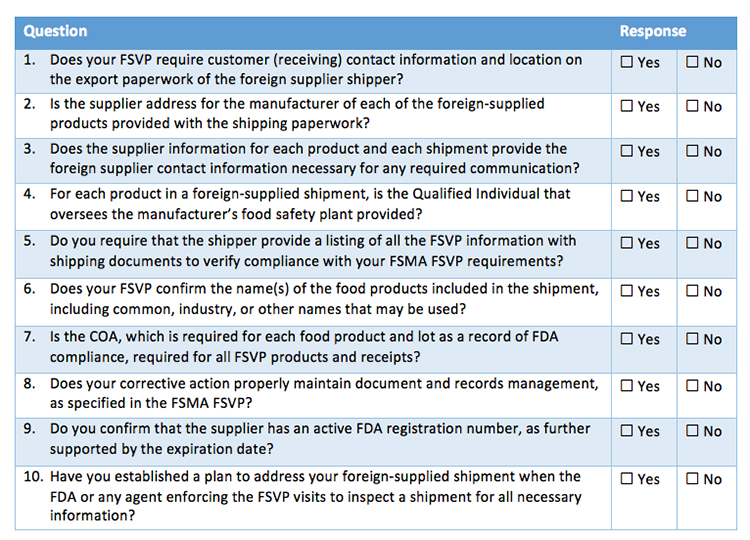
The following self-diagnostic assessment tool can help organizations better determine their current state of planning when it comes to implementing and managing FSMA FSVP requirements. To complete your own assessment, review and compare your programs to the questions in Table I.

FSMA, Foreign Supplier Verification Program
Table I. Kestrel Management’s self-diagnostic tool can help a company assess its Foreign Supplier Verification Program (FSVP) for FSMA compliance.

Get Compliance-Ready

Companies must have the appropriate systems in place to comply with FSMA FSVP requirements or face possible willful non-conformance, which can include fines and criminal penalties under FDA enforcement. The questions above will help companies identify areas to consider regarding their FSVP programs. Kestrel can also help answer questions, provide input on solutions, discuss how to better manage all your food safety requirements, and change “No” responses into “Yes” responses that promote best practices for FSMA and food safety compliance.

Learn More about BRC & FSMA Readiness

This video on BRC’s FSMA readiness module is designed to help companies understand how well their facilities are prepared for FSMA. Featuring John Kukoly, Director of BRC’s Americas, the video delivers information on what the program is, how it should be prepared for, expectations for audit time, and how to get started.

Scott Gottlieb, M.D., FDA

FDA Commissioner Announces Steps To Support Produce Safety Rule

By Food Safety Tech Staff
No Comments
Scott Gottlieb, M.D., FDA

FDA Commissioner Scott Gottlieb, M.D., announced the next steps in their approach to implement the Produce Safety Rule that was established by FSMA. During the September 12th speech at the National Association of State Departments of Agriculture, Dr. Gottlieb outlined new measures the FDA will be taking, including compliance dates for agricultural water standards, recognized water-testing methods, and inspections related to non-water requirements of the produce rule.

According to the press release, Dr. Gottlieb also announced steps the FDA will take to “address concerns related to the complexity and feasibility of implementing standards for agricultural water.” One proposed rule concerning agricultural water compliance dates, if finalized, would extend compliance dates by up to four years for produce other than sprouts.

The press release states the reasoning behind this change is allowing the FDA to revisit those standards, ensuring they are implementable for farmers across the country. Sprouts are an exception here because of their high risk for contamination and will remain subject to original compliance dates.

The announcement also covered key changes to produce farm inspections, water testing methods and training opportunities for producers and regulators. For more information, see the press release here and the full text of Dr. Gottlieb’s speech here.

Chelle Hartzer, Orkin
Bug Bytes

How to Prepare for an Audit at Any Time

By Chelle Hartzer
1 Comment
Chelle Hartzer, Orkin

Everybody knows to prepare for the worst while hoping for the best. But being prepared for an unannounced audit isn’t something that can be done overnight, especially when it comes to pest management.

That’s why it’s important to carefully review your food safety plan and the specific pest management measures contained within it. Pest management can account for up to 20% of an audit, so it can make or break a facility’s score. There’s no room to gamble—between federal regulations, audit regulations, internal standards and customer expectations, you need to stay in compliance.

With FSMA in full effect, it’s important to become familiar with the regulations found on the FDA’s website if you haven’t yet. Reacting to problems isn’t good enough anymore, as many of these regulations emphasize a preventive strategy. The FDA has the authority to mandate recalls, shut down facilities and more. If you need help determining the rest of your facility’s food safety program, the FDA has a helpful downloadable food safety plan builder.

To make sure pest issues don’t spoil your score during an unannounced audit, remember that pest management is an ongoing partnership that requires your entire staff’s participation. It’s something you should plan for as part of regular maintenance and sanitation schedules.

The first step is to establish an integrated pest management (IPM) program. This plan should be developed with your pest management provider and should be a comprehensive look at all factors that may contribute to pest issues. It should be designed to reduce pest pressure around a facility, address all sanitation and exclusion issues, actively monitor for pests and set action levels.

The goal is to proactively deal with pests and prevent as many issues as possible. An IPM program is tailored to meet a facility’s specific needs based on a wide range of different factors. An IPM program uses pesticide treatments as a final step once all conducive conditions have been identified and addressed. The program should adapt as both the facility and the pest pressures change over time.

Implement regular training for all employees and encourage participation. Something as simple as a poster featuring the “most wanted pests” in break rooms or locker rooms can help train personnel to recognize the signs of potential pests around the facility. Make it clear that each employee is a key player in your program and empower them to speak up should they see something. Ensure you have a pest-sighting log and all personnel are aware of where it is and how to report issues. Their help will be vital to point out issues, ensure sanitation is adequate and identify problem areas on a daily basis. Your pest control professional can host a training meeting for you and your staff if needed.

When implementing an IPM program at your facility, there are numerous preventive tactics you can implement and perform on a regular basis.

  • Monitoring devices: Using devices like fly lights, rodent traps and bait stations can help reduce pest populations and keep them away from food products. These monitoring devices also offer insight as to how many and what kinds of pests are plaguing the facility, which is valuable information when determining a strategy to resolve existing pest problems and minimize pest pressure.
  • Sanitation: Any food source, including the foods you are producing and storing, can draw pests. Clean up product spills quickly. Don’t forget about food in employee areas such as break rooms and locker rooms. While it is impossible to clean up every food particle (you are producing food at your site!), you can work to limit the access pests have to food sources.
  • Take out the trash: Emptying trash daily and cleaning out the trash bins helps prevent the buildup of organic material, which can attract many different pests. Make sure dumpsters are placed away from the building if possible and always keep them closed. Don’t a smelly garbage or a full bin—when in doubt, take it out!
  • Seal cracks and crevices: Keep a constant watch around the facility for any openings big enough for a pest to fit through. Remind employees that rats only need a quarter-size hole to squeeze into a facility, while mice only need an opening the size of a dime. And that’s not the worst of it; cockroaches only need one sixteenth of an inch, making it vital to seal off any openings found. Don’t forget to look at your facility from the outside as well!
  • Install automatic doors: Often, open doorways are prime locations for pests to enter. All doors should remain closed when not in use. Especially in docking areas when loading/unloading, try to open dock doors only when needed and keep the gap from the truck to doorway sealed off if possible. Installing automatic doors can reduce the likelihood flying pests inside the facility by ensuring doors stay closed when not in use.
  • Inspect shipments: Anytime a new shipment arrives, it should be inspected closely for pests. Stored product pests could be in products and spread to others in close proximity quickly, so catching them early is key. Don’t forget to inspect shipping containers for outgoing product too, because if your product goes in an infested truck, your product will be considered infested!
  • Remove clutter: Many pests love to hide under clutter. Remove unused equipment, product and packaging—especially cardboard boxes—to avoid giving pests a convenient hiding place. Don’t forget about clutter outdoors, too.
  • Outdoor concerns: Sanitation is important outside the facility as well. Make sure to remove clutter and garbage on the ground and near the facility to help reduce pest pressure. Many pest issues start outside, so removing clutter outdoors means fewer pests to potentially get into your site. In addition, installing sodium vapor lights instead of mercury vapor lights near the building will attract fewer insects.
  • Install air curtains: The perfect complement to automatic doors, air curtains create positive airflow—or air flowing outwards from building entrances—to push pests away from the building.

Auditors are looking for a number of things when it comes to pest management. One important item they want to see is the record of past pest issues and the steps taken to resolve them. You and your pest management provider should ensure all records are up to date and accurate with pest trends that can be explained.

Documentation is perhaps the most critical part of a strong IPM program. It ensures your efforts are captured, organized and available should an unexpected auditor arrive on site.

The following are six main documents to have ready at all times.

  1. Food Safety Plan
    Perhaps the most important piece of documentation, the overarching food safety plan is absolutely necessary to have on hand. The plan should be a comprehensive document describing all activities to ensure the safety of food during manufacturing, processing, packing and holding. It should include a list of potential hazards, preventive controls and corrective actions to mitigate those risks, along with monitoring and verification procedures.
  2. List of Service Changes
    An IPM program needs to be dynamic. But when modifications are made to meet the ever-changing needs of a facility, make sure to keep careful records of how and why the plans have changed.
  3. List of Monitoring Devices/Traps
    Your plan must include a map documenting all monitoring equipment, traps and any other devices used around the facility to reduce pest pressure. Note the locations and activity levels of each. The trend report from the collected data can show important information and help make management decisions. Your pest management professionals can help with this, as they should be noting activity each time they inspect your property. Auditors will want to see the historical data of pest monitoring devices and the corrective actions associated with any issues. Monitoring devices work as a great early warning system for developing pest issues and are a great proactive approach.
  4. Annual Assessments
    Each year, you should review your food safety plan and current IPM program. These annual assessments will note problem areas and set goals for the coming year. Auditors will be looking for these yearly assessments, and if you’re able to demonstrate year-over-year improvement then you’ll give your facility a better chance at a great audit score.
  5. Sighting Reports
    If a pest is spotted within the facility, employees should document it on the pest-sighting log. The report should include information about the location of the pest within the facility, who found it and the number of pests spotted. Capturing the pest is ideal, but it’s not always feasible to do so. In that case, photo evidence helps with identification, so obtain a close-up picture of the pest(s) if possible. Ensure the pest is identified and any corrective actions documented.
  6. Proof of Training/Certification
    You know that your pest management professional is trained and certified, but an auditor doesn’t. To demonstrate your provider’s expertise, keep a valid license or certification document, written evidence of the pest management professional’s training, and documentation of internal training on IPM and Good Manufacturing Practices (GMPs).

According to FSMA guidelines, a strong food safety plan identifies potential hazards to food products, and focuses on a preventive, risk-based strategy instead of a reactionary one. With an IPM program in place and detailed documentation of actions taken, you’ll be prepared anytime an auditor decides to “pop in” for a “quick chat.”

Compliance, food safety

FDA Releases Small Entity Compliance Guide for Produce Safety Rule

By Food Safety Tech Staff
No Comments
Compliance, food safety

Learn more about FSMA implementation strategy at the 2017 Food Safety Consortium | November 28–December 1FDA has released a Small Entity Compliance Guide (SECG) to help small and very small businesses comply with the Produce Safety Rule. The SECG provides assistance for farmers in determining whether they are eligible for a qualified exemption and can help them understand the modified requirements as a result.

The compliance dates under the Produce Safety rule are as follows:

  • Small businesses: January 28, 2019
  • Very small businesses: January 27, 2020
  • Sprout operations: January 26, 2018 (small businesses) and January 28, 2019 (very small businesses)
  • There are also extended compliance dates for certain agricultural water requirements
FSMA

FDA Releases Chapter 6 of Draft Guidance for PC Rule

By Food Safety Tech Staff
No Comments
FSMA

Last week FDA released the sixth chapter of the draft guidance, “Draft Guidance for Industry: Hazard Analysis and Risk-Based Preventive Controls for Human Food”. The document aims to assist food facilities in establishing and implementing a heat treatment (i.e., baking or cooking) to prevent bacterial contamination.

Learn more about FSMA compliance at the 2017 Food Safety Consortium | November 28– December 1 | The 60-page draft guidance addresses the use of heat treatments as a process control, providing information on understanding potential hazards, design and validation of the heat treatment, establishing and implementing monitoring procedures (and how often), verification, and record keeping.

FDA states that it intends to publish at least 14 chapters of the guidance. In just two weeks, the compliance date for the preventive controls for human food rule falls for small businesses (fewer than 500 full-time employees).

FSMA

How the Sanitary Transportation Rule Waiver Applies to Retail Food Establishments

By Food Safety Tech Staff
No Comments
FSMA

This week the FDA issued another guidance document to explain a waiver to the Sanitary Transportation rule and that it applies to retail food establishments that sell food for humans as well as those that sell both human and animal food. It does not apply to establishments that exclusively sell animal food.

“The Sanitary Transportation rule established a process by which FDA may waive any of the rule’s requirements for certain classes of persons, vehicles, or types of food if doing so will not result in the transportation of food under conditions that would be unsafe for human or animal health, or contrary to the public interest.” – FDA

In April, FDA announced three waivers that apply to businesses with transportation operations subject to State-Federal controls. Since this time, FDA stated that it has received questions regarding whether the term “retail food establishment” also applies to businesses that sell animal food. “The purpose of the guidance document is to clarify that the waiver is intended to apply to establishments that are covered by human food regulations based on the FDA Food Code and administered by state and local authorities,” FDA stated in a news release.

Earlier this month FDA released three guidances related to low-acid canned foods, juice HACCP and seafood HACCP.

FSMA

FSMA Exempt? FDA Guidances Explain

By Food Safety Tech Staff
No Comments
FSMA

This week FDA released three guidances to help food producers understand how the FSMA rules apply to their commodities. The regulations covered in the guidances pertain to low-acid canned foods (LACF), juice HACCP and seafood HACCP. Since FDA’s regulations for HACCP and LACF were in place before the FSMA final rules were established, the agency is clarifying the FSMA requirements as well as exemptions for these products.

The following guidances are available on FDA’s website: