Tag Archives: FSMA

Stephen Ostroff, FDA

FDA’s Ostroff Says Foodborne Illness Still Resistant to Change

By Maria Fontanazza
No Comments
Stephen Ostroff, FDA

“Everything changes; nothing remains without change.” It’s the Buddha quote that Stephen Ostroff, M.D., FDA deputy commissioner for food and veterinary medicine, used to kick off his plenary presentation at this year’s Food Safety Consortium. Yet “there is one thing that is stubbornly resistant to change,” he commented, and that’s foodborne illness. The incidence of culture-confirmed human infections hasn’t improved, and it can be seen in the number of cases reported through CDC’s FoodNet system. Why?

Stephen Ostroff, FDA
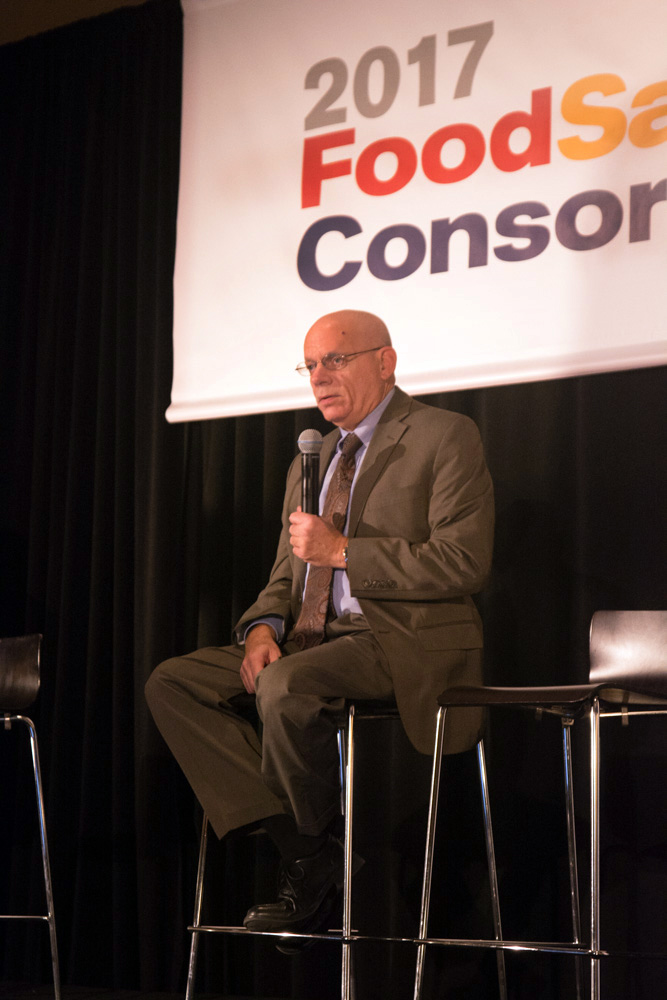
FDA’s Stephen Ostroff, M.D. answers audience questions during a town hall meeting at the 2017 Food Safety Consortium.

Ostroff has a few theories. First, there are much better diagnostics and surveillance systems in place versus 10 or 20 years ago. “Those improvements in finding the cases may be masking improvements that have occurred,” he said. Second, looking at the data from the big picture perspective may mask positive sub-trends. “We are actually doing better,” Ostroff said. “Within the data, there is some good news and some bad news.”

Ostroff also proposed that emerging food safety risks are having an impact on the rates of foodborne illness, including new trends that are altering the food landscape. The global food supply is more diverse than ever. In addition, the change in consumer preferences and eating patterns may lead to gravitation towards higher risk foods that are improperly handled. Other areas of risk include new methods of food delivery (i.e., e-commerce—Ostroff added that within a few years, up to 20% of our food will be delivered to our homes.). The final risk he touched on was new food types, such as synthetic foods (i.e., synthetic meat). “Nobody is quite familiar with the potential hazards associated with those foods,” he said.

FSMA Update

Over the past year, a new administration has come into place, along with a new FDA commissioner. In addition, compliance dates for six out of the seven foundational rules are now in effect (the compliance date for the Intentional Adulteration rule is July 2019). Although the new administration is focused on reducing the regulatory burden, it doesn’t appear to be impacting FSMA requirements. “To date we have no requests to change or delay FSMA requirements,” said Ostroff. “And that’s very good news.”

Third-party certification program. In June FDA launched a website through which organizations could apply to be recognized as an accredited body. Ostroff said the response and interest related to the program has been “overwhelming”, with hundred of entities visiting the agency’s website to learn more.

Voluntary Qualified Importer Program (VQIP). The agency anticipates that the application window will open January 2018 (however, Ostroff hinted that it may be delayed a bit). October 2018 is the projected start of the first benefit period.

FSMA Fixes. “There have been quirky issues that ended up in the FSMA regulations either because of the way FSMA was written by Congress or because of the way the regulations ended up,” said Ostroff, who added that the most problematic “quirk” is the intersection of whether an entity must comply with the Preventive Controls rule or the Produce Safety rule, and it all comes down to the farm definition. As a result, the agency extended compliance dates for a number of situations, one of which involves the agricultural water provision (January 2022 for large farms, January 2023 for small farms, and January 2024 for very small farms). Related to this provision, FDA is looking to reducing the regulatory burden but will keep standards in the lab analytic methods, frequency of testing and determination of water quality.

Training. The FDA has been partnering with many entities around the world to implement FSMA training both for industry and regulators. More than 50,000 people have been trained for the Preventive Controls for Human Food rule and more than 5000 have been trained for the animal food rule.

Inspection. At last year’s Food Safety Consortium, there was a lot of chatter about agency enforcement and inspection. Although Ostroff didn’t touch on enforcement, he provided a few figures on inspection activity for fiscal year 2017:

  • Preventive Controls for Human Food
    • Modernized CGMPs: 720
  • Preventive controls: 165 (46 outside of the United States)
  • Preventive Controls for Animal Food
    • CGMPs: 220
  • Foreign Supplier Verification Program: 285
  • Produce safety rule: 8 (sprouts)
3M Food Safety

From Culture To Compliance: The Link Between Food Safety Culture & Audit Preparedness

3M Food Safety

On Tuesday, December 5th, 3M Food Safety and Neumann Risk Services will host the final part of a 4-part webinar series on the Food Safety Modernization Act (FSMA). A special panel discussion of food safety experts will provide insight into how a robust food safety culture can positively impact audit preparedness and signal a culture of compliance.

Attendees will learn what a strong food safety culture looks like and how it can help comply with FSMA and the Safe Quality Food (SQF) Code. The free webinar will be recorded at the 2017 SQF International Conference in Dallas on November 9. It will conclude with a live Q&A for attendees and be offered on-demand to webinar registrants.

The first three webinars are currently available for on-demand listening at the 3M Health Care Academy, and each presents the opportunity to learn about the challenges companies are facing in operationalizing FSMA rules. The webinars offer real-world insight into how companies streamline implementation and execution of food safety plans, supply chain programs and other FSMA-driven programs.

Melanie Neumann, Neumann Risk Services
Melanie Neumann Neumann Risk Services, LLC

Melanie Neumann, president, Neumann Risk Services, a Matrix Sciences Company, will be moderating the panel discussion. Panelists will include:

  • Bill McBride, principal and managing director of Foodlink Management Services and SQFI Asia Pacific representative
  • Dr. Lone Jespersen, principal and founder, Cultivate
  • Dr. Martin Wiedmann, Gellert Family professor in food safety, Cornell University
  • Dr. Jay Ellingson, corporate director of food safety and quality assurance, Kwik Trip, Inc.

The webinar will take place on Tuesday, December 5 at 1:00 p.m. Central Standard Time. To sign up for the webinar, click here.

Randy Fields, Repositrak
FST Soapbox

Technology’s Role In The Future Of Food Safety

By Randy Fields
1 Comment
Randy Fields, Repositrak

As we have all read in the media, when a food safety emergency occurs, a company’s reputation stands to take a significant hit that may be unrecoverable. This phenomenon isn’t going away soon, nor are compliance requirements that pose a threat to the personal freedom of executives. If these aren’t enough reasons to get busy automating your food safety programs, read on.

Learn more about the future of food safety and technology at this year’s Food Safety Consortium, November 12–16 in Schaumburg, IL

The trends toward social and health-related product claims, like organic, the ‘free-froms’ and locally-grown, have had the impact of adding dozens if not hundreds of new suppliers to a retailer’s procurement list. And, it’s important to note, that these generally smaller suppliers are just now approaching their compliance deadlines for FSMA, and if they are very small, still have another year. New trends appear every year, and they will compound the challenge for retailers and wholesalers of knowing exactly who all of their suppliers are, which in turn will worsen compliance issues.

Our studies show that at least 12% of documents that certify organic, ‘free-froms’ and other product label claims have some level of discrepancy or inaccuracy making them invalid, and rendering the systems that rely on vendor self-disclosure near useless. With sales expected to skyrocket within these categories during the next few years, companies need to leverage technology to protect the supply chain, and consider having the system hold purchase orders generated for vendors who are not compliant with requirements.

An alternative is to have the system add a compliance fee to the purchase order that escalates over time or swiftly replace suppliers if they are not willing or not able to comply. That also speeds compliance as news travels quickly if there is a hard-hitting consequence for non-compliance. Either way, it’s important to be able to substantiate any claims to the consumer, since if those assertions are deemed unreliable, retailers and their suppliers risk a breach in consumer confidence and will suffer economically when shoppers turn away from them at the shelf.

And while retailers and wholesalers have begun to turn the Titanic on regulatory and business compliance, they need to continue to diligently find the risks in their supply chain, working even more aggressively to automate their current food safety and quality programs using new technology and procedures. Otherwise, their reputation and their existence are in jeopardy.

Cloud-based compliance management solutions that help retailers, wholesalers and suppliers meet the new food safety requirements can be configured to manage documentation requirements by supplier type vs. requiring the same documents from all suppliers. These systems also go beyond just storing digital copies of documents, and actually manage any form of compliance by reading inside the document to confirm it meets requirements. The benefits of these compliance management tools extend to streamlining new vendor approvals, which can save time and enable the redeployment of resources to more productive business-building activities.

Make no mistake: business and regulatory compliance will continue to be a focal point in the future. This includes addressing potential safety, certification and quality challenges throughout the extended supply chain as nearly one-third of all recalls are due to ingredient suppliers. We believe that in less than three years, retailers will require supply chain visibility from the shelf all the way back to “dirt”. It’s been proven too risky not to have that kind of visibility for ultimately everyone’s customer – the consumer. And now technology companies are on the hook to deliver it.

Bill Bremer is Principal, Food Safety Compliance at Kestrel Management LLC
FST Soapbox

FSMA Checklist: Intentional Adulteration Rule

By Bill Bremer
1 Comment
Bill Bremer is Principal, Food Safety Compliance at Kestrel Management LLC

The FSMA Intentional Adulteration rule is focused on preventing intentional adulteration from acts intended to cause wide-scale food safety impacts to public health, including acts of terrorism, economic adulteration and disgruntled employees. Such acts, while unlikely, could cause illness, death and economic disruption of the food supply absent mitigation strategies. This rule requires mitigation strategies to reduce risk versus specific food hazards.

How much do you know about the Intentional Adulteration Rule? Test your smarts by taking the FSMA IQ Test here The Intentional Adulteration rule is established to address large companies with products that reach many people, while exempting smaller companies. This rule requires covered facilities to conduct a “vulnerability assessment” to identify vulnerabilities and actions to take for each type of food manufactured, processed, packed or held at the food facility. For each point, step, or procedure in the facility’s process, these vulnerabilities must be identified and evaluated. Covered facilities must also prepare and implement a Food Defense Plan. This written plan must identify the vulnerabilities and actionable process steps; mitigation strategies; and procedures for food defense monitoring, corrective actions and verification. A reanalysis is required every three years or when certain criteria are met, including mitigation strategies that are determined to be improperly implemented.

Self-Diagnostic Assessment Tool

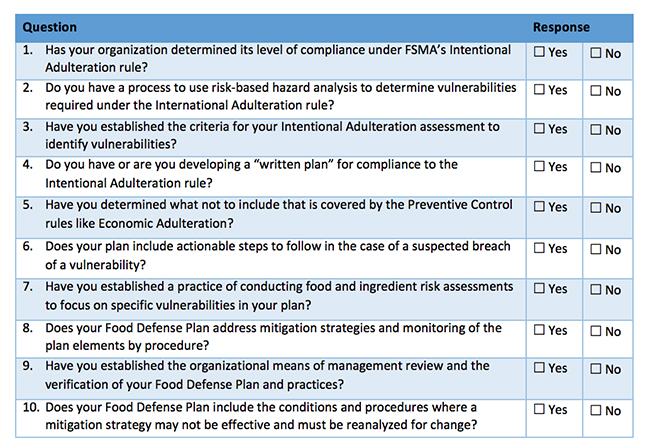
The following self-diagnostic assessment tool can help organizations better determine their current state of planning when it comes to implementing and managing FSMA Intentional Adulteration requirements. To complete your own assessment, review and compare your programs to the questions in Table I.

FSMA, Intentional Adulteration
Table I. Kestrel Management’s self-diagnostic tool can help a company assess its Intentional Adulteration program for FSMA compliance.

Get Compliance-Ready

Companies must have the appropriate systems in place to comply with FSMA Intentional Adulteration requirements or face possible willful non-conformance, which can include fines and criminal penalties under FDA enforcement. The questions in Table I will help companies identify areas to consider regarding their program. Kestrel can also help answer questions, provide input on solutions, discuss how to better manage all your food safety requirements, and change “No” responses into “Yes” responses that promote best practices for FSMA and food safety compliance.

Brendan McCahill

Four Ways Technology Can Ease The Burden Of New FSVP Compliance Regulations

By Brendan McCahill
No Comments
Brendan McCahill

What if it was possible for importers, or the customs broker that imports food into the U.S. on behalf of shippers, to stop salmonella-tainted food before it arrives in the hands of a consumer? While there are assorted systems in place to prevent contamination, often times, grocery stores and other businesses are unable to track the supply chain of foreign food importers, leaving customers blind to the origin of a product.

Descartes FSVP InfographicThe U.S. Food & Drug Administration (FDA) is working to address this issue with the Foreign Supplier Verification Program (FSVP). The new program makes importers responsible for better tracking hazards, identifying their suppliers and ensuring that their food is compliant with processes that meet the FDA’s standards for preventive controls and safety.

On the surface, this visibility seems like a great benefit to both consumers and businesses. But what will it mean for importers as they try and keep up with reporting requests and new regulations?

To prepare businesses for the continuing list of FSVP regulations that must be implemented by 2019, here are four ways in which technology will ease the burden and make the food industry’s supply chain even stronger.

1. Gain a holistic view of the supply chain

For navigating FSVP specifically, technology provides food importers with an efficient way to identify and better trace a supplier network, as well as and a quick and easy way to locate D&B D-U-N-S® Numbers*. For importer self-filers and customs brokers, similar solutions enable them to streamline techniques to transmit data to U.S. Customs & Border Protection (CBP) in the Automated Commercial Environment (ACE) as their goods move across borders, as well as to store details, such as D&B D-U-N-S Numbers, Harmonized System (HS) codes and more.

Ultimately, food importers and customs brokers that enlist the expertise of one technology provider can better prepare for FSVP compliance. While piecing together a technology solution using multiple logistics technology providers may work in the short term, a forward-looking, compliance-centric approach that aligns with future regulations must be adopted – one that gives a holistic view of the supply chain via one service provider.

2. Identify and better trace the supplier network

Supplier verification is an additional area of FSVP whereby suppliers must undergo periodic review and approval, and must be identified in order to perform an effective supplier hazard analysis and evaluation. Accurately identifying suppliers is a highly complex task due to intricate supply chains, compound food formulations and the number of SKUs in a product line. Plus, a supplier ecosystem evolves over time for many reasons, such as changing cost and consumer demand. Simply put, managing a complex supplier network can be a drain on resources and costly. Luckily, technology can help.

Logistics solutions that feature periodic updates that adapt to changing supply chains can help food importers better target suppliers to ensure regulations are followed. It can also help focus on suppliers with higher shipment volumes to optimize data management and prioritize compliance responsibilities.

In the event a food code is subject to FSVP, customs brokers are required to input the importers’ name, mailing address, email address and D-U-N-S Number. Because the FDA’s consumer protection function is dependent on the entry process, brokers are aware of the added scrutiny shipments subjected to FSVP-related information will be under, especially if any of the above information is noted as Unknown (UKN). Logistics technology can help automate this process and ease custom entries, booking, security filings and more.

3. Streamline techniques to transmit important data

Transmitting data to the CBP as goods move across borders can be challenging in its own right. Basic customs issues include import/entry process, tariff classification, valuation and duty assessment.

Innovative technology solutions can help businesses go beyond the bare minimum to improve the speed and accuracy of submitting entry and Partner Government Agency (PGA) data to CBP. Users can receive and react to responses and customs status messages by exception. Proactive alert functionality can notify users of actionable items including rejections, intensive exams, requests for electronic invoices, Temporary Importation Bonds (TIB) expiration notices and more. On-demand solutions also enable brokers and forwarders the ability to run complex international operations more efficiently.

4. Dedicate D&B D-U-N-S numbers for imported food product

The D&B D-U-N-S Number was selected by the FDA as the recording system to identify importers by a common reference system. The FSVP regulation indicates that a D-U-N-S Number must be provided by an importer for each line entry of food product imported into the U.S.

Today’s complex food industry means importers often work with an extensive ecosystem of subsidiaries, affiliates and Doing Business As (DBA) divisions. To comply with FSVP, technology can help quickly locate the D&B unique identifier for each member of the network, and streamline the complicated process of managing each line entry of food product offered for importation into the U.S.

A tech-driven pathway forward

There is no doubt that the new FSVP regulation is complex. U.S. food importers are now responsible for ensuring compliance in an effort to improve the safety of food entering the U.S. This will require food importers to fully understand the regulation on a practical level and react accordingly, using technology to its fullest.

Leading businesses should consider the FSVP regulation as an opportunity to look forward and prepare. With the right logistics technology and processes in place, organizations can improve their readiness to enable compliance, improve data management and execute a holistic regulatory strategy to meet the new stringent requirements.

* D&B D-U-N-S Numbers are proprietary to D&B, are licensed from D&B and are for internal use only. 
D-U-N-S is a registered trademark of D&B.

Accreditation

Why Accredited Services Increase Business Opportunities And Contribute To The Harmonization Of Regulations

By Natalia Larrimer, Jacqueline Southee, Ph.D.
No Comments
Accreditation

Accreditation is an internationally accepted independent oversight process for maintaining operational standards and ensuring confidence. It is accepted by many governments and private industries, including at various levels of the global food supply.

Recognized within the food industry and endorsed by the Global Food Safety Initiative (GFSI), the process of accredited certification has become essential for business.

In the United States, the Food and Drug Administration (FDA) Food Safety Modernization Act (FSMA), in its rule on accredited third-party certification, incorporates the accreditation process for oversight over third-party certification bodies certifying foreign food facilities manufacturing for import into the United States.

With accredited services increasingly becoming an integral part of business operations, many wonder how the processes of accreditation and certification work.

Accreditation is the process of ensuring that an organization has the necessary technical competence to perform a specific task, and has met and continues to meet a specific set of operational requirements. An accreditation body (AB) uses internationally established techniques and procedures to assess conformity assessment bodies (CABs) against recognized standards to ensure their impartiality, competence, and ability to produce consistently reliable, technically sound and impartial results.

Accreditation provides formal recognition that an organization is competent to carry out specific tasks, and provides an independent assessment of conformity assessment bodies (CABs)1 against recognized standards to ensure their impartiality and competence. Accreditation provides assurance to a CAB’s customers and industry that the CAB continuously operates according to internationally accepted criteria applicable to CAB’s scope of accreditation.

Although there is flexibility for an AB to design its accreditation process within the constraints of ISO/IEC 17011, Conformity assessment – General requirements for accreditation bodies accrediting conformity assessment bodies, the standard to which all internationally recognized ABs must conform, some aspects are mandatory.

As part of the application process, the applicant for accreditation submits information about the desired scope of accreditation and its documented quality management system. The AB conducts a document review to verify that the applicant has documented all management system requirements specified in the relevant criteria and any other applicable requirements. Additional requirements could include, for example, those mandated by a specific regulatory authority or industry. During the assessment, through witnessing of the CAB conducting a conformity assessment activity, interviews of personnel, and review of records and other objective evidence, the AB’s assessment team verifies the CAB’s technical competence and implementation of the quality management system.

The applicant is required to provide corrective action for all identified deficiencies. Only after all identified issues have been addressed can the accreditation decision process begin. To ensure that the accreditation decision is impartial, members of the assessment team do not take part in the decision. The designated decision maker, which may be a group or an individual, is responsible for reviewing the assessment team’s recommendation and ensuring that all accreditation requirements have been met by the applicant and are properly documented before granting accreditation.

A certificate and scope of accreditation are issued only after a favorable accreditation decision.

Once accredited, the CAB is regularly re-assessed to ensure continued conformance to the accreditation requirements, and to confirm that the required standard of operation is being maintained.

To ensure transparency, the AB is required to make publicly available information on the status and scope of accreditation for each accredited CAB. Any changes occurring after initial accreditation, such as suspension for all or part of the scope of accreditation, are published on the AB’s website.

It is important to note while ABs provide oversight over CABs, internationally recognized ABs are themselves subject to regular oversight from organizations orchestrating the harmonization and recognition of the accreditation process internationally.

The International Laboratory Accreditation Cooperation (ILAC) and the International Accreditation Forum (IAF) provide this international oversight. ABs that are signatories of the ILAC and/or IAF mutual recognition agreements (MLAs or MRAs) must conform with the requirements of ISO/IEC 17011 as applicable program-specific requirements, and are admitted to the agreements for a specific capability, for example, as an accreditor for testing labs or for management systems certification bodies. Technical competence of the AB and conformance to the requirements is verified through rigorous on site evaluation by other member of the IAF or ILAC community.

Without international oversight, there would be no evidence or confirmation that an AB operates in accordance with international requirements when providing oversight of accredited CABs. This oversight provides assurance that the AB understands the CAB’s process and can attest to the CAB’s competence.

The IAF, MLA and ILAC agreements are internationally recognized forms of approval; signatories have demonstrated their compliance with specified standards and requirements. Accreditation by a signatory of the ILAC MRA and/or IAF MLA provides assurance that decisions are based on reliable results, thus minimizing risk.

This is of particular importance in the constantly evolving global food-supply network. Many specifiers, such as regulatory authorities, have acknowledged the importance of credible accreditation programs.

A number of government agencies in the United States and around the world, including the U.S. Consumer Product Safety Commission (CPSC), U.S. Environmental Protection Agency (EPA) and the Canadian Food Inspection Agency (CFIA), have mandated accreditation by an internationally recognized accrediting body for their programs.

Accreditation within the MLA/MRA process helps regulators meet their legislative responsibilities by providing assurance that testing, inspection and evaluation results are issued by organizations whose technical competence and compliance with specified criteria has been verified by an independent third party. It provides assurance to stakeholders, such as the regulatory authorities, that the accredited CAB operates in accordance with recognized and accepted criteria.

Continue to page 2 below.

Question mark

FSMA IQ Test Part III: Intentional Adulteration Rule

By Food Safety Tech Staff
1 Comment
Question mark

The FSMA Intentional Adulteration rule provides a new level of compliance in food security and defense with specific requirements to be determined, implemented and maintained. The planning must include effective assessments on possible risk areas and steps for responding to these. Do you know the correct response to these questions?

Kestrel ManagementWorking with Bill Bremer, principal of food safety compliance at Kestrel Management, LLC, Food Safety Tech is continuing its FSMA IQ test series. Results will be posted monthly in our Food Safety Consortium newsletter leading up to the 2017 event.

Confirm your company responsibility in meeting FSMA Intentional Adulteration rule compliance by answering True or False.


Patricia Wester, PA Wester Consulting

Q&A On FSMA Audits: A Conversation With AFSAP CEO Patricia Wester

By Food Safety Tech Staff
No Comments
Patricia Wester, PA Wester Consulting

As a trade association for auditors and the auditing industry, AFSAP has researched the various references to audits found in all of the FSMA rules, and monitored the steps taken across the auditing community to meet these requirements. In this Q&A, we sit down with Patricia Wester, chief executive officer of AFSAP, to talk FSMA audits, criteria for supplier audits, preventive controls and FDA guidance. She will be running the Pre-Conference AFSAP Food Safety Auditing Fundamentals Course at this year’s Food Safety Consortium.

Background on the AFSAP and FSC Alliance

In July 2016, GFSI announced they would re-open the Guidance document revision process so that FSMA’s requirements could be considered for inclusion. When the final GFSI Guidance document was released, it included most of FSMA’s requirements. At this point, the Schemes still had to accommodate these changes, which were then provided to the CB’s. Depending on the Scheme, a CB also had to consider including content to address any FSMA related gaps. In the end, these audits could take more than a year to reach the market, and depending on the individual site’s renewal period, it could be many more months before a supplier was actually audited.

Patricia Wester moderated the Plenary Panel “What’s Next for Audits”
and running the
Pre-Conference AFSAP Food Safety Auditing Fundamentals Course at the
2017 Food Safety Consortium November 29 – December 1, 2017 in Schaumburg, IL.

Recognizing the need to inform the market, the inaugural Plenary Panel on Auditing, moderated by AFSAP’s Patricia Wester was presented at the 2016 Food Safety Consortium meeting. Dr. Ostroff opened the discussion to share FDA’s perspective on the use of audits for FSMA. His remarks were followed by representatives from GFSI, Schemes and CB’s as each described their role and recent activities to meet the new regulatory requirements, and provide insight into the timelines involved.

Dr. Ostroff has agreed to join us again for the 2017 meeting, and will participate in the Plenary Panel “What’s Next for Audits” as Industry, Retailers and the auditing community prepares for the accredited certification audits necessary for VQIP.

FoodSafetyTech: How are audits used in FSMA?

Patricia Wester: In the Third Party Audit rule, FDA outlines an accredited certification program for imported food that applies in 2 specific situations. The first applies to any imports FDA designates as “a high risk food” and the second is the use of certification audits for importers in The Voluntary Qualified Importer Program, (VQIP). Under VQIP, participating importers are required to source their products from suppliers that are certified under the FDA program.

In addition to the certification audits for VQIP and high-risk foods, audits are one of the options for supplier verification activities under the human and animal food preventive controls rules. When the hazard analysis identifies a raw material has a serious hazard, (SAHCODHA hazard), that ONLY the supplier controls, a supply chain preventive control is required, and the supplier verification activity must be an onsite audit. FDA allows some flexibility here, the audit can be a second or third party audit as long as it meets the requirements listed in 117.435, and is performed by a qualified auditor as defined in 117.3. These requirements are applicable to audits used to verify foreign suppliers (FSVP) as well as domestic suppliers.

FST: Don’t GFSI Scheme audits meet the criteria for Supplier Audits?

Wester: FDA allows the use of any audit that meets FDA’s criteria for audit content. This includes second party audits executed by employees of the receiving facility and third party audits, including GFSI audits, as long as they meet the requirements for audit criteria and are performed by a qualified auditor.

FDA acknowledges that the GFSI Auditor Competence provisions are consistent with the Agency’s findings, but that recognition does not extend to the audit criteria/content of GFSI audits.

In fact, any audit program in use prior to the publication of FSMA’s rules would probably need to be updated for these new requirements. GFSI, the Schemes, the CB’s, and others involved in the delivery of audits have likely all updated their audits to eliminate the major gaps, however, there are still some key FDA requirements that remain unmet.

FST: So, even though audit programs have been updated for FSMA’s new requirements, they are still missing some of FDA’s requirements? Why didn’t they just add everything?

Wester: In most cases, it appears to be due to a misinterpretation of the audit criteria that underpins all FDA’s audits. FDA’s audits focus on assessing a suppliers compliance with “applicable food safety regulations, the HACCP and/or Food Safety Plan and the plan’s implementation”. The Preventive Controls for Human Food Rule states the audit requirements in Subpart G:

§117.435 states:

If the raw material or other ingredient at the supplier is subject to one or more FDA food safety regulations, an onsite audit must consider such regulations and include a review of the supplier’s written plan (e.g., Hazard Analysis and Critical Control Point (HACCP) plan or other food safety plan), if any, and its implementation, for the hazard being controlled.

We (FDA) have revised phrasing to state “and its implementation” to emphasize that implementation of the plan is distinct from the plan itself (e.g., § 117.126(c). (The PCHF Final rule preamble)

Similar phrasing such as “any applicable FDA regulations” is used elsewhere when FDA discusses audit criteria, such as FSVP and VQIP and the Third Party Certification Audit rules. Further, the PCHF rule, §117.190 provides a comprehensive list of “Implementation Records” that can be used as a guide to understanding what meets this element of the FDA’s requirement.

The auditing community and Industry have assumed the regulatory reference was limited to the FSMA regulations, such as Preventive Controls for Human or Animal Food or the Produce Safety final rules), and has focused on those regulations to update their audit programs. Other FSMA regulations, such as Intentional Adulteration and Sanitary Transport, could easily be considered part of the requirement, so there are a few audit options that include those rules.

FST: What about products that are exempt from the Preventive Controls Rules?

Wester: Audits for products that are exempt from the PCHF (human Food) rule, such as Juice and Seafood HACCP, are probably available under a general HACCP format, but they may not include the level of detail required under FSMA, and would have to specifically requested when arranging a supplier audit.

Audits for other PCHF exempt products, such as bottled water or low acid canned foods, would be audited using a general food safety audit, with the specific product treated as a product category under that audit. Once again, these audits lack the product specific regulatory content and implementation details required by FSMA.

The question becomes, which FDA regulations (beyond FSMA) apply to an audit used for regulatory compliance and how much detail in the audit is necessary?

In other words, what is the full scope of regulations needed for the audit, and what are the audit criteria? Is it just FSMA or does it go further?

FST: Where does one look for this information? Does FDA offer any guidance about the scope of the audit?

Wester: The CFR, or Code of Federal Regulations is the starting place for regulations. Finding the regulatory information would not be difficult, Title 21, CH 1 Parts 1-1499 include FDA’s food regulations. In addition each part can have multiple subparts etc.

Given the sheer quantity of regulations, and that some are product specific while some are not, developing different audits for all of the possible regulatory combinations would be a daunting task and enormously costly. Remember, every auditing company will have to go through this process.

There are FDA references to scope and criteria in several responses to comments:

Audit Criteria means the set of policies, procedures or requirements used as a reference against which audit evidence is compared. During regulatory and consultative audits, accredited third-party certification bodies will examine compliance with applicable food safety requirements of the FD&C Act and FDA regulations within the scope of the audit. In consultative audits, the third-party certification bodies also may be conducting an examination to determine conformance with applicable industry standards and practices.

The applicable requirements that accredited third-party certification bodies and their audit agents will use relate to the food safety standards under the FD&C Act, such as the adulterated food provisions in section 402 of the FD&C Act and the provisions on the misbranding of food allergens in section 403(w) of the FD&C Act. The applicable requirements of the FD&C Act and FDA regulations would depend on the type of eligible entity being audited. Other examples include labeling requirements and the CFR citations listed under scopes.

Certainly, more detail than this is needed, and AFSAP is working to engage all parties, including FDA, in collaborative discussions to resolve these questions and concerns. The auditing community will need to address these issues in the near future, and industry should be vigilant to understand the requirements and make sure any audits used for FSMA are compliant.


Bill Bremer is Principal, Food Safety Compliance at Kestrel Management LLC
FST Soapbox

FSMA Checklist: Sanitary Transportation of Human and Animal Food Rule

By Bill Bremer
No Comments
Bill Bremer is Principal, Food Safety Compliance at Kestrel Management LLC

The FSMA rule on Sanitary Transportation of Human and Animal Food is now final, advancing FDA’s efforts to protect foods from farm to table by keeping them safe from contamination during transportation. Sanitary Transportation is one of seven foundational rules proposed under FSMA since January 2011 to create a modern, risk-based framework for food safety. The goal of this rule is to prevent practices during transportation that create food safety risks, such as failure to properly refrigerate food, inadequate cleaning of vehicles between loads, and failure to properly protect food.

How much do you know about the Sanitary Transportation Rule? Test your smarts by taking the FSMA IQ Test hereSpecifically, the Sanitary Transportation rule establishes requirements for vehicles and transportation equipment, transportation operations, records, training, and waivers. It applies to shippers, receivers, loaders and carriers who transport food in the United States by motor or rail vehicles. Additionally, it impacts shippers in other countries who ship food to the United States directly by motor or rail vehicle (from Canada or Mexico) or by ship or air, and arrange for the transfer of the intact container onto a motor or rail vehicle for transportation within the United States, if that food will be consumed or distributed in the United States. These requirements took effect April 2017 for shippers, carriers and receivers subject to the rule.

As the FSMA rules move to enforcement status, food companies must prepare to best respond to requirements and to develop programs for compliance, including Sanitary Transportation. This requires companies to document specific verification steps to satisfy regulations and meet food safety transportation requirements.

Self-Diagnostic Assessment Tool
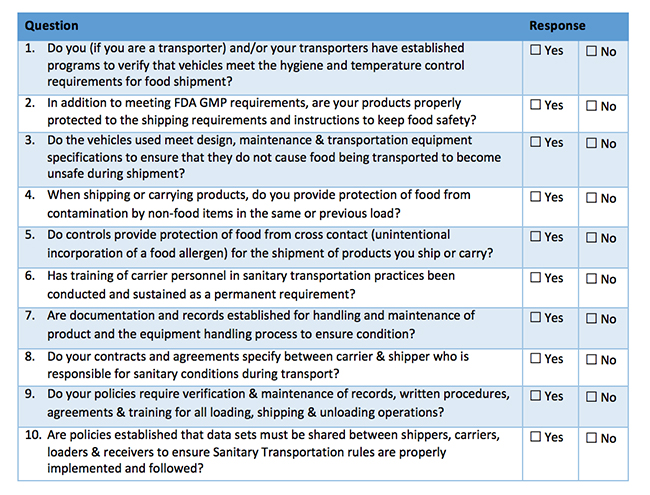
The following self-diagnostic assessment tool can help organizations better determine their current state of planning when it comes to implementing and managing Sanitary Transportation Requirements. To complete your own assessment, review and compare your programs to the questions in Table I.

FSMA Sanitary Transportation rule
Table I. Kestrel Management’s self-diagnostic tool can help a company assess its Sanitary Transportation of Human and Animal Foods programs, as required under FSMA compliance.

Get Compliance-Ready

Companies must have the appropriate systems in place to comply with FSMA Sanitary Transportation of Human and Animal Food requirements or face possible willful non-conformance, which can include fines and criminal penalties under FDA enforcement. The questions in Table I will help companies identify areas to consider regarding their Sanitary Transportation programs. Kestrel can also help answer questions, provide input on solutions, discuss how to better manage all your food safety requirements, and change “No” responses into “Yes” responses that promote best practices for FSMA and food safety compliance.

Robert Rogers
FST Soapbox

Validating Your Foreign Material Inspection System

By Robert Rogers
No Comments
Robert Rogers

The Food Safety Modernization Act (FSMA) requires that food manufacturing and processing companies identify potential hazards within their production systems and then:

  • Put in place preventive controls to address those hazards,
  • Monitor those preventive controls to ensure their effectiveness &
  • Provide documentation proving compliance with these requirements.

There are also requirements for each company to develop and establish its own plan identifying potential food safety hazards and preventive controls to counter them, and to establish the monitoring procedures that will verify the efficacy and reliability of the preventive controls.

Validating, verifying and monitoring the performance of the systems that ensure that only safe food enters the market enables food manufacturers and processors to meet the specific regulatory standards mandated by the countries where they operate and sell. This enables them to avoid product recalls that are costly and that severely damage brand identity. But these processes, in addition to satisfying regulators, also play a valuable part in protecting the companies from potential liability lawsuits, which can often be even more damaging.

The preventive controls most often used to effectively deal with such identified hazards are inspection systems (checkweighers and metal detection, X-ray and machine vision inspection systems) that quickly and efficiently detect non-standard and contaminated products and defective packaging and reject them from production lines before they can enter the marketplace. The performance of these systems must be validated, verified and monitored on an ongoing basis to ensure that they are performing as intended.

These terms–validation, verification and monitoring–are often used interchangeably, creating confusion within organizations and across industries because people interpret and use these terms in different ways. In fact, each term identifies a distinct process that has a clear purpose and role to play at different points throughout the equipment lifecycle. It is important to understand the purpose of each process to make sure that validation, verification and routine performance monitoring tests are performed to comply with regulatory requirements, particularly where the equipment is designated as a Critical Control Point (CCP).

Validation

The fundamental act of “validation,” when applied to inspection systems that are part of a food manufacturing or processing production line, is conducting an objective, data-based confirmation that the system does what it was designed, manufactured and installed to do. The International Featured Standards (IFS) organization defines validation as “confirmation through the provision of objective evidences, that the requirements for the specific intended use or application have been fulfilled.” In 2008, the Codex Alimentarius Commission defined validation as, “Obtaining evidence that a control measure or combination of control measures, if properly implemented, is capable of controlling the hazard to a specified outcome.” An important part of the validation procedure is the production of detailed data that demonstrates to line managers and to regulators that the system is operating as designed.

The manufacturer of each inspection system will validate its performance before delivery, testing it with generic products and packaging similar to what the customer will be producing. But that is only the beginning of the validation process. Onsite, that same system needs to be validated when inspecting the specific products that the production line where it will operate will be processing and/or packaging. This is ideally done at the time the system is originally installed in a production line, and then becomes one element of a complete program of validation, periodic verification and ongoing monitoring that will keep the system operating as intended and ensure that products are adequately and accurately inspected, and that accurate records of those inspections are kept.

It is critical for producers to remember, however, that the original onsite validation relates only to the specific products tested at the time. As new or additional sizes of products are developed and run on the production line, or packaging (including labeling) changes, the system will need to be re-validated for each change.

Verification

Verification is the process of periodically confirming that the inspection equipment continues to be as effective as when it was first validated. The verification process uses standard, established tests to determine whether the inspection system is still under control and continuing to operate as originally demonstrated. This verification process is conducted periodically at regular intervals to provide evidence-based confirmation that the system continues to be effective as specified. Formal performance verification is typically an annual process, to support audit requirements. It should continue throughout the productive life of the system.

Both validation of an installed system and periodic verification of operating systems can be conducted either internally by the end-user, or by the supplier of the equipment. Validation and verification services are often included as part of equipment purchase contracts.

Monitoring

Routine performance monitoring, as distinct from periodic verification, consists of a series of frequent, regular performance checks, during production, completed to determine whether processes are under control and to confirm that there has not been a significant change in the system’s performance level since the last successful test. The monitoring frequency may be as often as every two hours, depending on company standards, industry standards and/or retailer codes of practice.

If the monitoring process finds that a particular device is out of specification, all product that has passed through the production line since the last successful routine performance-monitoring event must be considered suspect and re-inspected.

In many cases, it is line operators that conduct online performance monitoring. However, many of today’s more sophisticated product inspection systems incorporate built-in performance monitoring software that automates this process and alerts operators when deviations occur. This valuable software feature removes any human error factor from the monitoring activity to help ensure that inspection processes are still being performed properly. It also provides documentation that will guide the end-user company’s QA groups in their continuous improvement efforts, and that will also be a valuable asset in the event of an inspection visit from regulators.

Routine performance monitoring can also have a direct impact on the production line’s OEE. Installing a system with built-in condition monitoring capability that automatically detects when the system may need correction and communicates that information directly to line operators reduces the frequency needed for verification testing, maximizing the line’s production uptime.

Reliance on the experts

Finally, food manufacturers and processors should remember that, while they are knowledgeable experts regarding their products, it is their equipment suppliers that are the experts on the capabilities and qualification procedures of their equipment. That expertise makes them the best source of reliable recommendations on questions from the most effective inspection equipment type for specific product needs, where to place that equipment on the production line for optimum results and how to validate, verify and monitor its performance.

Relying on these experts to conduct onsite validation and to advise on conducting periodic verification and ongoing performance monitoring can reduce both the time needed for the original onsite validation time and that needed for verification and ongoing monitoring procedures, increasing productivity.

Companies can also rely on these experts to be knowledgeable on the most current food safety regulations and the technology that affect equipment validation. It is critical for their success that they stay current on those topics, and sharing that knowledge is a valuable part of their service.