

Tag Archives: Focus Article

Gary Smith, Eurofins’ Food Safety Systems

FSMA Mandates Employee Training. Are You Prepared?

By Maria Fontanazza
No Comments
Gary Smith, Eurofins’ Food Safety Systems
Gary Smith, director of food safety, Eurofins Scientific

Training plays a huge role in the effective implementation of FSMA. The preventive controls for human food final rule calls out areas in which training is now obligatory, namely ensuring that employees involved in the manufacturing, processing, packaging and holding of food are properly educated on food safety and food hygiene (mandated under Current Good Manufacturing Practices). FDA has initiated an extensive training strategy, part of which includes establishing a National Coordination Center (the agency awarded a $600,000 grant to the International Food Protection Training Institute in October), along with several collaborative efforts with other federal agencies and industry partners.

Although many food companies have been conducting training as part of their standard procedures, preparing employees for the implementation phase of FSMA may be more complicated than they anticipated. In a Q&A with Food Safety Tech, Gary Smith, director of food safety services at Eurofins Scientific, shares insights on some of the hurdles that industry is encountering (including manufacturers in the animal food arena) related to training and FSMA compliance.

Food Safety Tech: How has FSMA changed the landscape of employee training?

Gary Smith: There are a couple of updates that are very important to note for the industries as a whole. First, employee training is now mandatory for both human food facilities and, probably even more importantly, animal food facilities. Many of the human food folks may have been asked by customers or by other entities via corporate internal procedures to do training of employees and to have a training program in place. For a lot of the pet food and animal feed manufacturers, having a comprehensive training program for all employees is significantly different than what has been requested and expected of them in the past.

Second, the preventive controls rule for both human food and animal food specifically requires that animal food and human food manufacturers conduct training of all their employees on at least food safety and food hygiene topics. Now, what does that mean? We’re interpreting that to mean basic GMPs as well as common food safety hazards. Realistically, this will probably be a 30 to 60-minute training session in which everyone in the facility will have to attend, and FDA doesn’t state specifically that it has to be done more than at least once. There is no frequency for re-training. However, once the compliance dates are effective, it’s mandatory that the training has been completed. This is a new concept for the majority of industry who may have had corporate training programs or customer-driven training programs, but never a mandated regulatory requirement for training.

FST: What challenges do food companies face in ensuring that employees are prepared for the implementation phase?

Smith: There’s the challenge of putting together the training, which, in the big picture of FSMA, shouldn’t be that big of a deal.

Some of the biggest challenges companies face (especially in trying to get ahead of the game and be proactive) is the identification of the preventive controls qualified individual. Is it an internal person? Is it a consultant? Do they have to go through a specific training class? The answer is yes, they do. How do they deal with foreign suppliers? A lot of folks are really confused about the concept of the Foreign Supplier Verification Program rule and what it means. Do they need to audit [their suppliers]? Do they need to be GFSI certified? There are a lot of questions concerning the importation of ingredients from outside the United States—what’s the requirement? This is probably the biggest area in which people seek clarity.

Another [challenge] is internal supplier approval, because the new rule talks about supplier approval as one of the preventive controls that has to be in place. Again, who can do those audits? When do we have to conduct an audit? What does the audit have to cover? A lot of folks are struggling with this area as well.

The last challenge: A lot of folks have HACCP, whether they are human or animal food manufacturers, and this has been required or requested by customers for a while. But how do we transition from having a HACCP plan to a food safety plan that meets the preventive control requirements in addition to the HACCP requirements? How do I build in allergen management as a preventive control? How do I build in sanitation as a preventive control? How do I build in supplier approval as a preventive control? There are a lot of questions surrounding whether companies should scrap their HACCP plan and start over, or whether they have to add on to it.

FST: Eurofins offers an extensive training schedule for the first half of 2016. How do these offerings play into FSMA’s compliance requirements?

Smith: Eurofins is now offering the highly anticipated 2.5-day training created by the FDA’s Food Safety Preventive Controls Alliance (FSPCA). The standardized curriculum is designed to meet the training requirements under Title 21 Code of Federal Regulations Part 117.115 for the “preventive control qualified individual” who conducts certain Food Safety Plan activities. In addition, Eurofins offers core courses such as Environmental Monitoring, Internal Food Safety Auditing and HACCP to help support the development and implementation of a company’s food safety plan.


Gina Kramer
Food Safety Think Tank

Listeria, the Pesky Bug is Everywhere!

By Gina R. Nicholson-Kramer
2 Comments
Gina Kramer

“When a flower doesn’t bloom you fix the environment in which it grows, not the flower.”  A quote, by Alexander Den Heijer, trainer, speaker, purposologist, that rings true in food safety. When there is a contamination issue in food processing, one must fix the environment in which food is being processed. Safe food is a product of a clean environment.

We have better environmental sampling programs in our food manufacturing plants and processing facilities, and we have sanitation standard operating procedures, so why are we seeing a prevalence of Listeria, and in rising numbers?  I recently sat down with Jeff Mitchell, vice president of food safety at Chemstar, about the recent increase in Listeria outbreaks and how you can rid your facility of the dangerous pathogen.

We’re seeing Listeria—in product recalls and outbreaks—over the last couple of years, and in multiple numbers. Why do you think this is happening?

Jeff Mitchell, Gina Kramer, Listeria
My interview with Jeff Mitchell about the increase in Listeria recalls.  Watch the video

Jeff Mitchell: The distribution of Listeria in the environment has not changed, and the processes that we use for processing food really haven’t changed. What’s changed is the way that we collect data. We have PulseNet now, which gathers information. If someone goes to a medical treatment facility with a foodborne illness, they’re going to investigate that and they’re going to get the whole genome sequencing on the pathogen.

There’s a difference between understanding what transient Listeria is and resident Listeria. I think there are a lot of sanitation efforts being put forth to eliminate the resident populations—those are the populations we’re most concerned about, and they’re the ones that are being related back to a lot of these recalls.

If I have resident Listeria in my facility, why can’t I find it?

Food Safety Tech is organizing a Listeria Detection & Control Workshop, May 31 – June 1, 2016 in St. Paul, MN. LEARN MOREMitchell: Resident populations of Listeria are found in a biofilm—most bacteria aggregate within a biofilm. A biofilm is a survival mode for the bacteria; it protects it from sanitizer penetration. That layer actually masks it from sampling. You could swab a surface or an area and not pick it up, because the biofilm is masking it.

Jeff goes on to discuss the type of sanitation program that companies should have in place to get rid of resident Listeria. You can learn about the steps you need to take in my video interview.

Audit

The Multi-Step Process of Third-Party Accreditation

By Charles Breen
No Comments
Audit

The FSMA Third Party Accreditation (TPA) final rule was published in the Federal Register in final form on November 27, 2015. Although TPA is not limited to imported food, its primary use will most likely be for food imports. TPA offers foreign food facilities and food importers a way to show FDA that the items coming to the United States meet federal food safety requirements.

An acceptable audit by a certified auditor is the only way an importer can take advantage of another FDA program, the Voluntary Qualified Importer Program (VQIP), which offers expedited review and entry of food. If FDA deems it necessary, the agency can also require certified audits for the import of specific foods.

The TPA process requires a number of administrative steps by FDA and non-FDA entities before the first third-party inspection is made. The four major steps are:

  • FDA is responsible for officially recognizing accreditation bodies.
  • An officially recognized accreditation body will accredit third-party certification bodies.
  • The accredited third-party certification body will certify third-party auditors.
  • The certified auditors will conduct consultative and regulatory audits of food facilities.

If FDA does not find an applicant that it can officially recognize as an accreditation body within two years, it may directly accredit third-party certification bodies.

In order to recognize an accreditation body, FDA must review an applicant’s legal authority, competency, capacity, conflict-of-interest safeguards, quality assurance and record procedures. By using an already existing framework familiar to industry, accreditation bodies and certification bodies will be allowed to use documentation of their conformance with the International Organization for Standardization and the International Electrotechnical Commission (ISO/IEC) standards, supplemented if necessary, in meeting program requirements under this rule. An official recognition of an accreditation body is granted for up to five years.

FDA is authorized to recognize a foreign government/agency or a private third party as an accreditation body under TPA.

Recognized accreditation bodies under TPA will be required to:

  • Evaluate potential third-party certification bodies for accreditation, including observing representative samples of the prospective certification body’s work
  • Monitor performance of the third-party certification bodies it has accredited, including periodical on-site observations, and notifying the FDA of any change in, or withdrawal of, accreditations it has granted
  • Self-evaluate and correct any problems in their own performance
  • Submit monitoring and self-assessment reports and other notifications to the FDA
  • Maintain and provide the FDA access to records required to be kept under the program

Once accredited, third-party certification bodies under TPA are required to perform unannounced facility audits, and to notify the FDA if a condition is found that could cause or contribute to a serious risk to public health.

Employee learning, Huddle guide

Trends in Digital Learning

By Holly Mockus
No Comments
Employee learning, Huddle guide

The food industry is becoming increasingly fast-paced. Regulations are changing, the supply chain is becoming more transparent, and resources are harder to access. To meet the needs of an ever-changing industry, digital learning is becoming the go-to solution for training managers and frontline food handlers alike, as it can be done quickly and efficiently. Now that most people have smartphones and mobile devices, there are multiple ways to make learning accessible.

Employee learning
Image courtesy of Alchemy Systems

The “Mind of the Food Worker” study conducted by the Center for Research and Public Policy (CRPP) points out that food workers have developed a preference for digital training over traditional classroom or instructor-conducted training. There are many new approaches to learning, including web-based eLearning, kiosk, gamification/competition, social media, digital signage, and coordinated communication programs. Let’s take a closer look at each of these.

eLearning

eLearning is no longer about reading through a PowerPoint presentation or watching a pre-recorded video. The number of companies offering eLearning continues to increase, as do the topics, content and format of the content. In addition, eLearning carries the added benefit of being affordable. For many companies, saving on the cost of travel when an individual attends a workshop provides an attractive incentive.

The ability to learn at one’s own pace at the time and place of one’s choosing has special appeal for today’s learners. The availability of eLearning via mobile devices is meeting that desire. It can be seen everywhere—people glued to their mobile devices while waiting in line, taking a lunch break, or in the evenings on their own time. This is multitasking at its finest.

Kiosks

The ability to take a device to a quiet environment helps with concentration and efficiency in training. Kiosks can be set up in an area that is conducive to learning with no traffic, noise or other distractions and are popping up at workplaces more and more. Learners can come and go at their convenience. A learning lab set up in a manufacturing facility will pay for itself very quickly. Sending workers to the lab one at a time is much more cost effective than shutting down a line or area of the plant for group or classroom training.

Gamification

Gamification, the use of interactive tools in conjunction with learning, is a term being used more often in training industry vocabulary. For example, it can involve the addition of a word and a definition-matching exercise in conjunction with a training module to encourage learners to retain what they have just learned. It also makes the education process more fun—and it seems to be working.

Gone are the days of sitting through hours and hours of dry lectures or reading textbooks that simply do not resonate. This method has always been especially difficult for employees working in a food plant. Sitting in a warm darkened room listening to a droning presentation is an invitation to sleep. Gamification eliminates the droning, and requires attention and participation.

The Association for Psychological Science has confirmed that competition engages learners, drives retention, and leads to higher test scores. Got a boring topic for training?  Get your game on!  A great example of gamified learning that is readily available is Merriam-Webster’s Word of the Day. Sign up for free and receive a daily email with a new word, along with its pronunciation, definition(s), use and history. The email also links to several great games that provide word calisthenics for the brain.

Social Media

Leveraging social media helps to expand and continuously improve training programs. This mode of technology will ensure that every employee in a company has timely, consistent answers to questions. Using private company social media provides a safe environment for posting questions and answers while complementing a training program and filling any knowledge gaps. The CRPP study points out that 80% of workers regularly use public social media platforms such as Facebook and LinkedIn.

Companies can take full advantage of this familiarity with social media by providing an internal forum that encourages open discussion and group learning. This approach enables the workforce to engage in an interactive learning path that is continually up to date. Internal social media also encourages networking, which fosters a sense of camaraderie between individuals, along with company loyalty. One major food company that has used this approach has seen employee questions flourish from 3,000 entries in the first year to more than 15,000 the following year. What an incredible way to keep the workforce updated minute by minute with appropriate, relevant answers to their inquiries.

The Future of Technology, Compliance and Food Safety

By Jason Dea
No Comments

There is no question that we are in the midst of a unique time period in history. Technology is continuing to innovate at an increasingly rapid rate, which has led to drastic changes that affect nearly every corner of day-to-day life. From the way we find information to our food choices, technology is influencing our lives in new ways.

The Rise of the Internet

Mary Meeker, the venture capitalist who was dubbed the “Queen of the Internet” more than 15 years ago, has described the current Internet age as a period of reimagining. At the heart of this reimagining has been the rapid growth, maturity and adoption of the Internet and Internet-enabled technologies.

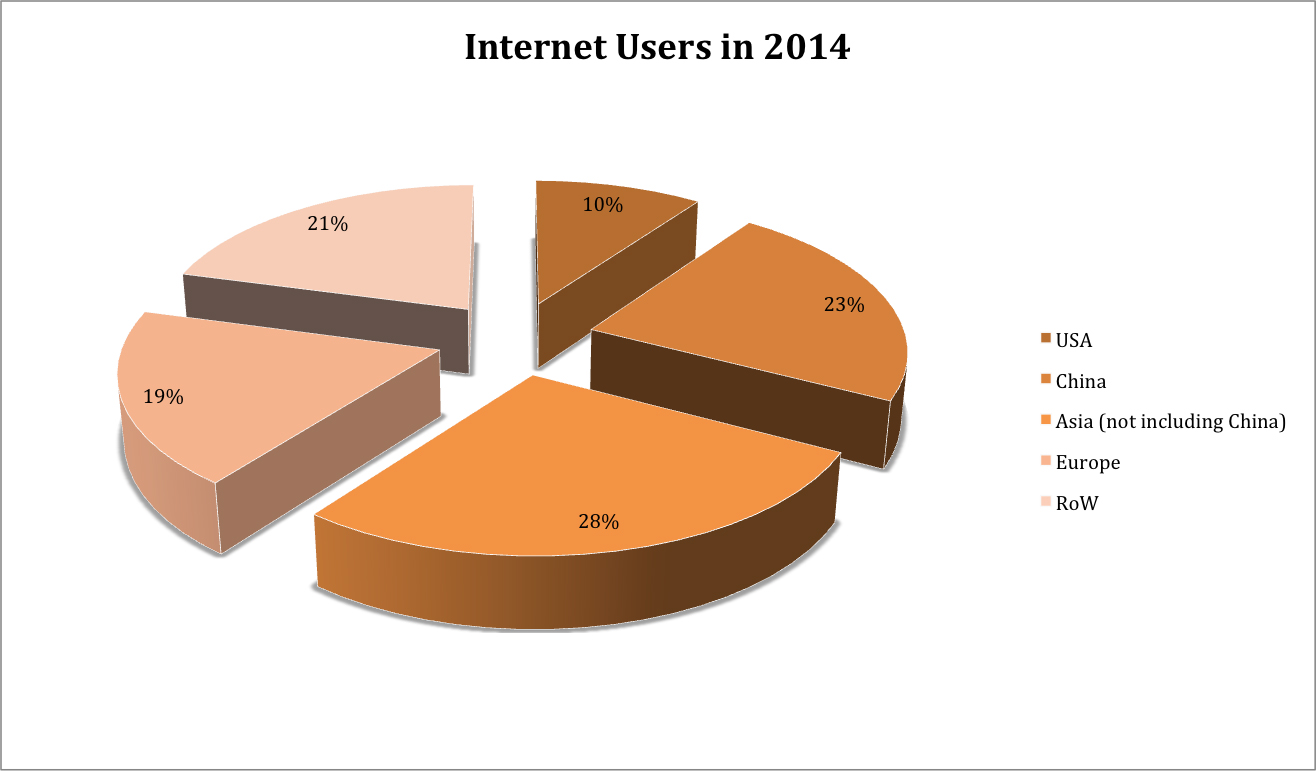
In her most recent 2015 research, Meeker published some fascinating statistics. The number of people online has ballooned more 80 times, from a user base of a mere 35 million in 1995 to a staggering 2.8 billion users in less than 20 years. This figure translates into nearly 40% of the total global population.

InternetUsers_2014
A breakdown of the 2.8 billion Internet users in 2014. This figure (39% global penetration) exploded from the approximately 35 million users in 1995. Source: Internet Trends 2015 – Code Conference

It hasn’t just been the volume of usage that has evolved radically. The nature by which those billions of users are signing online has also changed. It’s hard to believe that the original iPhone was released in 2007, less than 10 years ago. In that time, the mobile Internet has gone from a novelty to a necessity for many of us in our daily lives. This smartphone adoption has fueled Internet use and has drastically increased the ease with which consumers can get online.

Reimagining Communication and Compliance

The result of our new “always-on,” globally connected world (to borrow Meeker’s term) is a complete reimagining of communication. Consumers expect a velocity and volume of communication that the world has never before experienced. We now take for granted that we can reach friends, family and acquaintances anywhere in the world—at any time—in an instant. This has also drastically changed our expectations of business relationships.

Consumers in an ever-connected world have an expectation of availability and transparency of information from the brands with which they interact and the establishments they frequent. What this means for businesses is that customers expect to have a degree of access to business data that they’ve never asked for previously.

A tangible side effect of this desire for data transparency can be seen within the regulatory environment that organizations operate. Governments and regulatory bodies have increased their expectations of data access and availability over time, resulting in more stringent regulations across the board.

Research from Enhesa shows that the regulatory growth rate is nearly as staggering as Internet growth rates. According to the firm’s research, from 2007–2014 regulatory increases by region were as follows:

  • North America: +146%
  • Europe: +206%
  • Asia: +104%

Impact on Food Safety: Consumer Engagement and Regulatory Growth

One particular area of regulatory growth has occurred within the food and beverage sector. Arguably no product category has a more direct impact on consumers than food, as it literally fuels us each day. It’s no wonder that in an environment of increasing regulations and more empowered consumers that food quality and food safety are under increased scrutiny.

In today’s environment, it becomes much more challenging to brush aside product recalls and food safety incidents or bury these stories in specialized media. The latest news is not just a fleeting negative headline. In a worst-case scenario these incidents are viral, voracious and more shareable than ever before. From Listeria outbreaks to contaminated meat to questionable farming practices—when fueled by the Internet, the negative branding impact of these stories can be staggering. Consumers are paying attention and engaging with these stories—for example, during a Listeria or Salmonella outbreak, online searches for these terms significantly rise.

The rise of hyper-aware consumers has had a measurable impact. As a result, governments have been quick to respond and have beefed up existing regulations for the food and beverage sector via FSMA and GFSI.

Chipotle Outbreaks Over, but Origin Remains Unknown

By Maria Fontanazza
1 Comment

The CDC has declared the Chipotle E. coli outbreaks over. As for its origin(s), we may never know. Yesterday the CDC provided its latest and final update regarding the two outbreaks, stating that investigators used whole genome sequencing to dig a bit deeper, and isolates tested from those sickened in the second outbreak (sickened five people in three states) were not genetically related to isolates from the people who fell ill in the initial outbreak (55 sickened in 11 states, with 21 hospitalizations).

“We are pleased to have this behind us and can place our full energies to implementing our enhanced food safety plan that will establish Chipotle as an industry leader in food safety,” said Steve Ells, founder, chairman and co-CEO of Chipotle in a company statement. “We are extremely focused on executing this program, which designs layers of redundancy and enhanced safety measures to reduce the food safety risk to a level as near to zero as is possible. By adding these programs to an already strong and proven food culture, we strongly believe that we can establish Chipotle as a leader in food safety just as we have become a leader in our quest for the very best ingredients we can find.”

While the outbreaks “appear” to be over, the fact that the source will remain a mystery is a bit unsettling. All the CDC can tell us is that the “likely” source was a common meal item or ingredient served at Chipotle Mexican Grill. Regulatory officials simply cannot trace a food or ingredient to the outbreak. “When a restaurant serves foods with several ingredients that are mixed or cooked together and then used in multiple menu items, it can be more difficult for epidemiologic studies to identity the specific ingredient that is contaminated,” according to the CDC’s final update on the outbreak.

The most recent reported illness started on December 1, 2015. No deaths were reported as a result of either of the outbreaks.

Today Chipotle released its Q4 2015 earnings, reporting a 6.8% decrease in revenue ($997.5 million) compared to Q4 2014. However, 2015 revenue increased 9.6% over 2014.

The problems are not over for the restaurant chain either. On January 28, Chipotle was served another subpoena that broadened the scope of the existing DOJ investigation. The company stated the following in a release, “The new subpoena requires us to produce documents and information related to company-wide food safety matters dating back to January 1, 2013, and supersedes the subpoena served in December 2015 that was limited to a single Chipotle restaurant in Simi Valley, California. We intend to fully cooperate in the investigation.”

Dollar

FDA Makes FSMA Education and Training Available

By Food Safety Tech Staff
No Comments
Dollar

As part of FDA’s FSMA training vision, the agency has announced two funding opportunities aimed at providing outreach, education and training on the FSMA preventive controls rules.

The Native American Tribes Outreach, Education and Training cooperative agreement will provide up to $750,000 annually for three years. “FDA anticipates that federally recognized tribes will need food safety education and training that addresses the regulatory requirements of the applicable FSMA rules and also encompasses specific cultural practices associated with produce farming and food manufacturing/processing within tribes relevant to their status as sovereign nations,” according to an FDA release.

The Local Food Producer Outreach, Education, and Training agreement will award local food producers $1.5 million this fiscal year with the potential for two more years if federal funds are available. It aims to assist small and mid-size producers/processors with particular practices related to their scale of production and management practices. The agreement will focus on those involved in local food systems while considering “account diversified, sustainable, organic and identity-preserved agricultural production and processing.”

Dole Listeria Batch, bagged lettuce

FDA Traces Three More Listeria Cases to Dole’s Bagged Salad

By Food Safety Tech Staff
No Comments
Dole Listeria Batch, bagged lettuce

Dole’s bagged salad was the culprit of three more Listeria cases last month. Last week the FDA released the latest figures on the outbreak, which began in July 2015. An investigation was not initiated until September, and the source of Listeria—a Dole processing facility in Springfield, Ohio—was not known until January 2016. The CDC reports that 15 people, all which were hospitalized, in eight states have been infected with Listeria traced back to the Dole facility since July.

On January 21 Dole told the FDA and CDC that it both stopped producing all packaged salads at the Springfield facility and stated that it would be withdrawing all packaged salads on the market that were produced there. The company initiated the recall of the salads, which were sold under the brand names Dole, Fresh Selections, Simple Truth, Marketside, The Little Salad Bar, and President’s Choice Organics, last week. The bagged salads were distributed in 24 states.

The Public Health Agency of Canada also issued a food recall warning for products made at the Springfield facility. The products were shipped to six Canadian provinces.

Metagenomics, Food Safety

Preventing Outbreaks a Matter of How, Not When

By Maria Fontanazza
No Comments
Metagenomics, Food Safety

When it comes to preventing foodborne illness, staying ahead of the game can be an elusive task. In light of the recent outbreaks affecting Chipotle (norovirus, Salmonella, E. coli) and Dole’s packaged salad (Listeria), having the ability to identify potentially deadly outbreaks before they begin (every time) would certainly be the holy grail of food safety.

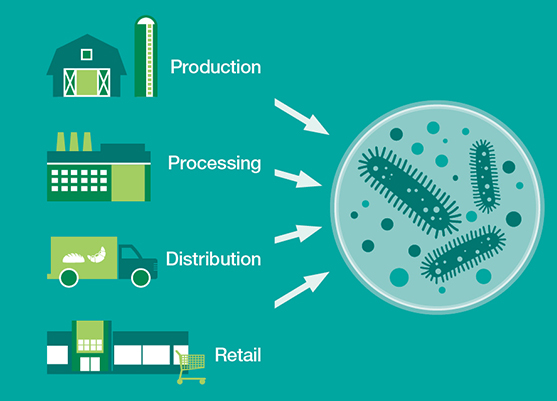
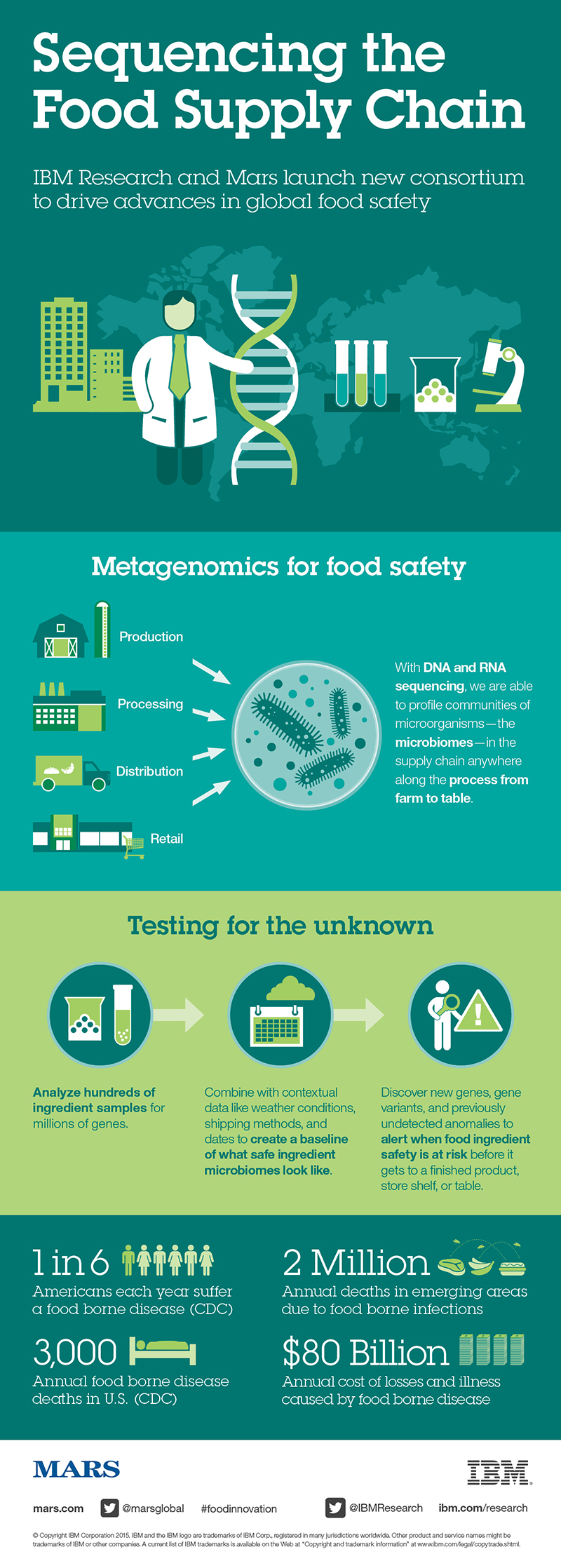
One year ago IBM Research and Mars, Inc. embarked on a partnership with that very goal in mind. They established the Consortium for Sequencing the Food Supply Chain, which they’ve touted as “the largest-ever metagenomics study…sequencing the DNA and RNA of major food ingredients in various environments, at all stages in the supply chain, to unlock food safety insights hidden in big data”.  The idea is to sequence metagenomics on different parts of the food supply chain and build reference databases as to what is a healthy/unhealthy microbiome, what bacteria lives there on a regular basis, and how are they interacting. From there, the information would be used to identify potential hazards, according to Jeff Welser, vice president and lab director at IBM Research–Almaden.

“Obviously a major concern is to always make sure there’s a safe food supply chain. That becomes increasingly difficult as our food supply chain becomes more global and distributed [in such a way] that no individual company owns a portion of it,” says Welser. “That’s really the reason for attacking the metagenomics problem. Right now we test for E. coli, Listeria, or all the known pathogens. But if there’s something that’s unknown and has never been there before, if you’re not testing for it, you’re not going to find it. Testing for the unknown is an impossible task.” With the recent addition of the diagnostics company Bio-Rad to the collaborative effort, the consortium is preparing to publish information about its progress over the past year.  In an interview with Food Safety Tech, Welser discusses the consortium’s efforts since it was established and how it is starting to see evidence that using microbiomes could provide insights on food safety issues in advance.

Food Safety Tech: What progress has the Consortium made over the past year?

Jeff Welser: For the first project with Mars, we decided to focus around pet food. Although they might be known for their chocolates, at least half of Mars’ revenue comes from the pet care industry. It’s a good area to start because it uses the same food ingredients as human food, but it’s processed very differently. There’s a large conglomeration of parts in pet food that might not be part of human food, but the tests for doing the work is directly applicable to human food. We started at a factory of theirs and sampled the raw ingredients coming in. Over the past year, we’ve been establishing whether we can measure a stable microbiome (if we measure day to day, the same ingredient and the same supplier) and [be able to identify] when something has changed.

At a high level, we believe the thesis is playing out. We’re going to publish work that is much more rigorous than that statement. We see good evidence that the overall thesis of monitoring the microbiome appears to be viable, at least for raw food ingredients. We would like to make it more quantitative, figure out how you would actually use this on a regular basis, and think about other places we could test, such as other parts of the factory or machines.

Sequencing the Food Supply Chain
Sequencing the food supply chain. Click to enlarge infographic (Courtesy of IBM Research)

FST: What are the steps to sequencing a microbiome?

Welser: A sample of food is taken into a lab where a process breaks down the cell walls to release the DNA and RNA into a slurry. A next-generation sequencing machine identifies every snippet of DNA and RNA it can from that sample, resulting in huge amounts of data. That data is transferred to IBM and other partners for analysis of the presence of organisms. It’s not a straightforward calculation, because different organisms often share genes or have similar snippets of genes. Also, because you’ve broken everything up, you don’t have a full gene necessarily; you might have a snippet of a gene. You want to look at different types of genes and different areas to identify bad organisms, etc.  When looking at DNA and RNA, you want to try to determine if an organism is currently active.

The process is all about the analysis of the data sequence. That’s where we think it has a huge amount of possibility, but it will take more time to understand it. Once you have the data, you can combine it in different ways to figure out what it means.

FST: Discuss the significance of the sequencing project in the context of recent foodborne illness outbreaks. How could the information gleaned help prevent future outbreaks?

Welser: In general, this is exactly what we’re hoping to achieve. Since you test the microbiome at any point in the supply chain, the hope is that it gives you much better headlights to a potential contamination issue wherever it occurs. Currently raw food ingredients come into a factory before they’re processed. If you see the problem with the microbiome right there, you can stop it before it gets into the machinery. Of course, you don’t know whether it came in the shipment, from the farm itself, etc. But if you’re testing in those places, hopefully you’ll figure that out as early as possible. On the other end, when a company processes food and it’s shipped to the store, it goes onto the [store] shelves. It’s not like anyone is testing on a regular basis, but in theory you could do testing to see if the ingredient is showing a different microbiome than what is normally seen.

The real challenge in the retail space is that today you can test anything sitting on the shelves for E. coli, Listeria, etc.— the [pathogens] we know about. It’s not regularly done when [product] is sitting on the shelves, because it’s not clear how effectively you can do it. It still doesn’t get over the challenge of how best to approach testing—how often it needs to be done, what’s the methodology, etc. These are all still challenges ahead. In theory, this can be used anywhere, and the advantage is that it would tell you if anything has changed [versus] testing for [the presence of] one thing.

FST: How will Bio-Rad contribute to this partnership?

Welser: We’re excited about Bio-Rad joining, because right now we’re taking samples and doing next-generation sequencing to identify the microbiome. It’s much less expensive than it used to be, but it’s still a fairly expensive test. We don’t envision that everyone will be doing this every day in their factory. However, we want to build up our understanding to determine what kinds of tests you would conduct on a regular basis without doing the full next-gen sequencing. Whenever we do sequencing, we want to make sure we’re doing the other necessary battery of tests for that food ingredient. Bio-Rad has expertise in all these areas, and they’re looking at other ways to advance their testing technology into the genomic space. That is the goal: To come up with a scientific understanding that allows us to have tests, analysis and algorithms, etc. that would allow the food industry to monitor on a regular basis.

Fritz Kriete
FST Soapbox

5 Ways Food Companies Can Protect Themselves And Customers

By Fritz Kriete
No Comments
Fritz Kriete

While illnesses linked to Chipotle restaurants are grabbing headlines, the federal government recently took steps to improve how manufacturers and packagers process and handle food. Last year FDA released several final FSMA rules, giving food companies a roadmap for ensuring food safety. The proactive approach of the regulations can help companies avoid the hazards that lead to disease and allergen contaminations, and even legal troubles. Indeed, unsafe food handling can carry costly consequences from both a financial standpoint as well as in lives lost or harmed.

In 2011, the good intentions of a family-owned cantaloupe company produced tragic results. The company, seeking more natural melons, followed a consultant’s advice and discontinued the chlorine rinse used to wash off contaminants. A Listeria outbreak followed, killing 33 people and hospitalizing 147 more. Although prosecution is rare in foodborne disease outbreaks, the company owners were sentenced to probation, home detention, community service, and $150,000 each in restitution.

A more egregious case occurred in September 2015, when the former CEO of the Peanut Corporation of America was convicted of knowingly shipping Salmonella-tainted peanut butter, which had caused an outbreak that killed nine people and sickened hundreds more. Stewart Parnell was sentenced to 28 years in federal prison.

The new regulations require companies to undertake hazard analyses of their production, along with remedial steps. This scrutiny leads to the creation of a written plan that details the controls to prevent contamination and establish a schedule for periodic testing. This analysis and control system is called the Hazard Analysis Critical Control Point, or HACCP.

Adherence to regulations doesn’t necessarily protect a company from liability, but not adhering can sound a company’s death knell when there’s a problem. The following are five ways in which companies can protect themselves:

  1. Put food safety first. The company culture must revolve around it. The message that the HACCP plan is to be followed must be relayed to all levels of the organization. Otherwise, companies can face severe consequences, based on the question, “Did the company behave badly enough to face strong punitive damages?”
  2. Concentrate on internal communications. In many cases, food recalls happen because of a breakdown in the communication process.
  3. Hire accredited consultants. Make sure that your consultants are qualified and have been accredited by an appropriate body such as the International HACCP Alliance or The Seafood HACCP Alliance.
  4. Don’t overlook supplied products. Suppliers should adhere to strict contamination-prevention protocols, but don’t assume they follow guidelines completely or have flawless processes.  Your contracts with them should require that they periodically audit their facilities and share the audit results with you.
  5. Label clearly. Packaging language might state that a product is manufactured in facilities that also process allergens such as peanuts and tree nuts. These types of warnings allow consumers to make up their own minds. It is also a reminder that HACCP plans must address prevention of cross-contamination (i.e., putting cleaning protocols in place if products with and without allergens are processed on the same equipment).

Many problems involve internal slip-ups or problems with supplied ingredients that allow contaminated food to reach consumers. If the contamination becomes known—and it often is not, when victims don’t equate their illnesses with tainted food—the businesses involved often face strict liability, meaning they carry some blame even if they didn’t act in a negligent manner and cause the problem directly.

Keep in mind that liability isn’t the only consequence of non-compliance. A recall or outbreak can damage the reputation of the company and the product. The cantaloupe tragedy sent sales of the melons plummeting, even in states not linked to the outbreak.

To minimize the hit on sales, a recall team should be in place, with a plan modeled on crisis management principles. Team members should come from all divisions of the company, including transportation and distribution to track down products, and communications to manage messaging. Legal counsel should be on board to advise on the ramifications.

When it comes to foodborne outbreaks, it’s a matter of taking classic prevention and preparation steps. Do everything you can to keep it from happening, but be ready just in case it does.