FDA will be exercising enforcement discretion for specific provisions in four FSMA rules, which means that the agency doesn’t expect to enforce the provisions as they apply to certain entities or activities. The agency made the announcement yesterday.
“In general, the FDA is exercising enforcement discretion to allow time to consider changes or other approaches to address concerns regarding the application of these provisions to certain activities or entities. FDA had previously extended the compliance dates for many of the provisions covered by this enforcement discretion guidance but is now exercising enforcement discretion.”
According to an FDA release, the enforcement discretion applies to provisions in: Current Good Manufacturing Practice, Hazard Analysis, and Risk-Based Preventive Controls for Human Food rule (PC Human Food), Current Good Manufacturing Practice, Hazard Analysis, and Risk-Based Preventive Controls for Food for Animals rule (PC Animal Food), Foreign Supplier Verification Programs rule (FSVP), and Standards for the Growing, Harvesting, Packing, and Holding of Produce for Human Consumption rule (Produce Safety). The applications is as follows:
Facilities that would be farms except for certain factors and activities
Written assurances provisions in the four rules related to the control of identified hazards or microorganisms that could be a risk to public health
Animal food PC requirements for certain manufacturing/processing activities performed on human food by-products used as animal food
FSVP requirements for importers of food contact substances
“Specifically, we found that FDA could not always ensure that firms initiated recalls promptly and that FDA did not always (1) evaluate health hazards in a timely manner, (2) issue audit check assignments at the appropriate level, (3) complete audit checks in accordance with its procedures, (4) collect timely and complete status reports from firms that have issued recalls, (5) track key recall data in the RES [Recall Enterprise System], and (6) maintain accurate recall data in the RES,” according to the OIG report.
Food Safety Tech first reported on the draft findings in June 2016 when the OIG said the FDA recall initiation process was not efficient or effective. Although Gottlieb noted that the agency took action after the draft was released, “we still have more work to do,” he said in an FDA statement.
One of the action steps for 2018 is that FDA will issue guidance on recall communications in the first half of the year. The agency is also looking at situations in which it can assist consumers in getting information about the stores and food service locations that may have sold or distributed recalled food, as well as the company that supplied the product.
“Much work remains to be done if we’re going to provide the highest assurance of safety.” – Scott Gottlieb, FDA
Gottlieb stated that the agency will be revealing more early this year about policy steps it will be taking to improve food safety oversight and how the recall process is implemented. FDA is also examining how it can expedite the timeliness and scope of information provided to consumers about food recalls.
As we look to 2018, the need for food defense activity remains. Increased adulteration incidents in 2017, consumer purchasing trends and FSMA rules implementation drive this need and the work necessary to complete it in 2018.
Intentional Adulteration of Food. It was evident that intentional adulteration of food did not diminish over the past year and likely increased. Adulteration cases of spices with undeclared ingredients to extend the product or boost color were documented. Terrorists plans and food adulteration tests were uncovered and publicized. In Germany, a man threatened to put antifreeze in the nation’s baby formula supply chain. And disgruntled employees continued to adulterate food to get revenge on their employer or co-workers. Given the complexity of our food system and the limited transparency of supply chains from farm to fork, those willing and able to adulterate will continue to do so in 2018.
Consumer Demands. Look in your local grocery aisles and you will find an ever-increasing section of “freedom foods”. These are foods that claim to be free of something whether it be gluten, lactose, pesticides or GMOs. With increasing frequency consumers are also asking questions about the sustainability and agriculture practices of the food they buy. How have the oceans been fished? Are my eggs from cage-free chickens? Does the food I buy protect the environment. Based on current trends, consumers will continue to spend their food dollars on organic, free-of, and sustainability produced food. This means food defense needs to have a keen eye on where fraudsters could adulterate products representing these food trends.
Company Food Defense. Two things have increased in the requests we are getting from companies: New incidents and the nearing deadline for compliance of the FSMA Intentional Adulteration (IA) rule. First, adulteration incidents that affect your product or the ingredients you use changes the lens you see food defense through. Even an adulteration in an ingredient or product similar to yours makes you look twice at how protected you are. With the continued incidents, companies are taking a hard look at how they are affected. Second, food companies have completed their work to prepare for the early FSMA rules such as Preventive Controls and Foreign Supplier Verification moving their attention to the next rules. The IA rule compliance dates begin in July 2019, and we anticipate increased activities, questions and food defense efforts in 2018.
As you can see, there is a nexus of need to accomplish defense work in our food system. Perhaps 2018 will be “the” year of food defense where individually and collectively we close vulnerability gaps.
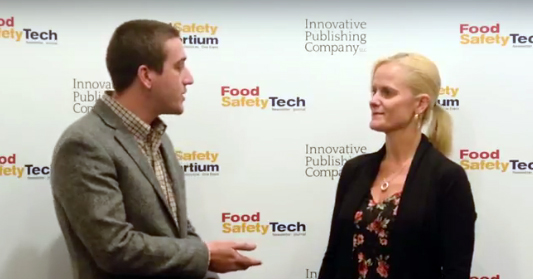
In today’s risk-based world, companies can’t just trust a third-party auditor based on a handshake, according to Melanie Neumann of Neumann Risk Services and Matrix Sciences. It is also a manufacturer’s responsibility to verify the auditor. Watch the following video, shot at this year’s Food Safety Consortium, to hear Neumann’s take on “trust but verify” and the importance of inspection and audit readiness both today and in the future.
Increasingly, we turn to technology to simplify tasks in our personal and business lives. Platforms like Facebook and Twitter allow us to connect, shop, advertise and publish with just a few clicks. LinkedIn is where people turn to prospect for new business, publish articles, discuss issues within industry groups, and look for a job. Need a ride? Apps like Uber and Lyft can usually get you where you’re going cheaper and more easily than a taxi. Devices like Google Home and Amazon Echo can listen to your voice commands to play music, manage your shopping list, adjust your lights, or tell a joke. And experiments are underway for driverless cars, which could make us the last car-owning generation.
With technology automating and solving so many tasks, how is it possible that food production is still dependent on paper-driven and manual processes?
The current way of doing things in the food and beverage industry is outdated, labor intensive, and—most importantly—error-prone. Under FSMA, companies need to be able to justify their decisions and processes, and of course, document them. It’s not only critical for brand protection—it’s a regulatory requirement. Ignorance is not bliss. Now, senior management is obligated to demonstrate their commitment to food safety and they risk criminal prosecution if their operations don’t measure up. There’s too much at risk to keep doing things the same old way. The following are some signs that your quality department is still in the Dark Ages.
1. You’re using clipboards.
In defense of clipboards, they were a wonderful invention. They are quite well suited for gathering signatures on petitions to save the whales or signing up for a PTA bake sale. But if you’re still using clipboards to log temperatures or document sanitation procedures, then your food safety records are not as current and organized as they could be. Inputting data later is not an effective use of time. Processes like these not only take away from the core competencies of your quality team, but they also make staff spend more time analyzing everything manually, which could lead to costly mistakes or inaccuracies. Tablets and PCs have replaced paper-based logs and other quality recordkeeping. Why make your staff do a task twice? By digitizing these records, you can ensure that your records are up-to-date in real time and reduce the likelihood of errors made during transcription. Trust me, your staff will thank you for rescuing them from extra data entry. Plus, the modern workforce expects digital solutions.
Still using a filing cabinet to store documentation? All images courtesy of TraceGains
2. You’re still using a physical filing cabinet to store food safety documentation.
If you’re putting your food safety plan, supplier documents and certificates of authenticity (COAs) in a filing cabinet, you have a transparency problem. Your department isn’t the only one that needs access to those critical documents. And if everyone has their own paper copy, then you are going to have problems with version control. Solve your transparency and version control problems by keeping critical documents in the cloud where the data can be extracted, analyzed and shared internally and externally across your supply chain.
Three-ring binders are no longer an appropriate place to store important information.
3. Three-ring binders are for middle school, not food safety.
If your idea of ensuring compliance involves keeping COAs in a three-ring binder, you probably still have a flip phone, too. Seriously, 1980 called and they want their Trapper Keeper back. Whether your documents are in filing cabinets or binders, you still don’t have the transparency you need to efficiently share that information with your peers and other departments. Plus, your audits are sure to drag on longer than necessary if you are doing audits with stacks of three-ring binder instead of using an online platform where you can show the auditor any documentation they need with just a few clicks of a mouse.
4. Your suppliers send critical food safety documents to you via e-mail.
Email is a great way to communicate. It’s just not the best way to gather and manage supplier documents. Admit it; we all get behind on email, and sometimes things slip through the cracks. What happens if an out-of-spec allergen declaration gets buried under the 586 emails you receive each day? I can tell you, it’s certainly not good. The alternative is allowing your suppliers to upload those documents into a platform, so they are immediately available to you and anyone else in the company that you’ve given access to the system. Leveraging a platform, you also have access to a dashboard that can quickly show you which suppliers are in compliance and which ones have issues that need to be addressed. And if you have incoming certificates of authenticity (COAs), you can sit back and rely on software to read those documents for you and spot anything that doesn’t match your specifications or purchase order details. Isn’t it time that you not only collected supplier documents, but really use that data within the documents to better manage your incoming material to ensure food safety and quality?
5. You rely on file sharing to store your food safety and quality documentation.
SharePoint and other file sharing systems may look more modern than the paper alternative, but they weren’t designed specifically for vendor management or supply chain transparency. They can file and retrieve, but it’s not automated document management. Ask yourself how long do you or fellow employees spend searching for requested documents? Perhaps you need certain documentation for your GFSI/FDA audit, but different pieces of information are stored in various locations, either in a shared drive like SharePoint or a custom vendor portal. Every minute counts when it comes to document retrieval. These systems are often a little more than an electronic filing cabinet. They can store the information electronically, but unless it’s gathering, analyzing, validating and sharing that data across all departments, you still don’t have an automated system.
If you’re still using spreadsheets, consider moving data to the cloud.
6. Spreadsheets are the main source of tracking your data.
While quality managers at competing companies are investing in the latest technology, other food companies are still inputting supplier lists and data in spreadsheets. Often, managers are reluctant to move their data to the cloud, opting instead to stick with what they know by using a spreadsheet that lacks a comprehensive system to track supplier performance in real time. This is a major disadvantage when different departments need one source of the truth about supplier performance and trend data about incoming material. Not only are spreadsheets hard to share and keep up-to-date, but the majority of them also contain errors.
A report by Ray Panko, a professor of IT management at the University of Hawaii, found that 88% of spreadsheets contained errors.
Coopers & Lybrand found that 91% of spreadsheets with 150 rows or more produced results that were off by more than 5%.
In a sample of 22 spreadsheets, KPMG found that 91% contained serious errors.
If your executives think automated supplier, compliance and quality systems are a “nice-to-have,” chances are you are still operating in the Dark Ages. This final advice is true no matter what software your business is thinking of implementing. Whatever the aims of the system, you must choose a long-term partner. Make sure your vendor can solve these six problems and meet the needs of your business now and in the future.
Today FDA released a draft guidance to provide information about what actions by a foreign food establishment or government are considered a refusal of inspection. “FSMA gives the U.S. Food and Drug Administration the authority to refuse imported food admission into the United States if the agency is not permitted to inspect the foreign establishment that produced the food,” FDA stated in a release.
The 12-page draft guidance, Refusal of Inspection by a Foreign Food Establishment or Foreign Government, outlines how the agency goes about scheduling inspections of foreign establishments (despite the fact that FDA is not required to pre-announce inspections), the inspection activities themselves, and very detailed examples of what it considers an inspection refusal from a facility (from a lack of communication with FDA that delays the agency’s request to schedule an inspection, to preventing an FDA investigator from entering a facility, when a facility sends staff home and tells FDA that it is not producing product).
The draft also details what it considers to be refusal of inspection by a foreign government. Some of the actions include preventing FDA investigators from entering the country or asks them to leave the country before an inspection is scheduled; and limiting access to areas of the facility that manufacturing, processing and packaging occurs; and limiting investigators from collecting samples for analysis.
If either a foreign food establishment or a foreign government refuses an inspection, they will stay on the agency’s Red List of Import Alert 99-32 until FDA is able to schedule and conduct an inspection.
“Everything changes; nothing remains without change.” It’s the Buddha quote that Stephen Ostroff, M.D., FDA deputy commissioner for food and veterinary medicine, used to kick off his plenary presentation at this year’s Food Safety Consortium. Yet “there is one thing that is stubbornly resistant to change,” he commented, and that’s foodborne illness. The incidence of culture-confirmed human infections hasn’t improved, and it can be seen in the number of cases reported through CDC’s FoodNet system. Why?
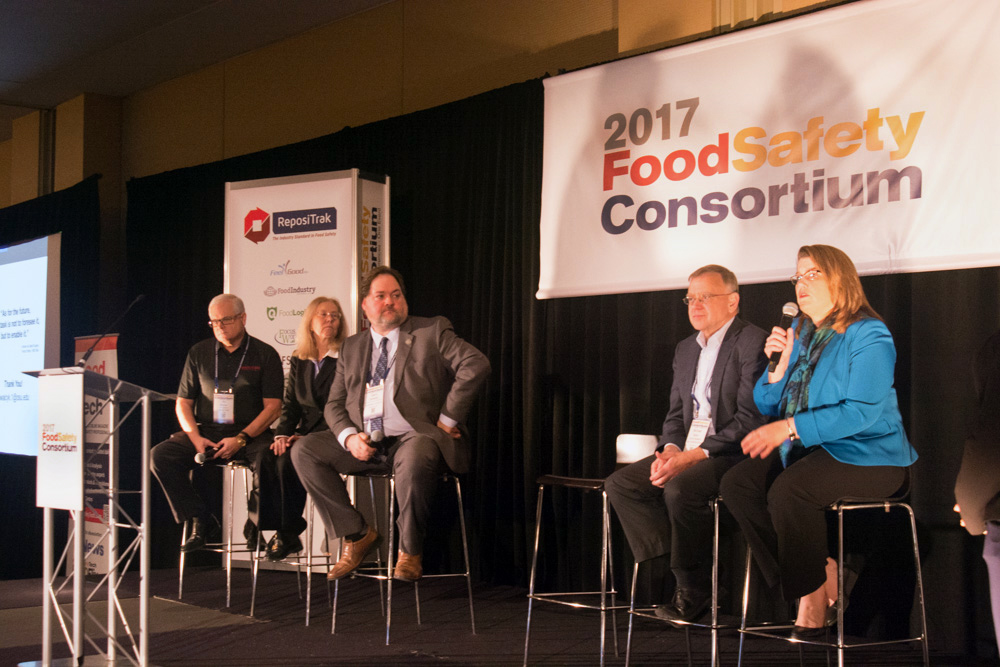
FDA’s Stephen Ostroff, M.D. answers audience questions during a town hall meeting at the 2017 Food Safety Consortium.
Ostroff has a few theories. First, there are much better diagnostics and surveillance systems in place versus 10 or 20 years ago. “Those improvements in finding the cases may be masking improvements that have occurred,” he said. Second, looking at the data from the big picture perspective may mask positive sub-trends. “We are actually doing better,” Ostroff said. “Within the data, there is some good news and some bad news.”
Ostroff also proposed that emerging food safety risks are having an impact on the rates of foodborne illness, including new trends that are altering the food landscape. The global food supply is more diverse than ever. In addition, the change in consumer preferences and eating patterns may lead to gravitation towards higher risk foods that are improperly handled. Other areas of risk include new methods of food delivery (i.e., e-commerce—Ostroff added that within a few years, up to 20% of our food will be delivered to our homes.). The final risk he touched on was new food types, such as synthetic foods (i.e., synthetic meat). “Nobody is quite familiar with the potential hazards associated with those foods,” he said.
FSMA Update
Over the past year, a new administration has come into place, along with a new FDA commissioner. In addition, compliance dates for six out of the seven foundational rules are now in effect (the compliance date for the Intentional Adulteration rule is July 2019). Although the new administration is focused on reducing the regulatory burden, it doesn’t appear to be impacting FSMA requirements. “To date we have no requests to change or delay FSMA requirements,” said Ostroff. “And that’s very good news.”
Third-party certification program. In June FDA launched a website through which organizations could apply to be recognized as an accredited body. Ostroff said the response and interest related to the program has been “overwhelming”, with hundred of entities visiting the agency’s website to learn more.
Voluntary Qualified Importer Program (VQIP). The agency anticipates that the application window will open January 2018 (however, Ostroff hinted that it may be delayed a bit). October 2018 is the projected start of the first benefit period.
FSMA Fixes. “There have been quirky issues that ended up in the FSMA regulations either because of the way FSMA was written by Congress or because of the way the regulations ended up,” said Ostroff, who added that the most problematic “quirk” is the intersection of whether an entity must comply with the Preventive Controls rule or the Produce Safety rule, and it all comes down to the farm definition. As a result, the agency extended compliance dates for a number of situations, one of which involves the agricultural water provision (January 2022 for large farms, January 2023 for small farms, and January 2024 for very small farms). Related to this provision, FDA is looking to reducing the regulatory burden but will keep standards in the lab analytic methods, frequency of testing and determination of water quality.
Training. The FDA has been partnering with many entities around the world to implement FSMA training both for industry and regulators. More than 50,000 people have been trained for the Preventive Controls for Human Food rule and more than 5000 have been trained for the animal food rule.
Inspection. At last year’s Food Safety Consortium, there was a lot of chatter about agency enforcement and inspection. Although Ostroff didn’t touch on enforcement, he provided a few figures on inspection activity for fiscal year 2017:
Preventive Controls for Human Food
Modernized CGMPs: 720
Preventive controls: 165 (46 outside of the United States)
The food industry has been one of the most celebrated and fastest-growing industries over the last decade or so. Which is no surprise, considering how much food is now being consumed, or posted on Instagram, on a daily basis. Pop-up food carts and hole-in-the-wall food places have been a huge hit too and even inspired a number of Hollywood films about the tough competition and revolutionary marketing tactics that have taken over the food industry (see: Jon Favreau’s Chef and Bradley Cooper’s Burnt). It’s good times, for sure. Well, for the most part, I mean.
When did foodborne illness become a major concern in the US?
Unfortunately, it’s not just the revenue that’s on the rise, because food borne illnesses too are making the headlines as of late. Talk about spoiling (no pun intended) the fun, eh? Well, according to the US Centers for Disease Control and Prevention (CDC) in Atlanta, Georgia, the number of foodborne disease outbreaks resulting from imported foods increased during surveillance years 2005 to 2010.
Where are the numbers coming from?
Dr. L. Hannah Gould, Ph.D., a senior epidemiologist at the CDC, revealed those findings during an oral presentation here at the International Conference on Emerging Infectious Diseases in 2012. According to the CDC, 39 foodborne disease outbreaks were reported in which the implicated food had been imported into the United States. These outbreaks resulted in 2348 illnesses, 434 hospitalizations and 3 deaths.
How many are affected?
Though foodborne illnesses are often never formally reported, about 48 million Americans, or one in six, get sick each year from food, the CDC estimates, with 128,000 hospitalizations and 3,000 deaths. In fact, in 2014, 19,542 cases of infection were traced from 15% of the US population being surveyed by CDC.
Why is it on the rise?
The culprits? Chances are, you’ve been storing them somewhere inside your establishment: packaged caramel-coated apples, frozen ice cream sandwiches, fresh peaches and nectarines, frozen meet, etc. Not exactly the answers you were expecting, perhaps?
According to experts, the growing popularity of packaged foods such as pre-cut fruit and prepared sandwiches has heightened the risk of spreading foodborne illnesses. Furthermore, they have identified that contamination can occur between preparation and packaging, or in high-tech processing plants, after heating to destroy harmful bacteria and before packaging. Which means, somewhere in the last decade, we lost our way (or something like that).
What can we do to stop foodborne disease from spreading?
The whole fiasco regarding foodborne illness is a public safety concern and must be addressed by everyone. However, while adjusting individually may not be a problem for most of us, the same cannot be said for food places and restaurants. Just imagine the public relations horror for restaurant managers if any of their customers get sick while dining at their place?
Restaurants must be more strict and thorough when addressing food safety concerns. The entire crew must be trained when it comes to food handling and a food safety manager must also take charge in overseeing procedures in the kitchen. In fact, proper storage and disposal must also be adequately done at all times. With those safety measures in play, establishments will be able to showcase their commitment to adhere with local food standards and basic food handling procedures. That’s a step in the right direction, for sure.
Summing up, foodborne illness is definitely a manageable concern and will likely not become a factor that will hinder the overall growth of the food industry. However, the fact that it can be controlled and yet still recurring means that there’s still a fair amount of work needed to be done to improve the industry in other aspects—and that isn’t necessarily a bad thing (at least not yet).
Sadly, more and more these days, terrorism has become a prevalent concern. The food sector is not immune to threats either, especially as soft targets and lone wolf attacks become more common.
Food Safety Tech discussed the issue with special agent Scott Mahloch, weapons of mass destruction coordinator for FBI Chicago, during a conversation leading up to this year’s Food Safety Consortium, where Mahloch will be speaking.
Food Safety Tech: In the past year, have there been any changes or new developments in the way in which the FBI conducts outreach to the food industry?
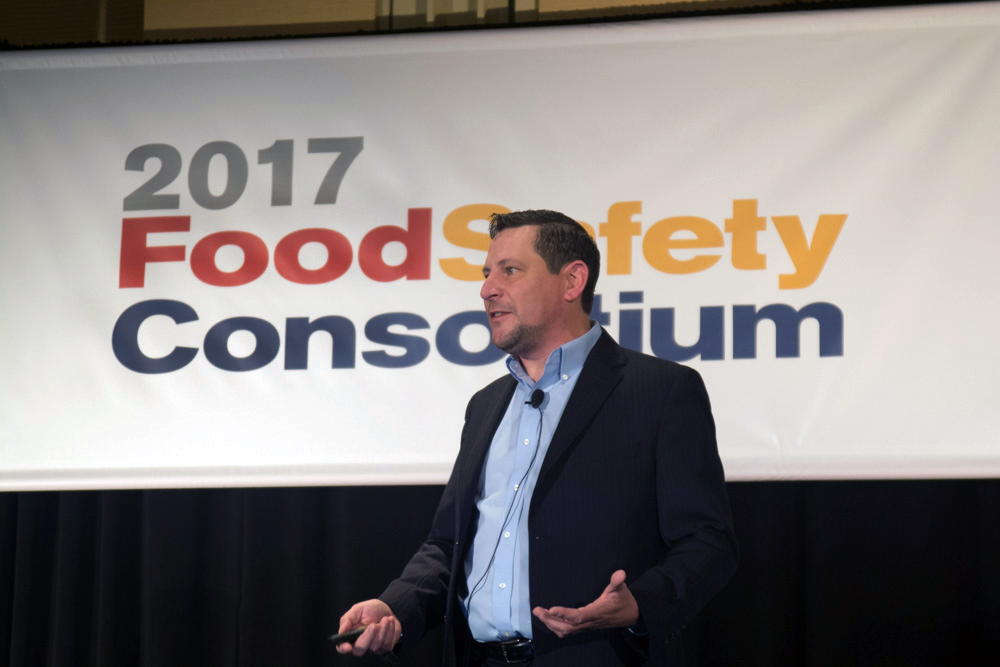
Scott Mahloch presented FBI’s Role in Food Defense on November 29 at the 2017 Food Safety Consortium | Learn moreScott Mahloch: The U.S. food system continues to be a soft target, largely unprotected from the insider threat. Since last year’s Food Safety Consortium we have done targeted outreach to the top dozen food processing facilities in the Chicago area. We worked with our intelligence team, came up with a list of questions and spoke with food safety managers and facility managers regarding the insider threat and educated them on the WMD [FBI’s Weapons of Mass Destruction] program.
FST: Do other divisions of the FBI work in a similar manner as the Chicago division?
Mahloch: It really depends on the office. We have 56 field offices around the nation. In every office we have a WMD coordinator, so it depends on his or her area of responsibility and what that area commands. For example, our office in Springfield [Illinois] is more agriculturally based than we are here in Chicago. Their food outreach would be very similar, but they might be looking at the farms and the agricultural aspect of food production.
FST: Are there any imminent threats to the food sector? Have you seen anything new over the past year?
Mahloch: No, we have not [seen] anything here in the homeland. The bad guys overseas have always expressed interest in attacking food and water, and that remains the same. It’s more the international terrorist groups that have always stressed this in the past. That’s one of the drivers of why we’re so involved in this outreach—we never want that to happen here in the United States. To get in front of the threat, we go out and talk to subject matter experts in this area, the facility managers and food safety managers to get the information out there.
FST: As FBI takes a proactive approach to food defense, what responses have you seen with food companies thus far?
Mahloch: It’s been very positive. People out there believe in our mission and in what we’re doing, and they want to ensure safety and security in their facilities. Communication has been great; they’ve welcomed us into their facility, taken us on facility tours, shown us production lines and answered our questions. It’s been a great relationship.
FST: Does the FBI concern itself with global food supply chain security in terms of how it affects the United States?
Mahloch: Yes, absolutely. What I do is more on a local level here in Chicago, and the same goes for my fellow coordinators in the field offices. We focus on our area of responsibility. The WMD director has a unit that deals with food and water safety. We also have an overseas lead attaché program that works—those folks are also involved in WMD.
FST: What can attendees look forward to hearing about during your presentation at this year’s Food Safety Consortium?
Mahloch: A lot of it will be education and just getting the word out there that the FBI has a role in food safety, food protection and water safety. A lot of people don’t realize the FBI is involved in this. Usually when you think food protection, you think the USDA, FDA, Homeland Security and other agencies that have programs. So a lot of it will be education and telling [attendees] what we do, what we’re about, and where they can turn in a time of need for additional resources. That’s probably the biggest takeaway from the FBI.
[In addition], on outreach and how the FBI is perceived, what we’ve noticed is that we’ve gone into facilities and their defenses are up a bit because they think the FBI is going to regulate, take a look at their processes and inspect. That’s really not what we’re about. We’re not a regulator—we don’t go in and try to change internal processes or rip apart what they’re doing. What we do is strictly education. There are other regulatory bodies that mandate how things are supposed to be shipped, stored and processed. That’s not the FBI. Sometimes there’s that misconception when we go in and want to do some outreach—that FBI is there to regulate. That’s not the truth. We’re a resource and we’re trying to open those doors of communication.
And as far as the threat in the homeland, right now there is none and we continue to try to stay ahead of the threat through education and being a resource.
This website uses cookies so that we can provide you with the best user experience possible. Cookie information is stored in your browser and performs functions such as recognising you when you return to our website and helping our team to understand which sections of the website you find most interesting and useful.
Strictly Necessary Cookies
Strictly Necessary Cookies should be enabled at all times so that we can save your preferences for these cookie settings.
We use tracking pixels that set your arrival time at our website, this is used as part of our anti-spam and security measures. Disabling this tracking pixel would disable some of our security measures, and is therefore considered necessary for the safe operation of the website. This tracking pixel is cleared from your system when you delete files in your history.
We also use cookies to store your preferences regarding the setting of 3rd Party Cookies.
If you visit and/or use the FST Training Calendar, cookies are used to store your search terms, and keep track of which records you have seen already. Without these cookies, the Training Calendar would not work.
If you disable this cookie, we will not be able to save your preferences. This means that every time you visit this website you will need to enable or disable cookies again.
Cookie Policy
A browser cookie is a small piece of data that is stored on your device to help websites and mobile apps remember things about you. Other technologies, including Web storage and identifiers associated with your device, may be used for similar purposes. In this policy, we say “cookies” to discuss all of these technologies.
Our Privacy Policy explains how we collect and use information from and about you when you use This website and certain other Innovative Publishing Co LLC services. This policy explains more about how we use cookies and your related choices.
How We Use Cookies
Data generated from cookies and other behavioral tracking technology is not made available to any outside parties, and is only used in the aggregate to make editorial decisions for the websites. Most browsers are initially set up to accept cookies, but you can reset your browser to refuse all cookies or to indicate when a cookie is being sent by visiting this Cookies Policy page. If your cookies are disabled in the browser, neither the tracking cookie nor the preference cookie is set, and you are in effect opted-out.
In other cases, our advertisers request to use third-party tracking to verify our ad delivery, or to remarket their products and/or services to you on other websites. You may opt-out of these tracking pixels by adjusting the Do Not Track settings in your browser, or by visiting the Network Advertising Initiative Opt Out page.
You have control over whether, how, and when cookies and other tracking technologies are installed on your devices. Although each browser is different, most browsers enable their users to access and edit their cookie preferences in their browser settings. The rejection or disabling of some cookies may impact certain features of the site or to cause some of the website’s services not to function properly.
Individuals may opt-out of 3rd Party Cookies used on IPC websites by adjusting your cookie preferences through this Cookie Preferences tool, or by setting web browser settings to refuse cookies and similar tracking mechanisms. Please note that web browsers operate using different identifiers. As such, you must adjust your settings in each web browser and for each computer or device on which you would like to opt-out on. Further, if you simply delete your cookies, you will need to remove cookies from your device after every visit to the websites. You may download a browser plugin that will help you maintain your opt-out choices by visiting www.aboutads.info/pmc. You may block cookies entirely by disabling cookie use in your browser or by setting your browser to ask for your permission before setting a cookie. Blocking cookies entirely may cause some websites to work incorrectly or less effectively.
The use of online tracking mechanisms by third parties is subject to those third parties’ own privacy policies, and not this Policy. If you prefer to prevent third parties from setting and accessing cookies on your computer, you may set your browser to block all cookies. Additionally, you may remove yourself from the targeted advertising of companies within the Network Advertising Initiative by opting out here, or of companies participating in the Digital Advertising Alliance program by opting out here.